
Translated material
Progress reached the wheel
Scientists intend to make bicycle happy
Inventing anew bike is not an easy task, but employees of the Massachusetts Institute of Technology are not surrendered. Senseable City Laboratory under MTI is working on the design of the wheel, which can store kinetic energy ...
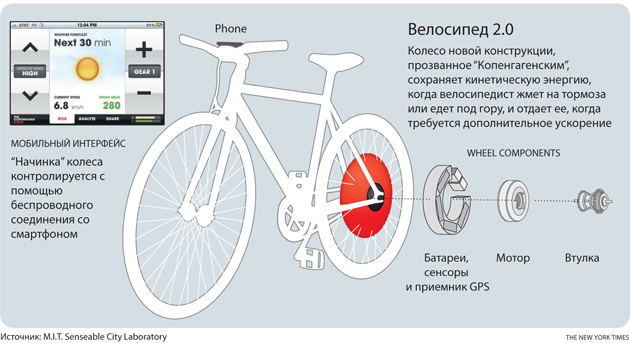
Inventing anew bike is not an easy task, but employees of the Massachusetts Institute of Technology are not surrendered. The Senseable City laboratory at the MTI is working on the design of the wheel, which can store kinetic energy released during braking, and use it when the cyclist needs acceleration. From a technical point of view, the invention showed itself well, but the developers have the task of achieving the favor of riders.
Carlo Ratty, the director of the laboratory, is sure that the invention will increase the efficiency of the bicycle. According to him, we are talking about Bicycle 2.0.
The new wheel is equipped with a recovery inhibition system similar to that used in hybrid cars, for example in Toyota Prius.
The wheel with a red hub, recently represented by the public in Copenhagen, dubbed Copenhagen. This hub can be mounted on the rear wheel of any bicycle, including the old structure. Among other things, it is equipped with an air quality sensor, a speedometer and a GPS receiver. The cyclist can receive information from these devices by Bluetooth communications on his smartphone.
The authors of the development sought to cope with the main drawback of the previous structures of electric bikes - it consisted in their bulknight and abundance of wires. To this end, the project manager Kristin Auterm said, technical filling was packed in a hub. Not all experts share the enthusiasm of the creators of the Copenhagen Wheel.
“Nothing can compare with a simple bicycle,” said Steve Hed, the designer and owner of Hed Cycling Products from the city of Schorveu (Minnesota). Its wheels are used by such famous cyclists as Lance Armstrong.
Jens Martin Skibsted, a Danish designer owning Kibisi Bureau and a Biomega bicycle company, believes that there is a time of large changes in the world of bicycle design. Skibsteded is sure that in the coming years new bicycle designs will appear that will contribute to the rid of the townspeople from auto -dependence. The winner may not necessarily become the most advanced design, but the one that modern culture will organically perceive.
Another group working at the Massachusetts Technological Institute considers the idea of a system of recovery inhibition by excess. “It increases the weight of the bicycle, complicates the structure and makes it more expensive, and the efficiency is small,” says William Mitchell, head of the Smartcities laboratory.
One of the graduate students of Dr. Mitchell, Michael Lin, is also engaged in the development of the design of an electrified wheel, which, unlike the "Copenhagen", needs to be recharged from the network. Perhaps the design of Lina will provide for a device for recharging kinetic energy, but only as additional equipment. “The designer is always forced to go to certain compromises,” Lin believes. “My main task is to create a really convenient vehicle.”