
Translated material
They decided to ask you
The President himself appointed a vote on his amendments to the Constitution. Agreement "For" or "Against" is not provided
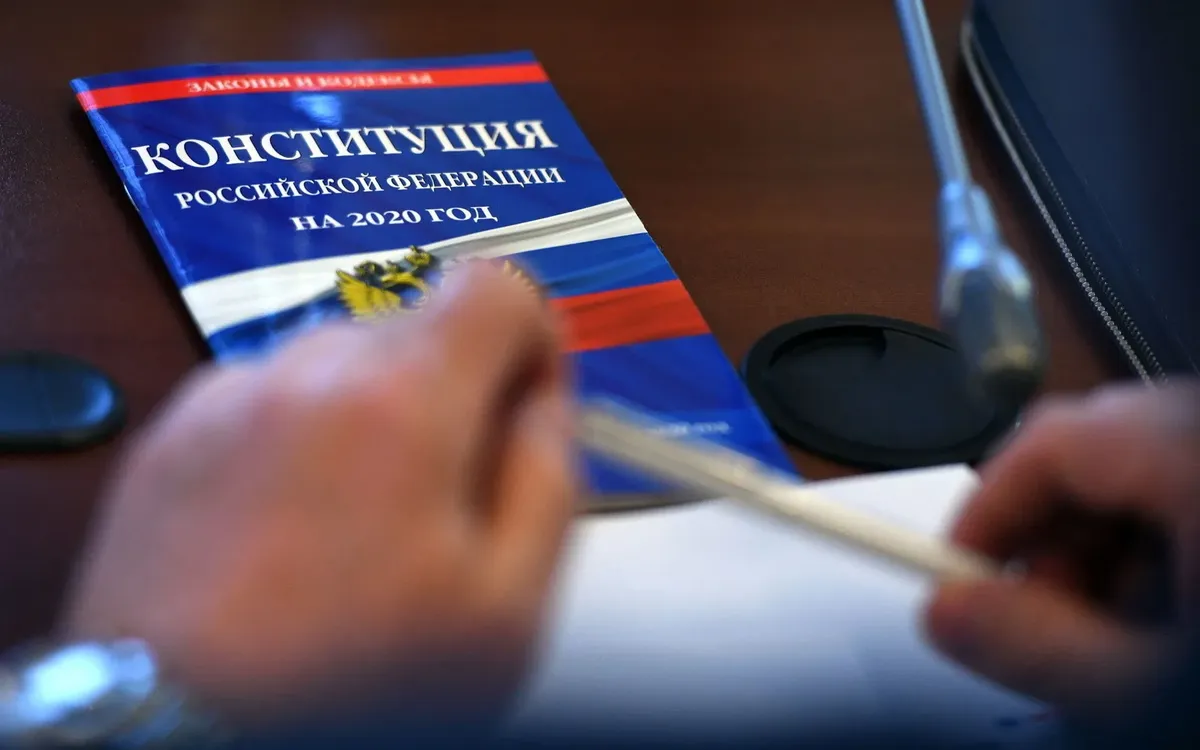
The all -Russian vote on the approval of Putin's amendments to the Constitution was appointed by his decree Vladimir Putin himself. To prepare a vote, to conduct and summarize its results is entrusted to the entire system of election commission. They will also explain to citizens the essence of presidential amendments through informing without agitation. Only appointments from public chambers will be able to observe the voting progress. This is the essence of the amendments made by parliamentarians to the Duma, where the presidential bill on the change in the constitution is being prepared for the second reading.
There is a sequel
Universal vote on amendments to the Constitution will be held on April 22
The Duma Committee on State Building received amendments, giving general attitudes to the upcoming all -Russian vote, on which Vladimir Putin insisted. This happened after the president proposed to straighten the Constitution, including its articles governing the country's political system. The presidential project “The Law on the Constitution of the Russian Federation ...”, already approved by the Duma in the first reading, contains a special article 2, which only means that “the law is submitted for all -Russian voting”. From such a wording, it is only obvious that the project can be carried out for voting ”when it becomes a law. And by law it will become only when constitutional amendments will be approved by the qualified majority of the deputies of the Duma (at least two -thirds of the vote), members of the Federation Council (at least three quarters of the vote), as well as the qualified majority of deputies of legislative assemblies in at least two -thirds of all regions of the country.
In other words, the Russians will evaluate the amendments that de jure will already become new norms of the current constitution.
Moreover, a citizen, having received a voting ballot in his hands, will not find in him any of those 22 amendments that Vladimir Putin decided to make to the Constitution. The Russian will be offered that the president promised him: to give a voice "all over the package of amendments." There will be only one question in the ballot. It will be formulated by the president in his decree, which will also appoint a voting day. The day can be a day off, as is now provided for elections and referenda, and maybe a worker. At the discretion of Putin. But if the president stops at the working day, he will need to be previously declared non -working.
There is no legal need for this vote. Amendments are made to those chapters of the Constitution that can be ruled by the voices of federal and regional parliamentarians.
But the president in January, announcing the editing in his message to the Federal Assembly, proved to parliamentarians the need to “vote of the country's citizens” by the fact that “innovations relate to significant changes in the political system”. Therefore, all the fractions of the Duma approved the idea of voting, although they had no idea how to hold it. Russian legislation provides for the All -Russian vote of citizens in only two cases: in elections and in a referendum. Neither in the same procedure (elections or referendum) could not fit the vote proposed by Putin, in which there is no alternative (as in the elections) and which has no legal consequences (as the results of the referendum).
As a result, the procedure of a new type of will, which is visible through today's amendments to the bill, is largely similar to a hundredth. Sociologists receive an answer to their question without affecting the opinion of the respondent. In the same way, there will be no impact on the opinion of Russians about constitutional amendments. The agitation of “pros” or “against” is not provided, unlike elections and referenda.
Democratic parties intend to agitate “against”. But the concepts of “agitation” are not in the voting procedure that is proposed today as amendments to the presidential bill.
Only "informing citizens of the Russian Federation on the preparation and conduct of all -Russian vote is allowed. State media are required to reserve airtime and printing space for this. The whole system of election commission with the CEC at the head will inform Russians. Increased in the field should also provide citizens with “the opportunity to familiarize yourself with the text of changes to the Constitution”.
At the same time, "bodies of state power of the constituent entities of the Russian Federation, local governments," will be promoted in the informing of citizens. " In Russian practice, the involvement of power structures in “informing” in the elections turns, as a rule, by agitation for the right candidate (in referenda for the “desired” answer), and therefore has long been called an “administrative resource”. Therefore, indirect campaigning “for positive” is guaranteed a package of Putin's amendments.
It is still unclear how direct agitation will be perceived to vote “against” (promised by the “Apple” party) or open calls to the boycott of voting (promised by Alexei Navalny and Parnas party). But among the principles on which the “new” type of will is being built, one of those on which “old” types are held is already included: “No one has the right to influence a citizen of the Russian Federation in order to force him to participate or uncertains in all -Russian voting, as well as impede his free will.”
It is difficult to predict what law enforcement practice this principle will receive in modern Russian conditions. But it is already extremely clear that opponents of the correction of the Constitution are unlikely to gain access to observation of voting.
Not a single opposition party will be able to send its observers. This right is enshrined only by public chambers: all -Russian and regional.
In full accordance with the law, the Public Chamber of the Russian Federation is controlled by the Kremlin, public chambers in the regions to governors.
But for ordinary citizens on the voting day there will be no problems and restrictions. It is allowed to use the "Portal of State Services, other state information systems, multifunctional centers for the provision of state and municipal services." This means that any citizen will be able to declare his attitude to the corrections of the Constitution in the place where he will be on the voting day. And “if there are conditions”, “remote electronic vote” is permissible. So, it will be possible to vote even from from from a border through a mobile phone or from a computer. And then (at the location), and another (through the gadget) causes distrust and suspicions of the falsifications of the results of the will. However, incredulous and suspecting figures are found only in opposition parties, among activists of the movement in the defense of voters' rights “Voice” and in a narrow circle of experts-constitutionalists.
The head of the Duma Committee on State Construction Pavel Krasheninnikov said that amendments to the law regarding the all -Russian vote were developed by the working group. The very one that Vladimir Putin gathered and who is engaged in the correction of the Constitution in parallel with the Duma. The authors of the amendments with a description of the voting conditions signed from the Duma by Pavel Krasheninnikov (United Russia) and the head of the budget and tax committee Andrei Makarov (United Russia). The Council of the Federation Council included the head of the Committee on Constitutional Legislation, Andrei Klishas (United Russia), Vice-Speaker Andrei Turchak (aka secretary of the General Council of United Russia) and the first deputy chairman of the Committee on the regulations Svetlana Goryacheva (Fair Russia).