
Translated material
"Make Peace, Not Pis"
To measure the President of Kachinsky as a Gordian knot of Polish contradictions
To measure the President of Kachinsky as a Gordian knot of Polish contradictions
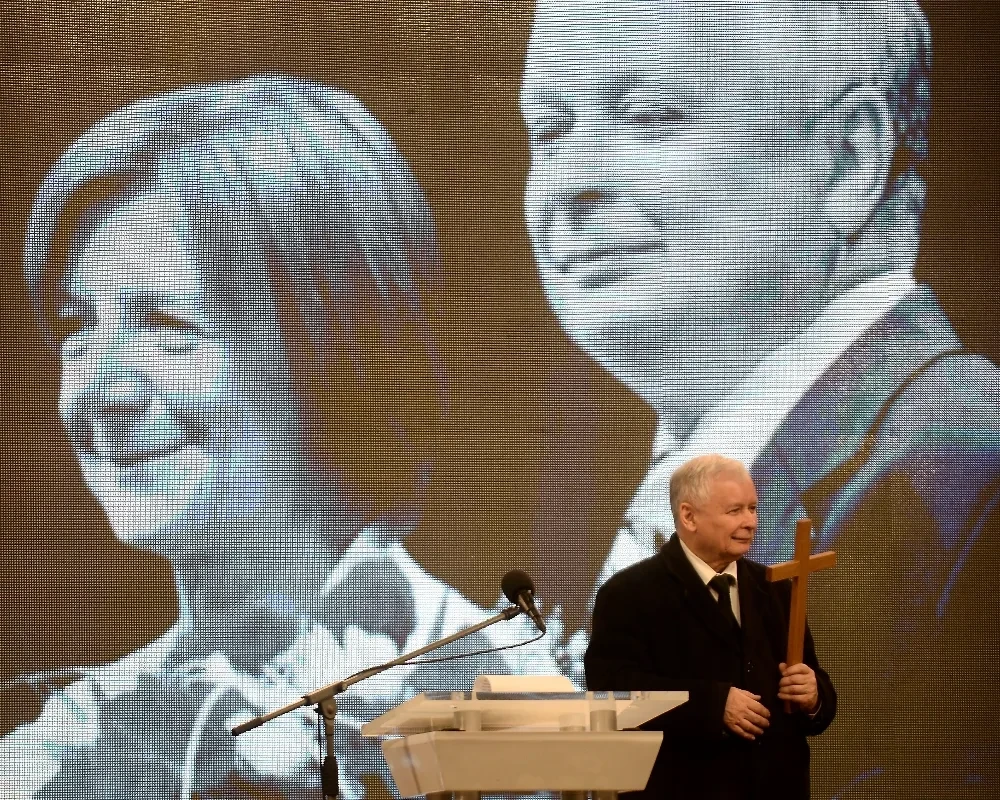
By the sixth anniversary of the disaster near Smolensk, a plane with the Polish leadership on board in Poland began to be prepared long until April 10. Almost all rhetoric in relation to Russia by the ruling party “Law and Justice” (PIS), led by the twin brother of the deceased President Lech Kachinsky, Yaroslav Kachinsky, has been built on a possible terrorist attack from the moment of coming to power in October 2015. By the beginning of 2016, officials, members of the PIS government, also spoke about this.
The first information space was blown up by the Minister of Defense of Poland Anthony Maderevich, accusing the Russian side of a terrorist attack near Smolensk. As the New Gazeta already wrote, this is a consistent conductor of the theory of the attack, which declared this almost immediately after the plane crash. Also, all six years, members of the Public Organization of the Solidarity 2010 committee came to the anniversary of the tragedy to the Russian embassy with a demand to return the Tu-154 fragments to clarify all the circumstances of the plane crash. One of the organizers of the action, the editor -in -chief of the Polish newspaper Tomash Sakevich, is sure that the Russian side does not give out the wreckage of the aircraft, because she has something to hide. According to the former member of the “solidarity” of Henrik Sikora, the version of the terrorist attack is based on the faith of the Polish society that Putin was able to organize the murder of Kachinsky, as well as the conviction of the conservatives who hate Donald Tusk that he could agree with the Russian authorities. The absence of evidence is compensated by this conviction and constant injection of the topic in Poland itself. On the memorial plaque, Lech Kachins, open on the anniversary of the tragedy, was written: "He died, protecting his homeland."
The myth of the murder in Smolensk of President Lech Kachinsky became a peculiar spiritual cross for Pis. Any doubting in the version of the attack risks receiving the title of “communist”, which for the Polish patriots is an analogue of the “fifth column”.
Monopoly on sorrow
Historical memory is sacred for the Poles. Respect for their history, especially for the tragedy of the people, can be called a national idea. However, many believe that this year commemorative events are not so much a tribute to memory as an aggressive PR of the current government. In the morning of April 10, at a military memorial cemetery in Warsaw, politicians Pis laid flowers to the monument of victims of the Smolensk plane crash. Near the monument, platforms for television operators were built, the laying of wreaths was broadcast on all central channels.
All day in the city center, there were ranges of memory organized by the ruling party. The culmination was a mourning rally near the presidential palace, striking in a scale and volume of loud sorrow. In many places of the rally, impromptu television studios worked, which conducted a live broadcast.
According to the opponents of the current government, Pis monopolized not only the memory of those who died in the Smolensk disaster, but also state symbols.
All events PIS take place under Polish flags, almost without their own symbols, the party, as it were, associates itself with the whole country. About this thought sounded in the speech of President Andrzej Duda, who called on those gathered to unite, and in the air the idea was hung that it should take place under the auspices of Pis. At the same time, the president was quite correct in assessing the causes of the disaster, although he suggested that the tragedy near Smolensk was the reason for the weakness of Poland under the liberal government of the Civil Platform. Clarity added comments not burdened with the official status of family members of the deceased president of Kachinsky. The daughter, Marta Kachinskaya, accused the previous liberal government of silent Smolensk tragedy. Brother, Yaroslav, spoke out extremely tough about the intentional killing of the top of the state power of Poland. However, having casually mentioned the Kremlin’s responsibility, he criticized the Donald Tusk government, saying that they were the main perpetrators of the tragedy. The activist of the Solidarity 2010 Committee, Eva Stankevich, even demanded for Donald Tusk’s death penalty.
Hard critic and first student
In the presidential and parliamentary elections of 2015, Pis came to power, removing the liberal “civilian platform”. Although Andrzej Duda became the president, and the Prime Minister of the one-party government-Beata Shidlo, the real power in the ruling party is concentrated in the hands of Yaroslav Kachinsky. He is known for his rigid rhetoric both in relation to the European Union and in relation to Russia. But in domestic politics, he gravitates to the methods of his oriental neighbors. First of all, President Duda signed a law under which the Constitutional Court is actually losing the opportunity to control legislative activities. The Constitutional Court decided on the anti -constitutionality of this law, however, in order for the decision to enter into force, it should be published in a government messenger. For more than a month there is a struggle for publication, European politicians joined the government. The Venetian commission, and after it, the European Parliament stated that Poland should fulfill the decision of the Constitutional Court. Activists-opponents of the current government in the tent town in front of the prime minister’s office, which costs more than 35 days, they say that the authorities do not want to go on dialogue with their own citizens, so they hope to decision the EU regarding Poland. So far, the functions of the Constitutional Court are artificially limited, amendments to the law on the police, which are called the “Law on Vying”, pushed through the Sejm: the police and special services now have access to the Poles data without receiving a court decision. Adam Bodnar, general inspector of personal data protection, lawyer organizations and the National Judicial Council of Poland, opposed the amendments.
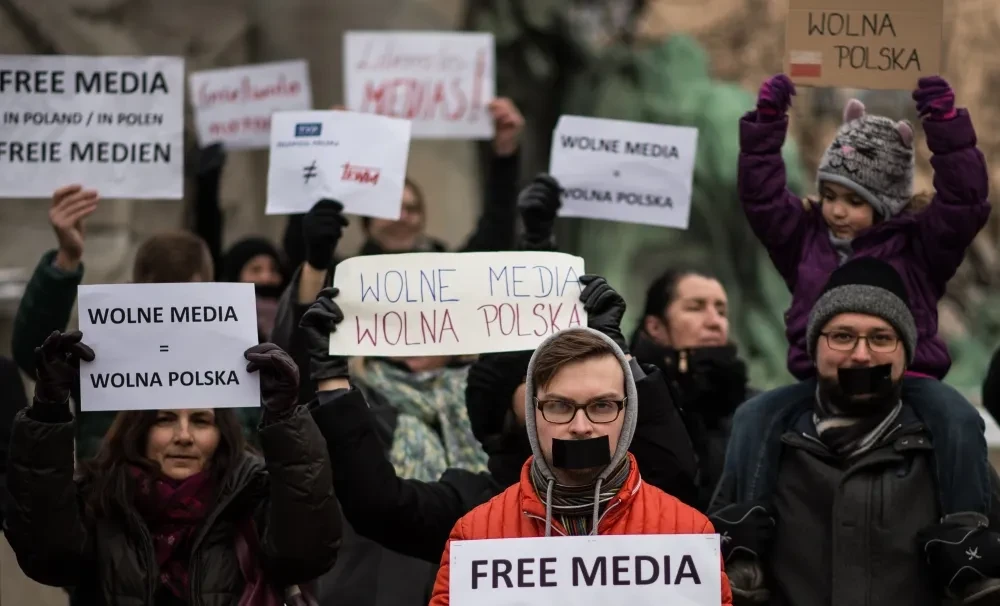
Another political reform of PIS is the adoption of a new media law in early 2016 regarding public media. Now the leaders of the public media are not elected, but are appointed by the government. At the same time, they are appointed indefinitely and can be removed at any time by decision of the minister. The Poles who passed the stage of decommunization and brought up on the ideals of “solidarity”, were quite sharply perceived by the lawmaking of the right, and society was divided not so much according to political preferences as in the way of thinking and worldview.
Pis
In the tent town of the prime minister, there are activists of the public movement “Committee for the Protection of Democracy” (code), which adheres to the traditions of the “Committee for the Protection of Workers”, the legendary human rights organization of the late 70s and early 80s. Leader Code Mateush Kiyuvsky does not consider himself a politician, emphasizing that he is an activist, and in the long term, he considers the construction of a thinking civil society the main task of the movement. And even now, during the period of acute political crisis, he counts on a dialogue in a split society. This position led to the discussion and inside the code itself. Some of the activists considered that in the split of society, not just some forces were to blame, but by the specific politicians of PIS trying to usurp power, and created the PP code-the Committee for the Protection of Democracy from the PIS. Now there are two parts in the tent town: one contains a code with a home -made scoreboard, which states the number of days of the lack of publication of the Constitutional Court, in the other part of the poster “Make Peace, Not Pis” and the score of the days of the hunger strike of the two activists of the PP code in protest against the actions of the ruling party. Perhaps the disagreement ends on this. Both movements believe that it is almost impossible to resolve the political crisis within the country, that the president and the government do not hear criticism, so hope is mainly on the EU.
In relation to the Russian authorities, the opposition has many complaints, but they relate to the restriction of freedoms and encroachment on international and constitutional norms. The Poles traditionally are distrustful of any Russian authorities, and after the events of 2014 in Ukraine, this distrust increased significantly. However, the statements of PIS Pis for Capacheus in Smolensk are Kaczynsky opponents consider public opinion to manipulate: “We know very well, who is mr. Putin, but even he cannot be attributed to the organization of the attack, if there are no serious grounds for this, because such statements insult not only him, but the whole Russian people, ”said Henrik Sikora.
Most of the political and social forces of Poland are united by a fundamental understanding of internal processes, which gives the Poles undeniable advantages and a chance to return to the democratic path of development: they came to understand the role of society in the state. Almost all speakers, regardless of political beliefs, emphasize that Russian citizens are not enemies, all claims exclusively to the Russian government.
Ela Znamenskaya, especially for "New"