
Translated material
Gold square meters
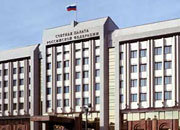
The Chairman of the Accounts Chamber Sergei Stepashin recently announced the inefficiency of the use of state funds for the construction of housing for military personnel. "Inefficiency" - in this case, euphemism, hiding the monumental picture - how huge funds are plundered. This case is a good illustration of how millions and billions of Dengies, released into the Armed Forces, ultimately enrich anyone, but not “trench” officers.
After the withdrawal of a powerful group of Soviet troops from Germany began, the question arose with all the acuteness of the placement of officers and warrant officers in Russia. The Germans allocated 7.8 billion marks for the construction of apartments for the withdrawn troops. But it probably seemed to the government that additional square meters of housing, which can be built due to the bound investment loans of Germany banks, would not hurt. Moreover, then in negotiations with the German side, the issue of employment of the Eastern Germans and the loading of enterprises of the former GDR was constantly discussed. And on August 5, 1992, the head of the government of the government and economic commission, Alexander Shokhin, approved the protocol, where Vnesheconombank recommended signing a separate credit agreement on the housing construction program for military personnel, headed by the Major General Krivulin. And the Ministry of Finance, who headed Vasily Barkchuk at that time, was recommended to ensure in the required volume payments for this loan agreement. State guarantees were provided by the first deputy chairman of the Government of the Russian Federation Yegor Gaidar. And then everything went along the hollow path: from 1992 to 1999, five orders of the government were adopted to attract German loans.
In total, 635.05 million German brands were bored for the construction of housing for military personnel. Taking into account the incurred interest had to give 768.73 million German brands.
What happened in the end? For the used loans (for contractual obligations, which, I must say, were completely fulfilled), it was possible to build 5067 apartments in the central and western regions of the country. These were mainly Kaliningrad, Leningrad, Moscow, Pskov and Tver regions. In addition to currency funds, the Ministry of Defense of Russia spent budget funds in the amount of 122.8 million rubles, which went to the construction of extraordinary networks, structures, access roads and social infrastructure facilities. As a result, the construction of housing from modular German structures came out about three and a half times more than a state than could do. The average -aged prices in our country at that time amounted to 6 thousand rubles per square meter (this level of the Ministry of Defense during the construction of housing with the forces of military builders withstand now), and the per square meter in "imported" apartments exceeded 21.6 thousand rubles.
There is nothing more to be surprised here, because the supplier of modular structures was the notorious Bison-Werke Baehre & Greten & Cokg in our country. It was thanks to the “bison” that managed to “poke” the USSR State Construction for several dozen technological lines that the Soviet country learned what cement-stoves are and how uncomfortable, an impractical and expensive thing.
Naturally, now we have remained in debt, as in silk. Russia owes Germany since 1999 260 million milkmaids or more than 3.2 billion rubles. If you look at the missed opportunities, then ineffective expenses, according to the Accounts Chamber, amounted to 5367 apartments for the state, and taking into account the outstanding loans, they will increase to 11171 apartments. By and large, this garden should not be fled. With the total volume of housing built for the Ministry of Defense during this time - 205 thousand apartments - the Module program was a small percentage and did not play a significant role in solving the housing problem of military personnel. But the amounts around her were huge. And he used this "feeder" a lot of people. Both in Russia and in Germany.
Photo from the official website of the Accounts Chamber