
Translated material
Beat the enemy that there is authority
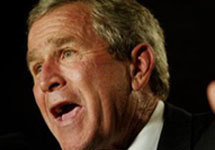
President Bush and the leaders of the House of Representatives of the US Congress came to a single position on the Iraqi issue. The coordination process ended on Wednesday morning at breakfast in the White House. On the occasion of the general victory, lawmakers and officials of the administration went out to the whole friendly team to the pink garden to journalists. Bush once again told the people with what insidious enemy he had to deal with-by the way, he called Saddam a "student of Stalin", who deals terror and violence even in his own family.
The speaker of the Lower Chamber Dennis Hastt assured the audience that the agreed text of the Congress resolution is exactly the same as the president wanted. “The resolution,” he said, “does not connect his hands to the president, it gives him the flexibility necessary for the task. The resolution does not require the president to previously enlist the UN consent. It supports the president’s readiness to work with the UN, but does not require him to seek the UN approval. If the president comes to the conclusion that he must act unilaterally in order to protect the American people, he has the right to do this.
The leader of the democratic minority in the House of Representatives of Dick Gephardt made exactly opposite positions - he emphasized not on what remained in the text from the presidential project, but on the amendments made at the insistence of the moderate wing of Congress. He called three such amendments: firstly, in the current edit, the resolution prefers diplomatic measures to influence Iraq as part of the UN Security Council; Secondly, if the president comes to the conclusion that the military action is necessary, he must inform the congress that all diplomatic funds have been exhausted and no longer provide US national security no later than 48 hours after the start of a military operation; And finally, in the future, the president must regularly (every 60 days) inform the congress about the progress of the operation. “We must respond to a threat to diplomatically, if we can, and by force, if we are forced,” Gephardt summed up.
The situation is more complicated in the Senate, and the point is not at all that the Democrats in the upper house have a majority of vote. The supporters of the war belong, for example, Democrat Joe Lieberman, and if the voices are divided equally, Vice President Cheney will come to the Senate and his voice according to the Constitution will be decisive. But among the Republicans there are moderate ones.
The question of the military powers of the president is generally in the "gray zone" of constitutional law. The announcement of the war is the exceptional prerogative of the congress. The President, by law, can give an order to start the beginning of hostilities only in order to repel a sudden attack on the country and suppress the rebellion. However, Congress declared war only five times in American history: England in 1812, Mexico in 1846, Spain in 1898, as well as when America entered the First and Second World War; The US military has been used more than 200 times. Congress simply did not enjoy its right and only after the Vietnamese War, in 1973, he adopted a resolution on military powers, which obliged the president "in every possible case" consult with Congress; If both chambers take together or separately a decision to terminate hostilities, the president is obliged to submit.
In the case of Saddam, the administration’s position is reinforced by the law on the liberation of Iraq in 1998, to which President Bush appeals. The document says that the United States supports "efforts aimed at removing the regime from the power of Saddam Hussein" and contribute to the "emergence of a democratic government that would replace this regime." The law authorizes the provision of military property and military training in the Iraqi opposition groups and contains a call to betray Saddam to the court of the international tribunal for genocide and crimes against humanity. However, the law has a special reservation that it cannot be used as the basis for the use of the US armed forces against Iraq.
That is why the president, although he refers to the 1998 law, needs a new "strong" resolution. Most likely, the Senate will accept her. Senator Joseph Biden, who offered an alternative project, perfectly understands that he is in the minority. However, the president will not receive unanimous support in the upper house.
Recall that in January 1991, the Congress adopted a resolution allowing the president to use force against Iraq, a modest majority: in the Senate the ratio was 52:47, in the House of Representatives - 250: 183, and the voices were distributed according to party affiliation. Voting was preceded by stormy three -day debate, during which an unprecedented number of legislators spoke - 268 members of the lower house and 93 senator. Signing the adopted resolution, President Bush Sr. said that his signature "in no way means any change in the position of executive branch both on the constitutionality of the President’s right to use the armed forces to protect the vital interests of the United States, and on the constitutionality of the resolution of the military powers itself." The dispute about the military powers, thus, is not completed and resumes whenever the president decides to use military force.