
Translated material
St. Petersburg walks
If there was the title of "ambassador of an unkind will", then the Japanese government would have to appropriate him to his compatriot Hiro Yamagato, the author of the laser show, which the warehouse promised to please the inhabitants of St. Petersburg on the birthday of the city on May 27. According to the city administration, more than a million Petersburgers, several times more planned, were going to look at the unprecedented representation in the sky over the Neva. The audience was waiting for not only the crush (65 people were hospitalized), but also a terrible disappointment. As eyewitnesses say, the show failed with a bang, instead of magic paintings, the audience watched the green stripes in the sky, after which they had to disperse. According to the official version, the weather disappeared - there were no necessary smoke and fog on which the laser was projected. The unofficial version, which the townspeople gloatingly retell: Yamagato-san was washed down and did not prepare anything. The damage caused by the image of the Land of the Rising Sun had to replenish the Prime Minister Junyitiro Koizumi. On Friday morning, he, along with Vladimir Putin, visited the school of higher sportsmanship, where the future president of Russia once trained, and gave the pupils Japanese equipment.
The owners of the unprecedented supercumite, dedicated to the 300th anniversary of St. Petersburg, tried to prepare memorable events for each of the 45 high visitors-just so many leaders of states and heads of international organizations arrived on the banks of the Neva in the last days of May. Gerhard Schreder is an amber room (the grand opening of a disappeared masterpiece in the Catherine Palace, which was restored to Rurgaz), George Bush-White Night and Fountains in Peterhof, Greek Prime Minister Konstantinas Simitis-the opening of the Monument to the President of Greece 1827-1832 and at the same time Russian diplomat Ioanis Kapodistria, Saparmurat Niyazov - nostalgic memories of the years of study in the Leningrad Polytechnic, all guests - Valery Gergiev, Placido Domingo, Dmitry Hvorostovsky and the Skorpions group ...
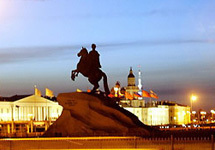
It will not be an exaggeration to say that the world political Olympus has moved to St. Petersburg for two days. More precisely, to the copper horseman, where on Friday evening the Russian president accepts the parade of the main leaders of the planet, at least the northern hemisphere.
St. Petersburg events were conceived as the personification of the course on rapprochement with the West, proclaimed by Vladimir Putin on September 11, 2001: the Baltic Window to Europe is the best place in order to declare Russia's belonging to Western civilization. The last zigzags of world politics somewhat lubricated the idyllic picture-relations with America were in question due to Iraqi disagreements, and large-scale undertakings in negotiations with the European Union (energy-dialogue, a single economic space, visa-free regime) were bogged down in numerous mutual claims and misunderstanding.
There is no doubt that the celebrations will be a great success. The collection of such a representative bomond is interesting as an opportunity to talk with many in an informal setting, and if all this goes against the backdrop of Peter dazzlingly beautiful these days, then a favorable atmosphere is all the more guaranteed. The holiday, however, will end, and the problems of Russian foreign policy will remain. Problems that are becoming more difficult to solve, since they are aggravated by truly radical and most importantly very rapid changes in the international arena.
Foreign policy is considered the most successful area of activity of the country's current leadership. And if you look in a slightly longer retrospective, then the St. Petersburg summit is, of course, an outstanding achievement. No matter how much those 45 leaders who gathered in St. Petersburg relate to Russia (and they relate to it very differently), everyone arrived. And this in itself is very important. The problem, however, is that Russia has more successful in recent years in the field of foreign policy PR, the organization of campaigns, the ability to arrange spectacular events than in the content of the course in the international arena.
The presence on the Neva shores of the leaders of Europe, America, Asia, the Far East symbolizes today not a breakthrough to the West, but what in smart diplomatic documents is called the "multi-vector" of Russia's foreign policy, a country that cannot unequivocally turn in one way or another without losing something on the opposite flank. And this, on the one hand, is an objective problem with which it is difficult to do anything (this is how geography and history have ordered), and on the other hand, the inconsistency of the strategy and the inability to build a hierarchy of priorities. Imagine that the next president of Russia will not be the indigenous Leningrad, who served in Dresden, but, for example, a native of Khabarovsk, who worked in Shanghai. Will the main state priority of foreign policy change?
The Iraqi campaign, which overshadowed the preparations for the St. Petersburg summit, especially sharply put Moscow to the need for a clear formulation of national interests. After a short St. Petersburg respite, we have new crises-Iran, North Korea, negotiations on the WTO ... Each of these conflicts will require a choice, and increasingly not between bad and good options, but between bad and very bad. And this must be prepared for this.
But while Pulkovo Airport serves exclusively the world political elite, the English embankment was moored by the eight -deck Silver whisper superlier, granted to the delegations of the CIS countries, which was redeemed by the American landing, and the Konstantinovsky palace in Strelna, whose reconstruction, was on the lean control of the Office of the skin of the skin More expensive than Borodin - the reconstruction of the Kremlin, is ready to accept everyone at once. 85 years after moving to Moscow, St. Petersburg returns to the international arena. In the city, they openly say who with hope, and who is horrified that the 300th anniversary will obviously be the first step towards the formal consolidation of a certain capital's status of the Neva metropolis. True, as a taxi driver philosophically remarked, who took the author of these lines along the deserted Nevsky: in order to put this city in order, St. Petersburg in Moscow should be edited for 20 years.