
Translated material
Charlie and Factory of Death
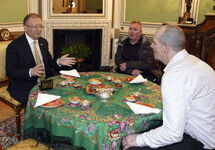
A resident of the British city of the British city of Eimsbury Charlie Rowley, poisoned by the Russian poison, in a conversation with the Russian Ambassador to London Alexander Yakovenko asked for a meeting with Vladimir Putin. Rowley told about this in an interview with The Sunday Mirror. The editors of the tabloid initiated the meeting with Yakovenko, which took place on Saturday at the Russian embassy. Together with Charlie Rowley, his brother Matthew went there.
According to Rowley, Yakovenko answered him that he would tell a request for a meeting with Putin, asking: "Where would you like to meet him?"
The conversation between the Rowley brothers with Yakovenko lasted an hour and a half. Charlie Rowley said that he asked the ambassador more than a dozen questions, including the following: why the suspects do not communicate with the British police; Does he admit that these suspects are GRU officers; How Russia can deny involvement in poisoning if it produced a "newcomer", and whether the ambassador really believes that Britain is responsible for Himataku. At the beginning of the meeting, Yakovenko presented Rowley's report “Salisbury: questions without answering”, published by the Russian embassy.
Yakovenko answered all questions, while some of his answers, according to Rowley, were "stupid." According to him, the ambassador assured that the substance that people were poisoned in Salisbury and Eimsbury was not a "novice", otherwise "it would have killed everyone."
“I said: Well, my girlfriend died, and only because I washed away this (substance. - Ed.), I am still here,” Rowley said. The ambassador did not know what to answer, the Briton claims.
Yakovenko assured the brothers that Russia no longer produces a "novice" and in the country supposedly there is only a small amount of this poison used "as an antidote." The ambassador said that the only places where this poison is now being produced is the USA and the Czech Republic. Then he expressed confidence that it was the American "newcomer" that was found in England, and its samples are in the British laboratory in Porton Dawn. When asked if he considers Britain involved in Himatak, Yakovenko replied that he did not know, since the British authorities do not inform him of anything.
When asked why GRU officers Anatoly Chepig and Alexander Petrov, suspected of poisoning the former GRU Colonel Sergei Skripal and his daughter Julia, were not questioned in Russia, Yakovenko replied that "the British police never asked for their interrogation."
“I went and asked them:“ Why did your country kill my girlfriend? ”Rowley said.“ But I didn’t get any answers. I received only Russian propaganda. ” At the same time, Rowley admitted that he liked the Russian ambassador. “But I think that some of his words are justified by Russia, that it was not involved, were ridiculous,” Rowley said. “I am glad that I met with him (Yakovenko. - Ed.), And I feel that I found out something that I did not know before. But I still think that Russia made an attack,” the Briton concludes.
“Very pleasant people, they had a lot of questions to us, and I answered everything with joy,” Yakovenko himself answered a meeting with the Rowley's brothers.
In early March, Evan Hope, the 20-year-old son of Don Styurzes, who died from the poisoning of a "novice" by Rowley’s civil wife, in an open letter to Vladimir Putin called him to allow British law enforcement officers to Mishkin and Chepiga.
On June 30 last year, 45 -year -old Rowley and 44 -year -old Steurzes were in the Salisbury district hospital - the cities where the creaks were poisoned - with symptoms of poisoning "newcomer". As it turned out, they accidentally found a bottle of poison and Styurzes sprayed the substance on her wrist. On July 8, she died in the hospital without regaining consciousness; Rowley survived andwas already discharged on the 20th .