
Translated material
Your card is bit
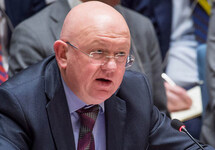
The United Nations Council rejected the Russian proposal to stop the meeting regarding the situation in Venezuela, convened at the initiative of the United States, Reuters reports .
Only 4 out of 15 countries, members of the Security Council, supported the cessation of the meeting, while 9 countries voted for its continuation and two countries abstained. To stop the meeting, at least nine votes were needed. Permanent members of the Council of People's Commissars - Russia, China, Britain, France - at the same time could not impose on the decision of the veto.
As Interfax reports , the Russian Permanent Representative to the UN Vasily Nevornya said that the purpose of the meeting is to further destabilize the situation in Venezuela and the change of power in the country. "Today's event was convened by the American delegation for the only purpose - to continue to destabilize the situation in Venezuela, imposing its approaches and recipes for solving problems that it has come across recently," the diplomat said. According to him, "the meeting at which we are now forced to attend is another element of the US strategy to change power in Venezuela."
Nebenja said that the events in Venezuela can be repeated in any Latin American country: “They would also like to turn to our Latin American colleagues. Do you understand that if you have connected such actions tomorrow at Venezuela, any Latin American country can be?”
In turn, American Secretary of State Mike Pompeo urged all countries to support Maduro's opponents. "It is time to support the Venezuelan people and recognize the new legal democratic government, headed by President Huan Guidido, and put an end to this nightmare," he said. Pompeo added that in the countries that support Maduro, there are problems with democracy. “Some countries publicly take the side of Maduro - China, Russia, Syria, Iran,” said the diplomat. “It is not surprising that those who rules, not based on democracy, in their own countries are trying to help Maduro ... China and Russia support the failed regime.”
Earlier on Friday, Madrid, Paris and Berlin promised to recognize the speaker of the National Assembly of Venezuela Juan Guydo , who accepted the presidential oath, as a temporary president of the country, if the usurpator Nicholas Maduro did not announce early elections for eight days.
Guydo himself demands to hold elections for six to nine months or earlier.
Maduro's presidential term expired on January 10. The National Assembly did not recognize his inauguration for a new term; On the 15th, the parliament declared Maduro a usurpator. In the current environment, Guydo took the oath as acting president . The powers of Guaido were recognized by the United States, Canada, Georgia, Albania and a number of Latin American states.
Meanwhile, Russia states that Maduro is the legal president. On Thursday, Vladimir Putin held a telephone conversation with a usurper. On Friday, Reuters reported that in Venezuela to protect Maduro from capture by supporters of the revolution from among his own security officials , militants of the PMC Wagner arrived .
On the same day, Maduro said that he was ready to meet with Guydo for negotiations.