
Translated material
Accepted mayors
The State Duma continues to take the right to elections from voters
State Duma deputies reformed the local government system. The bill, essentially canceling direct elections of mayors in large cities, was adopted on Tuesday at once in two readings - the second and third.
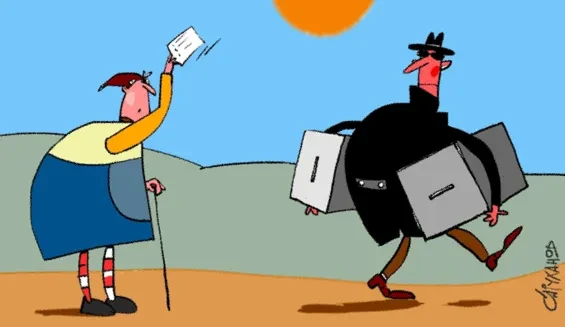
State Duma deputies reformed the local government system. Like many other legislative transformations of recent years, this reform does not lead to the expansion of the rights of Russian citizens, including the right to elect, but quite the opposite - to their restriction. The bill, essentially canceling direct elections of mayors in large cities, was adopted on Tuesday at once in two readings - the second and third.
"New" wrote in detail about how the structure of the authorities on the ground will change due to the ingenuity of the deputies. By the second reading, opponents of the bill (and there were a lot of such deputies in the ranks of deputies) prepared a number of amendments, but, according to the first deputy chairman of the committee on federal structure and issues of local self -government Alexander Burkov, the text did not fundamentally change in comparison with the first reading.
So, for example, deputy Dmitry Gudkov made a proposal: if the subject of the Federation wants to cancel the election of the mayor in the city, let him organize a referendum. But Gudkov’s correction was rejected. As a result, the bill was adopted by a majority of votes, which belonged mainly to United Russia. “Fair Russia” and the Communists voted against, and some Eldeparers, usually loyal authorities, abstained.
In fact, how local self -government will look like in a large city (the cities in which there are division into areas are considered to be such - there are 67 of them in Russia), now depends entirely on the will of the subject - the regional legislative assemblies are given six months to make appropriate amendments to local legislation.
The main innovation proposed by the bill is the construction of the so -called “two -level system”. Direct elections remain only at the level of the districts: residents choose district councils, which, in turn, delegate representatives to the city council. Or not to participate in the experiment - decides the Legislation of the subject of the Federation.
It also decides who will choose the mayor - the people or competitive commissions, which are half of representatives of the subject, are half - from representatives of the city council. In the second case, the mayor (in essence-appointed from above) performs only representative functions, and the city economy will head the city manager appointed by the subject, with which a contract is concluded for a period of 2 to 5 years.
The law, in essence, is the absenteeism - given the actual control of the Governor of the Legislative Assembly. Thus, the power vertical is strengthened: the governors through loyal regional lawmakers will be able to decide whether to leave the townspeople the right to will. This will avoid problems in hot spots like Yekaterinburg, where Evgeny Roizman became the mayor from the “Civil Platform”, or Petrozavodsk, where Galina Shirshina, supported by the “apple” won.
City managers are another lever of the influence of governors.
“When the concept of city managers had just begun to introduce, we were promised a lot of things: that this is the departure from political dependence, that these are economic functions that the professional should perform,” recalls deputy Alexander Burkov. - In fact, the opposite is true. The city manager is completely dependent on the party in power. And most importantly, he is appointed - therefore, he does not bear any responsibility to the people.
So now in many large cities where the main potential of the region is concentrated, the mayor actually will remain, who shares his powers with the appointed city manager.
At the same time, where the new system will be introduced, the district councils are given to citizens to be a mercy: they say, you want to choose, choose. The fact that these tips are needed, and will not become part of a bulky design that will simply increase the number of deputies and bring even more confusion to the local government system, many experts doubt it.
“Decorative elected structures will arise at the district level,” says political scientist Rostislav Turovsky. - To lower the large amount of authority to this level will not. In fact, they will be a problem for the city government, because there will be an unbalanced urban economy. From this, on the contrary, they went in cities of federal significance.
Interestingly, citizens themselves do not want to choose district meetings - they want to choose mayors. According to the April survey prepared by the Levada Center, 77 percent of Russian citizens against cancellation of mayor's elections. But, judging by the fact that the bill has already been sent to the Federation Council, these votes are worried about few.
In fact, Turovsky believes, it is hardly worth waiting for the universal cancellation of mayor’s elections, if only because it has already passed several years ago. Another thing is that now where residents are actively fighting for their return - for example, in Perm - this struggle becomes useless. Because lawmakers sent a completely unambiguous signal: to limit free vote where it is possible.