
Translated material
The winner of censorship
40 years ago, the "New World" of Tvardovsky was defeated
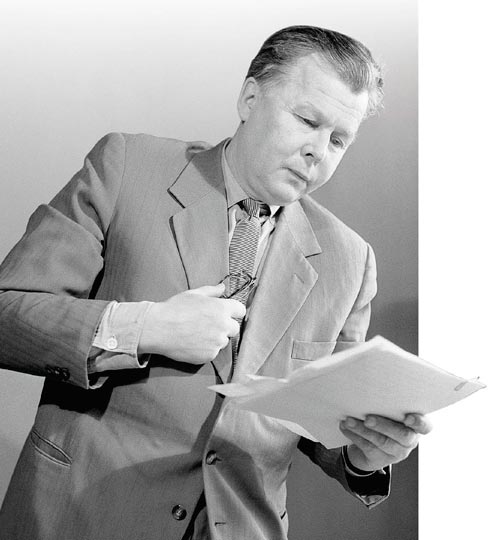
The winner of censorship. 40 years ago, in February 1970, Twardowski's "New World" was defeated-a unique example of Soviet super-interest, a magazine on which the generation of perestroika has grown
History of the "New World" Tvardovsky
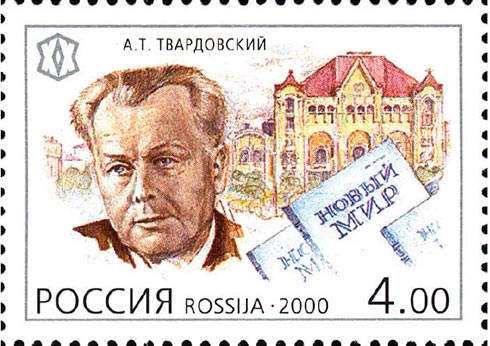
* * Alexander Twardowski (1910–1971) was the editor -in -chief of the New World in 1950–1954 and in 1958-1970. It ended with a decision of the Bureau of the Secretariat of the Board of the Union of Writers (SP) of the USSR of February 9, 1970 on the withdrawal from the editorial board of key employees of the magazine: Vladimir Lakshin, Alexei Kondratovich, Igor Sats, Igor Vinogradov. This was followed by the predictable statement of Alexander Tvardovsky about the resignation. On February 10, Alexander Solzhenitsyn persuaded the editor-in-chief to stay in order to try to do at least something with a small number of faithful employees. On February 11, Litgazeta printed the decision of the “Bureau of the Secretariat of the Board” on changes in the editorial board and the appearance of ideologically faithful functionaries in it. Subsequently, the head of the Culture Department of the Central Committee Albert Belyaev, who oversaw the literature, admits that the SP secretariat was given a strict instruction for the removal of Twardowski.
On the 12th, Alexander Trifonovich will record in his workbooks: “I put things.”
The February issue of the magazine, which was fully formed by the old edition, was signed by the new editor Viktor Kosolapov, the former head of the Fiction Literature publishing house. And therefore, the impression of the preservation of the Line of the "New World" was given. Yes, and in the Central Committee, as follows from the diary of Novomirz, Alexei Kondratovich, the new editorial board was given the order: "To make a magazine no worse than it was." But it was clear that this was impossible. Yuri Grigorievich Burtin,
* Yuri Burtin (1932–2000) - historian, publicist, literary critic. In the "New World" edited the "Politics and Science" section. who submitted a departure statement to the new editor, wrote to his colleagues: remaining in the editorial office, "we become direct and very valuable accomplices of the crime, an instrument in the hands of the organizers of the Stalinist revolution."
From sincerity to freedom
The first time Tvardovsky was removed from the editorial of the New World in 1954 for the article by Vladimir Pomerantsev “On Sincerity in Literature”. (Once on the Old Square at the Partyer Polikarpov, the “legendary” character, who personally applied to Boris Pasternak, Vladimir Pomerantsev, a former prosecutor who pulled out of the innocent prisons, said: “We won’t understand each other, comrade Polycarpov. You do not need freedom, but I need the concept of“ sincerity ”into a concept.”) "Truth", fundamental for the "new world" of the 60s. True, it was more important for Twardowski’s artistic merits of literature: he always searched in the texts primarily factual material and did not like, as he put it, “fiction”. The struggle for the truth for the Tvardovsky, registered by the power of the poet, the author of the famous "Vasily Terkin",
* When Pasternak was asked what work about the war he considers the most important during a public speech, he called Vasily Terkin. And in response to a laugh in the hall, he exclaimed angrily: “I have not come to joke here!” She turned into a struggle for freedom. By the end of the existence of the “Tvardovsky” “New World”, Solzhenitsyn was already smashed, from which the large -scale glory of the magazine began,
* “One day of Ivan Denisovich” was published in 1962. And the editor -in -chief himself turned out to be a prohibited author: the poem “by the right of memory” was not missed by censorship. In January 1970, the poem was printed in the West: in the Italian journal Espresso, in Sowing, in the Appendix to Figaro. “What - me? Who is me? - Recorded on January 16, 1970 in the diary of Tvardovsky. - The editor -in -chief of the New World or the author published in foreign publications of a poem, previously prohibited house by censorship? " This situation was very unusual for him, and he even agreed to oppose publications in the West, but only if the poem was discussed at the Secretariat of the Writers' Union. All this turned out to be empty chores.
Sensation of the mission
According to Vladimir Yakovlevich Lakshin,
* Vladimir Lakshin (1933–1993) - a well -known literary critic and historian of literature. Since 1962 - a member of the editorial board, in 1967–1970. - Deputy Chief Editor of the New World. Truly Tvardovsky was imbued with a magazine as a mission of the year in 1960. After the publication of Ivan Denisovich, already in 1963, there were rumors about the resignation of Tvardovsky and a massive attack on the “New World” in the press, including in the “liberal” Izvestia, with which the “New World” shared the printing house. He distinguished himself, for example, the now alive Malor Sturua, who defeated the publication in the “New World” of Viktor Nekrasov’s travel notes: the feuilleton was called a “tourist with a cane”. On April 23, 1963, Lakshin records Twardowski's keywords about the magazine’s mission: “We have no true concept of the scale of the matter that we do. For contemporaries, there are always different relationships than in history. The chamber-junker Pushkin could have seemed to someone a third-rate detail in the biography of the powerful Benckendorf. And it comes out the other way around. Ilyichev
* Leonid Ilyichev - Secretary of the Central Committee of the CPSU according to ideology. They will forget, and we will stay with you. ”
In 1965, by the fortieth anniversary of the "New World", the editorial board published its, in fact, manifesto. The abstracts of the Tvardovsky article “On the occasion of the anniversary” were written by Vladimir Lakshin and Alexander Dementyev (in 1966, together with Boris, he would be removed from his post, inflicting a tangible blow to Twardowski; Lakshin will work as a collar of the main one, and without being officially approved in the position). And although the “editorial” was conquered in the most acute places with censorship, it can be considered a political and aesthetic credo of the editor -in -chief. There are words about Solzhenitsyn, and the abandonment of “shaving life”, and that the truth, which is published on the pages of the magazine, cannot be used by “enemies from the bourgeois world”. “We welcome disputes, discussions, no matter how acute they are ... do not intend to evade spicy questions and directness in their judgments and assessments. We stand on that. " This is “standing on that”, crossed out, by the way, by censorship, for a long time later they remembered Twardowski.
Tvardovsky’s experience talks about how to get rid of the temptation of self -censorship dictated by political circumstances. The fact that you do not need to be afraid when you write the truth: "The magazine pays preferred attention to works, truthfully, realistically reflecting reality." Back in 1963, at a high meeting, Tvardovsky entered into a dispute with a major literary functionary Nikolai Gribachev, saying that real realism does not need an epithet “socialist”. (Just like democracy, which does not need a definition-kostle-"sovereign").
It must be understood that the “New World” of Tvardovsky is also a set of aesthetic restrictions. The editor -in -chief accepted only the prose that he liked. He was not a dissident, did not like “aesthetics”, so many strong writers were not published in the New World. His attitude towards Yuri Trifonov was not easy. Tvardovsky managed to print in December 1969 Trifonov’s first story from the Moscow-“exchange” cycle, but did not see in it a breakthrough of domestic prose: moral conflicts among the eminent city middle class of late stagnation were uninteresting to him. As for political nuances, many on the “first floor”, where editors were sitting in the “New World”, had claims to the “second floor”, where Twardowski and members of the editorial board were located. The overly sharp materials that the “first floor” supplied were often obviously impassable for the magazine, the issues of numbers were invariably and painfully delayed. Actually, in the logic of the “first floor”, Solzhenitsyn’s book “Boda Boda with an oak” was written. But it was impossible to demand the behavior of the dissident and Samizdatovsky from the super -censored journal - otherwise he would immediately cease his existence. And for Twardowski, as Burtin wrote, it was important to save the magazine - "To continue the struggle."
Debe
After the Czechoslovak events of August 1968, it became clear that the magazine could not survive. (True, even before that, in June of the same year, a decision was made by the Central Committee’s Secretariat of the shift of Tvardovsky and, according to Yuri Burtin, “only delayed by execution.”) The pressing press intensified. In the summer of 1969, the magazine began the attack of “patriots”: the famous “letter of eleven” was published in the “Ogok”-the answer to the article in the “New World” Alexander Dementiev “On Traditions and Nationality”, where he dealt a tangible blow to Russian nationalism and Stalinists from the “Young Guard” and “Our Contemporary”.
In the early 90s, in an interview with these lines, Yuri Grigorievich Burtin, a dry, impeccably intelligent person with hard-firm democratic principles, said: “The main opponent of the“ New World ”was seen at that time in the form of frank Stalinist restoration ... The farther peacetime, the more the main support of the system became-official Marxism. It should not have been replaced, but supplemented, completed. Such an additional support was the state-patriotic ideology, the representatives of which was just the “young guard”, and then “our contemporary”. They were never given a strong offense ... The New World was an exponent of the antitotalitarian line, the “young guard” became one of the forms of protection, holding the system, and giving it additional persuasiveness. ”
Burtin's diaries for 1969. The record of July 26 of the “Ognkovsky” letter: “So they have not yet written about us:“ It was on the pages of the “New World” that A. Sinyavsky printed his “critical” articles, alternating these speeches with foreign publications of anti -Soviet Pasvilles. ” * * In the mid-60s, Burtin tore off the defense of his own dissertation about Twardowski, expressing publicly gratitude to Andrei Sinyavsky, who had already served time at that time. July 31: “In the newspaper“ Socialist Industry ”“ Open Letter to the chief editor of the “New World” comrade. Tvardovsky A.T. " From the hero of social labor Tokarya Zakharov - ordinary journalistic cooking, in a boorish tone. " And so on.
In the fall, it became clear that the end of the “New World” was not far off.
***
The blue cover of the "New World" was for the Soviet intelligentsia of the 60s symbol of free thought and anti-Stalinism. The significance of the Tvardovsky magazine for the awakening of public consciousness turned out to be no less, and in terms of volume of influence, of course, greater than unceraited literature and journalism, which had few access. For the Twardowski magazine, as it turned out, life means literally. Soon after the defeat, he was discovered by the neglected cancer of the lungs, and on December 18, 1971 he died, entering history not a literary dignitar, and not even a significant poet, which he was certainly, but a great editor who defeated censorship. And what is even more important in the context of the current state of Russian print media is self -censorship.
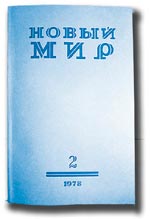
The subscription to the New World was invariably limited, and, for example, in Dnepropetrovsk, in the homeland of Brezhnev, it was generally prohibited. In 1969-1970, the circulation of the magazine was 271 thousand excorks.
And since 1986, with the beginning of “Perestroika and Glasnice,” the magazine was first headed by a non -partisan writer - the famous prose writer Sergey Zalygin (1913–2000). Under him in 1991, the circulation of the magazine soared to record heights - 2 million 700 thousand copies (the circulation, in essence, incredible for a fat literary magazine and possible only in the euphoria of the then Perestroika).