
Translated material
Fur and only
Shub-Jubba Blue. Popures of a well -known saying, everyone who does not have a fur coat wants to buy it. Everyone who has a fur coat wants to sell it. In our man, the eternal dream of wrapping in fur struggles with the desire to discard this heavy heritage of the past ... Winter will judge us?
It’s good for me in my old -man fur coat, as if you were carrying your house on yourself. They will ask: is it cold in the yard today-and you don’t know what to answer, maybe it’s cold, but how much I know? There are such fur coats, there were priests and trading old people in them, people are calm, incomprehensible, they won’t take someone else’s mind, a fur coat, a fur coat, that the cassock, the collar is worth the wall, thin, not faced, without age, a coat is clean, spacious, and wear it, for nothing, but I can’t get used to it, it smells of something bad, and a sundom incense, spiritual testament. I bought it in Rostov, on the street, I never thought that I would buy a fur coat. We all walked, Petersburgers, mobile and windy people, European cuts, in light winter, waisted, from a mandel, with a children's collar, it is good if Karakul, semi -gags, nor sets. Yes, Rostov seduced me as a furry trading, the city is expensive, you won’t begin to do anything, and fur coats are cheaper than steamed turnip.
O. Mandelstam. "Fur coat"
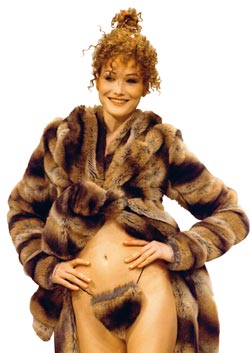 |
| The top model of Karl Bruni, before she became the wife of France President Nicolas Sarkozy, demonstrated clothes from the collection of Vivienne Westwood photo Reuters |
Despite the apocalyptic forecast for the advancing global warming, the winter was real. The arrival of colds coincided with abundant snowfalls, Christmas frosts smoothly moved to the Epiphany - frost and sun, which could be more fun, especially when you are warm and comfortable! For a long time, there were no such fur diversity on Moscow streets, even native hats are used, unjustly displaced in recent years with orphaned hats, baseball caps “on fish fur” and leather cartules with a chice of Tsigeika. Even the heavy long -willed fur coats, which are usually sorry and hot to carry in the subway, are taken out of Naftalin, and the inhabitants of the subway in long distances are entertaining themselves with unraveling that the neighbor put on the beast. During the long January holidays, the Chekhov story “The Mowers” was remembered every now and then: “Evening. A motley crowd consisting of drunken sheepskin coats and katsavek is walking along the street. ”
Today, however, it is difficult to find sheepskin coats and katsaveiki. But the democratic short fur coat, ordinary clothing of the 60s, has gone the past. And the elite in the 70s of the sheepskin coat today looks terribly old-fashioned. And where did the karakule “pies” of the most-very large bosses go, where are the nomenclature peppers, the ondatrous for middle-hand officials, rabbit for all others?
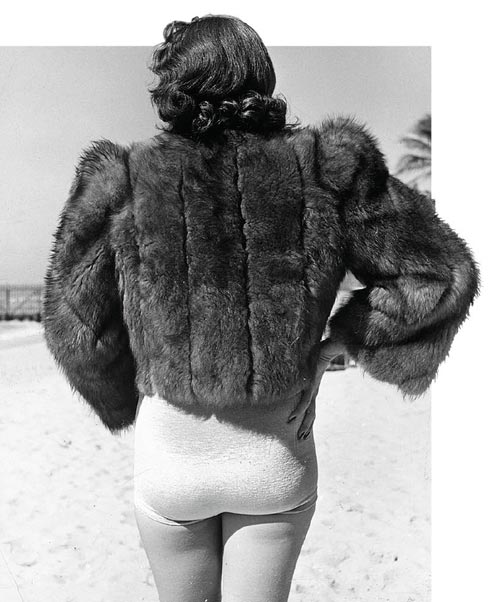
Photobank.com/gettyimages
Together with the fur hats, by the way, the common thieves' fishing also left - in the old days, even a rabbit earflaps could be pulled off the head of a tipsy citizen ...
The merchant Yeremey Babkin stole a raccoon fur coat.
The merchant Eremey Babkin howled. It’s a pity for him, you see, fur coats.
“A fur coat,” he says, “it is painfully good, citizens.” It's a pity. I won’t regret the money, but I will find a criminal. I spit in his face.
M. Zoshchenko. "Dog smelling"
The first written mention of fur coats in Rus' dates back to 1368, and this word came from the Arabic “jubba” - so in the Middle Ages the Arabs called long -poured cloth clothes with sleeves. In the royal wardrobe of the XVI - XVII centuries. They kept fur coats for departure, techniques, weddings. The king was at the feast in the “dining room” of a whitish fur coat, covered with white axamite - an eastern silk fabric.
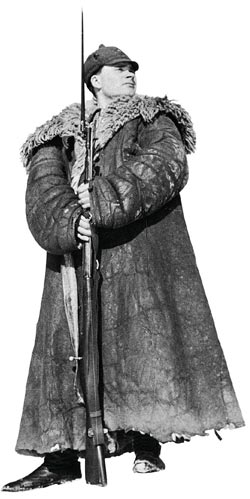 |
| Soviet border guard at the post photo RIA Novosti/STF |
In the words of the historian N.I. Kostomarova, fur coats were “the most elegant dress for Russian ... It happened that the Russians not only went out into the cold, but also sat in them in the rooms, receiving guests to show their wealth.” The boyars, as a rule, dressed in expensive fur coats from sables and foxes-black-tower, black, gray and “siva-wrapped”, that is, Siberian foxes with dark blue throat and chest. Kuni and squirrels were considered simpler. The wealthy people had elegant fur coats “to the exit” and the so -called sanarians, in which in winter they went on the road. Wealthy peasants could afford, and even then not always, a sheepskin fur coat-usually one or two per family. The fur coats were covered with fabric or they were nagal, that is, they were sewn to the outside.
The sheepskin coat in Rus' has been known since the 16th century. The Turkic word meant a bag of without seams, from a solid skin. A long, to the heel, with a wide, and without fasteners and without fasteners, the sheepskin coat was worn over the caftan, Armenian, fur coats, going on a long journey in the winter or, like the guard, for the shift. He was undergoing a sash, smelled or wore an armored. Before the 1917 revolution, the black immense sheepskin coat served as a winter uniform of St. Petersburg and Moscow janitors.
From the Mongols, the Russians got the Siberian doha, which the steppes themselves called Yaga. They sewed from foal and calf skins with fur out. The dochi from wolf and dog skins was fur and inside. They also put on a doha on top of an ordinary fur coat and did not fasten, but smelled. The Doha saved from the fierce frosts of the inhabitants of the Urals, Siberia and the Far East. On long trips on horses from the winter cold, fur coats on the wolf and bear fur were saved. They didn’t go to them: incredible severity and length to the floor did it impossible. 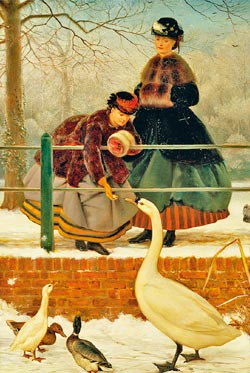
Practical and beautiful outerwear were Romanov fur coats and short fur coats. The skins of the famous Romanov sheep had a very thick, not very wavy wool and tangled softly, in a special way. They painted them in black or brown. They sewed a fur coat in a naked way, that is, they did not cover with a cloth on top. They had a cutting “hussar” back of three parts, which was below the waist on assemblies. Flapped on hooks both on the left and on the right side. The collar is long or persistent. Fur stripped stripes, embossing with embroidery in two colors along the side and along the edges of the sleeves and pockets gave Romanovsky fur coats an elegant look. The Romanov fur coats were mainly in provincial everyday life, short fur coats were considered warm and comfortable clothes for winter hunting. In the First World War, front -line officers, military doctors, and sisters of mercy were put on them.
It came to the court in Russia and Bekesha, warm outerwear originally from Hungary, named after the infantry commander in the army of the Polish king Stefan Batoria. Lined with cloth or gabardine of gray or brown color, during the war - the color of khaki, usually on the sheepskin with a strict collar of gray karakul, fruit cut, with a cut -out waist, with a cut from the back from the waist itself and on hooks - Bekesha emphasized the harmony and youthfulness of the military. No wonder during the Great Patriotic War, she returned to the army as a winter non -term uniform of colonels and generals.
It's dark: he sits down in a sled.
"Fall, fall!" - there was a cry;
Frost dust is silver
His beaver collar.
A. Pushkin.
"Eugene Onegin"
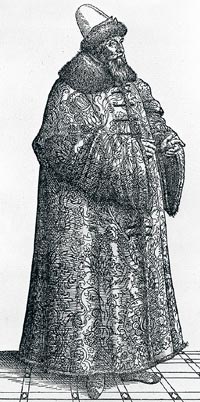
Dokhi, Bekeses and fur coats, in addition to their main goal - to protect from the cold - were a kind of estate label. With a frosty dust, a beaver collar could be silver only among a rich young lane. Not every young beauty was warmed by sables - even from those who traveled in carriages. A fur coat from the royal shoulder in Peter's times, even for a nobleman, was a high distinction, then the expression “from a leopard shoulder” began to mean sophisticated humiliation.
At the beginning of the twentieth century, the invention of the car returned the pragmatic interest in fur. The first cars that appeared on the streets of European capitals were open and demanded more warm clothes. Then fur coats from long -haired furs came into fashion - foxes, ilse, sable, mountain goat, wolf, raccoon.
After the revolution, after the revolution, the unfinished noblewomen were calculated on the worn fur coats, and during the time of NEP, fur returned for a short time as a sign of wealth and the subject of the lusts of the then fashionables-we recall the Green Mexican tushka, the cereal-ears.
The Soviet woman, possessing the treasured furs, felt like a queen. The fur coats were pushed and redrawn, sutured and shortened. They inherited. The famous Moscow fur cutter earned no less, or even more academician, was a welcome guest at all the premieres of “Contemporary”, the owner of the “Volga” color of the color of coffee with milk. 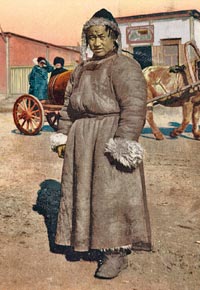
A beautiful full lady sits in the bed ... A thousandth fur coat lies near it. In the corridor, her footmen with galloons await, and on the street a couple of Vorony and a sleigh with a bear cavity ... a well -fed beautiful face and the situation say: "I am happy and rich." But do not believe, reader! “I'm ashamed,” she thinks. - Tomorrow or the day after tomorrow the baron will converge with Nadine and remove all this from me ... "
A. Chekhov. "Powers"
One of the 90s will become Chop-tours to Greece: the Greeks quickly orientated themselves and specially for Russia to establish mass sewing fur coats, mainly from the American mink. The Moscow markets were littered with long, to the heels, coat-coat, which seemed to former Soviet women, the top of luxury. Any self -respecting manicure or masseuse went in such a fur coat to attract wealthy clients.
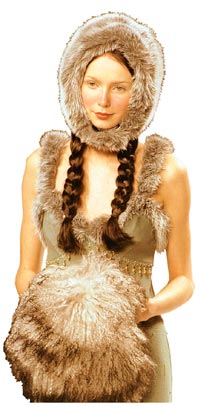 |
| Today fur is material for experiments of fashion designers photo Reuters |
The cargo has not yet passed, but now the fur coat has finally lost its functional advantages. The emergence of modern durable fabrics and new materials allows you to create clothes much warmer, light and practical. Syntipon jackets and down jackets on gagachy fluff are perfectly saved from winter colds, in them it is much more convenient for both children and adults. But ... women still attract fur stores like a magnet. Let the fur coat are insanely expensive and pointless, but how refined, feminine and sexy!
One of the December frosty days, the author happened to observe a lovely picture on the Belarusian Station Square: a young person with luxurious brown hair, in a luxurious mink fur coat, in a luxurious silver Mercedes jeep with a lowered glass of the scrap and spit out the husk on the pavement. Dreams, apparently, this young lady came true one hundred percent. Sophistication and femininity remained on the bridge in the form of a husk from sunflower ... fur and nothing more!
Photo on the main page: Alikhan