
Translated material
Cunning
How did it happen that not the most famous universities in Russia were on the list of the most prestigious educational institutions in the world
There are three universities ratings in the world that are considered authoritative: Times Higher Education, QS (Quacquarelli Symonds) and Shanghai.
Last week, it suddenly turned out that in the first thousand universities in the world and in the best 15 Russian universities, Times Higher Education includes the Don State Technical University, St. Petersburg Polytechnic, Mountain University, Moscow State Construction University, REU named after Plekhanova, Rudn, from which no one was waiting for victories in the Highest Scientific League. In addition to them, in the thousands of the best universities in the world are (in order to deteriorate the rating) of Moscow State University, MFTI, HSE, MEPhI, ITMO, MISIS, Tomsk State University, St. Petersburg State University, Bauman, Kazan University, the Novosibirsk University, the deserted high place of which, on the contrary, does not surprise anyone.
What happened? Really the technical universities of the second or third echelon ( Don GTU , MGSU ) ahead of classic universities of the royal coinage, which formally look worse in the Times?
The answer was funnier. The Russian Research Telegram channel analyzed the data of the publication activity of universities and, as it seems, put a lot in its place.
It is these universities that break up into two well -defined groups: one - with a small number of points for articles and a high number of citation points; The other - on the contrary, with a large number of articles and lower citation. The first group included the very “upstarts” - DSTU, MGSU, Plekhanovka, St. Petersburg Polytechnic. In the second -
Hit, Moscow State University, MEPhI, ITMO. Did their articles be unclaimed? No, they simply did not use citation wrapping services.
The Russian Research counted the Times rating without taking into account the information about citation, and here is who was upstairs: Moscow State University, Fizteh, MEPhI, Thale, Tomsk, ITMO, St. Petersburg State University, Novosibirsk, Baumanka - which is completely logical, reasonable and expected.
As the Vice President of the Russian Academy of Sciences Alexei Khokhlov noted, the screening of quoting is a service that is often provided by “predatory” (that is, those who make money, among other things, are incomprehensible) publications, whose danger has repeatedly declared wounds. The service is provided along with the very possibility of publishing "any nonsense for your money." It seems that this assumption completely explains what happened.
We have already indicated in the publication “Write, Emel” that the three leaders in “predatory publications” include Kazan University, Plekhanovka, and St. Petersburg mountain. We also noticed DSTTU then: 173 articles in “Predators” for a small university - this is not so little.
How intensely these universities participated in the purchase of publications in “predatory” magazines - is shown on the schedule compiled according to Dissernet. Basically, solid universities (in a strange way, in addition to Moscow State University) used the services of “predators” much less than those whose appearance in the top rating raised questions. (HSE, Tomsk State University and Novosibirsk University are absent on the schedule, because for convenience we made a vertical scale by logarithmic, and in the indicated three universities publications in the "predatory" magazines were not detected.)
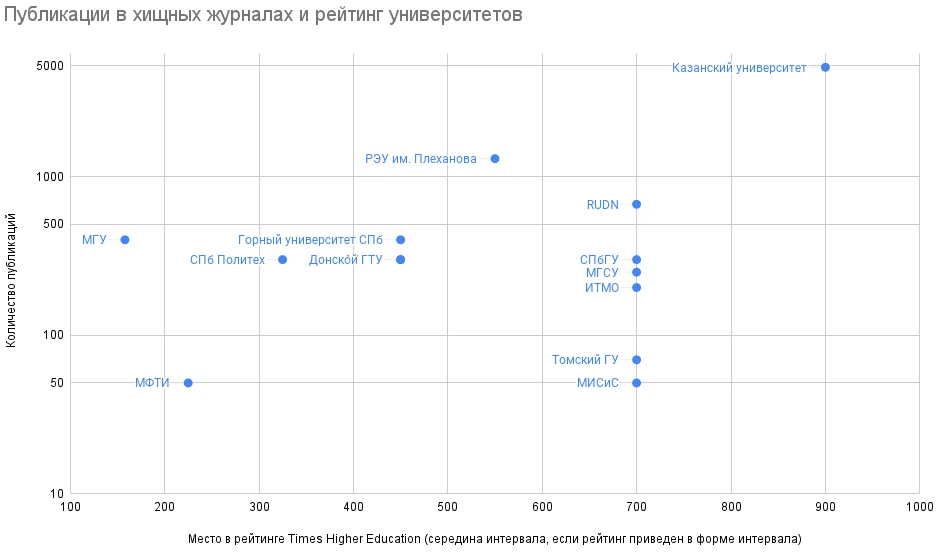
Rating: Times Higher Education
At one time, an analytical certificate from the Russian Academy of Sciences was received in the name of the leadership of the Ministry of Education and Science, which said that it was the most difficult to wind up a Shanghai rating, as taking into account a large extent higher scientific achievements; In the QS rating, a large weight has “sociological” data obtained through massive surveying of teachers; Finally, the Ministry of Black and Blacks wrote that the Times Higher Education rating is most opaque and there is a huge loophole for manipulations in the form of a large share of citation. But the Ministry of Education and Scientists listened to the academy and did everything in their own way. The race for formal signs continued.
I talked a lot of my life with the officials of the Ministry of Education and Science and is ready to testify that the arguments of mind and common sense reach them not easy. Apparently, the simple idea that almost any formal scientometric indicator that is ordered to achieve, the Russian university bureaucrat “Haknet” is not reached them - to general harm to teachers, students and state budgets. Only crooks from “predatory publications” and those who offer arts for weight and square meters will receive benefits from the racing races behind the ratings.