
Translated material
Bank with tin
Report from the Indonesian island where ore is mined for all gadgets in the world
According to laptops, smartphones and tablets, I have already gone billions. But does the consumer know, at what cost all this is given? The NEW Times visited the island where the ore is mined for all gadgets in the world
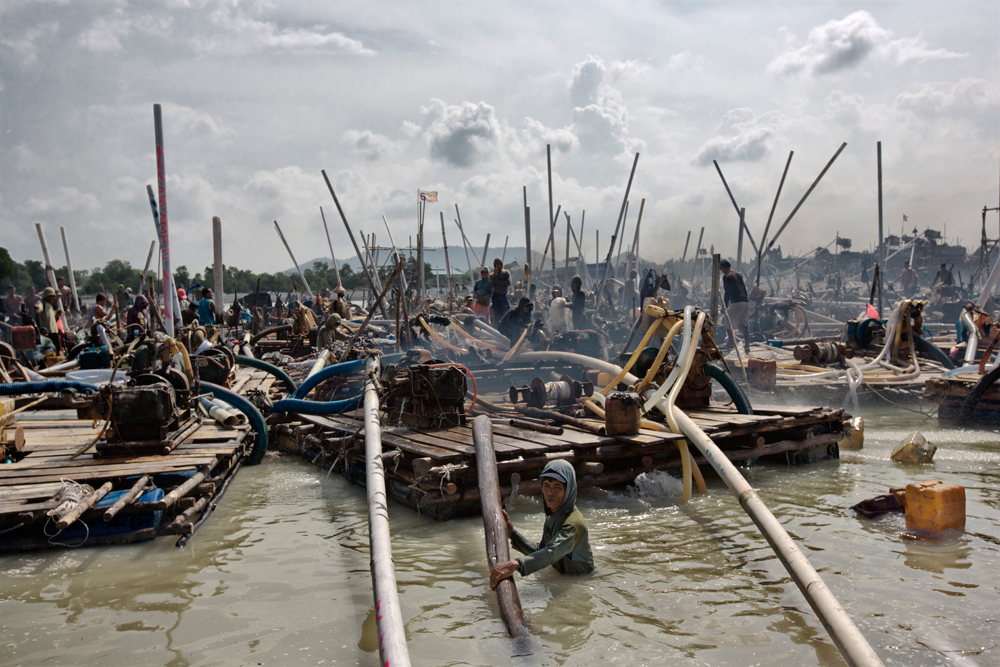
Platform-ponton, bamboo pole and slightly luck-what needs thousands of miners on the bank
In Rebo, a fishing village on the east coast of the Indonesian island of the bank, 8 in the morning. Dozens of untidy, poorly dressed young people gather in a small bay. They only have a fuel canister and meager rations with them. Under the white tropical sun, scorching through the morning fog, they silently peer over the horizon, each with their thoughts, and patiently wait for the arrival of a small fishing ship. On it, they will sail to a wooden platform, drifting a few hundred meters from the shore. And it will not be fishing. Under the platform, something much more valuable lurks, for which they are ready to even die. There, on the seabed, - tin, one of the most valuable metals to date.
And the market is growing ...
The island of a bank with a population of 1 million people is located near Sumatra, in size it is slightly larger than Cyprus. About 30 % of the world tin is mined here, which cannot be dispensed with in the manufacture of automobile spare parts, cans and plates. But not only. 52 % of the tin is used as a solder in the microcircuits of smartphones, laptops and tablets. Over the past 10 years, tin prices have rapidly jumped up, from $ 5 to $ 23 per 1 kg-mainly due to the constant growth of smartphone production (40 % annually, according to IDC) and tablets (by 53.4 %). In 2013, more than 1 billion smartphones and 184 million tablets were produced. Leading manufacturers - Samsung, Apple, BlackBerry, LG Electronics, Motorola Mobility, Nokia and Sony Mobile - use the tin on the can. Moreover, world giants are most likely only the peak of the iceberg. According to Monica Lemper from the Dutch research company IDH, "Indonesia is the largest world supplier of Tin, without which, it is likely, not a single manufacturer of electronics can do."
Due to the constantly growing demand for a tin of the bank, once a paradise island, is now rapidly turning into one large closing mine-both on land and sea. Once the virgin forests are now cut by thousands of craters filled with poisoned water with acid and heavy metals - the result of 13 years of uncontrolled tin production. In 2001, the island government issued permits for production and remelting to local entrepreneurs. As a result, illegal “Shakhters” quickly flooded the market - they became all of them, from pensioners and housewives to former fishermen and children. According to the Indonesian Ministry of Mineral Media and Energy, from 30 % to 40 % of the local population is employed in tinnote, without official permits. Minus is in protected natural areas, including using children's labor. The usual phenomenon is injuries and even the death of people for which families of the dead do not receive any compensation.
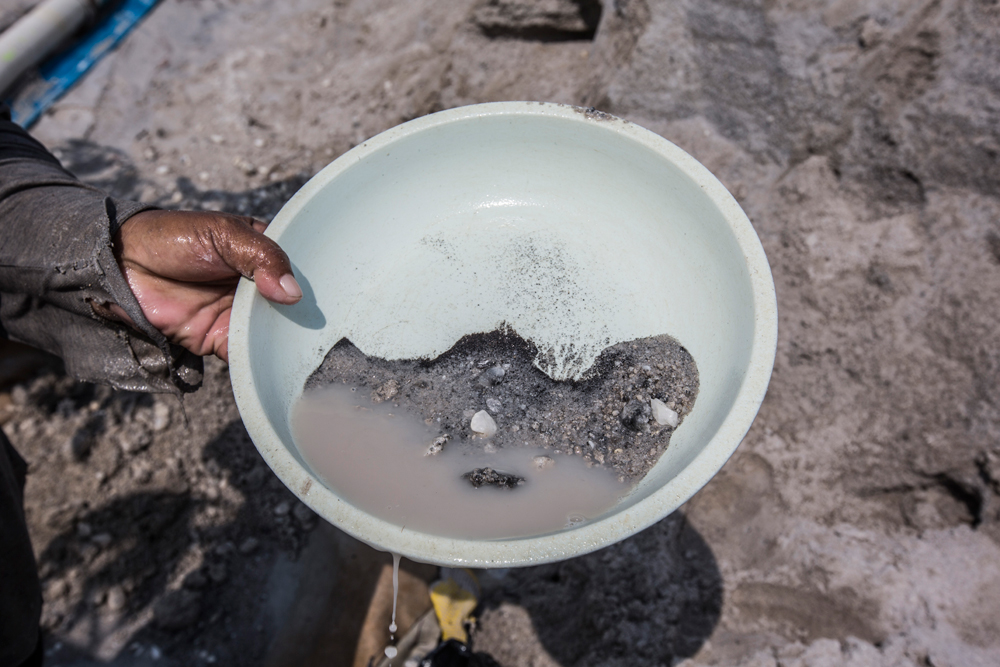
Tin is freed from water and sand with bare hands
Expensive price
“Shakhtar” from RezO - all the same illegal immigrants. Upon arrival at the platform, the men are immediately accepted for work: three dive into the pool temporarily built from drifting tanks, dirty brown water in which sharply contrasts with turquoise water of the surrounding sea. Every 30 minutes, the trinity rises to the surface by a 10-minute break, and then again dives to an eight-meter depth.
With the help of a huge vacuum cleaner of the unit consisting of a large plastic pipe connected to the diesel pump, they “suck” tin from the bottom. The “miners” breathe through the hose, connected to the pipe that exit to the surface, and the air is supplied to the hose all the same diesel pump.
Meanwhile, the workers who are on the platform “whip” sand on the seabed with the help of long and heavy bamboo sticks. The ore in this way is put into tanks placed at the bottom of the wooden platform, and the sand is washed back into the sea. During the day, in each reservoir you can collect up to 15 kg of ore worth up to $ 100. Each employee receives about $ 15 per day, which is twice as much as the average salary of a local farmer. But the price of this money is very high, especially for those who work on the open sea. “Divers are most at risk,” says 31-year-old Huvei Long. Due to the noise of the generator, he has to scream.
Unbearable heat and poisonous exhaust gases - in such conditions these thin, but incredibly hardy guys work, some of them are only 14 years old. Half an hour of work - and they are already all in mud, sweat and sea water. But despite difficult conditions, no one thinks to complain. The pits where tin ore is mined can collapse and bury divers under the thickness of the sand at any moment - Long knows this very well. Now he leads the process, and once he himself was a diver and barely survived after several collapses. “Everything happens unexpectedly, the collapse cannot be prevented. Sometimes, in order to pull out a person, it takes half an hour or an hour, ”Long recalls. Many were not lucky: according to the local environmental association, Walhi, 53 Shakhtar died over the past year, that is, almost one death per week.
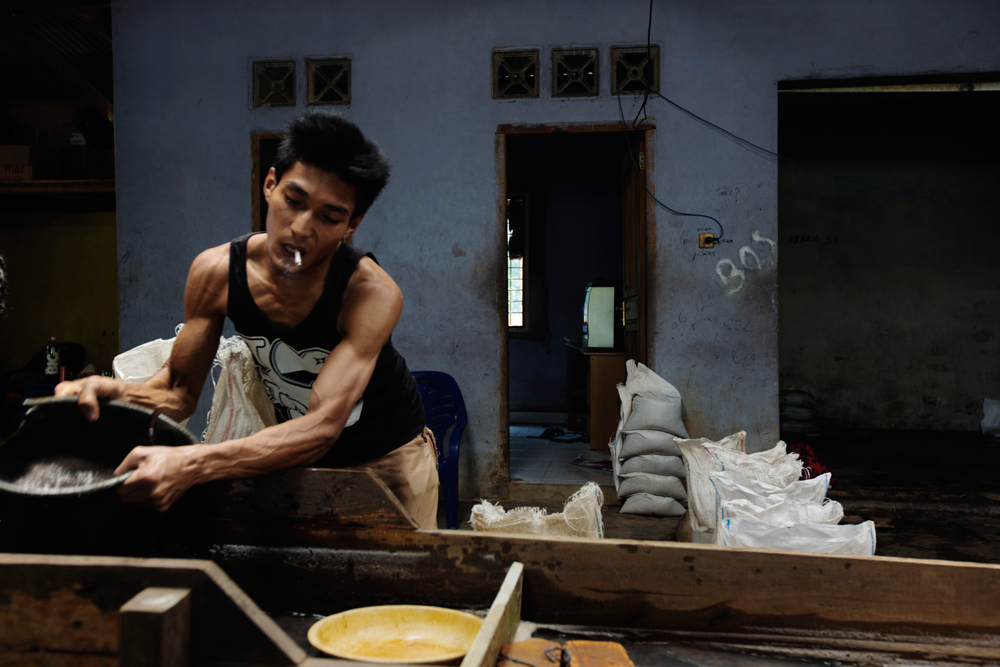
Sifting tin before sending for processing. Pemali, island of a cat-mouse bank
Many illegal immigrants play cat-mouse with the police. For example, 33-year-old Malasari Amirudin and her 15-year-old daughter Novy Aher-the conversation with them took place in their poor lupus in the coastal town of Batako. Two more women were sitting here involved in the booty of tin. The night before, the police held a raid on mines on the shore and closed the one on which Amirudin and Aher worked.
“We have no other choice but to wait until a new booty opens: it usually takes no more than a week,” explains Amirudin, who began to extract tin at the age of 10. She explains how this is done on land: at first, often with improvised means like ordinary shovels and hoes, a pit is dug up, and then the earth is soaked in simple water. The resulting dirt is pumped through plastic hoses into flushing containers - ordinary wooden tubs with constant circulation of water, where the ore passes the same stages of cleaning as when mining to sea.
Amirudin and her daughter only recently arrived in Batako from Punkalpinang, the capital of the island of the bank. They collect the remains of ore, remaining after washing, thus earning up to $ 20 per day. Like many “miners”, they have no idea what the obtained tin is going on. Seeing the iPhone, the women cried out in horror. “These things are very expensive. We definitely must demand more (money) for the mined ore, ”Amirudin jokes.
Mass production of tin ore on land led to the fact that the forest is rapidly increasing on the bank. Many illegal workings are abandoned, who will eventually bear responsibility for this is not clear. The government demands that at the end of the work, tining companies bury the foundation pit and plant new vegetation. But the instructions are obvious: the entire island is covered with huge abandoned pits, and only in some places the tin-tortures “deigned” the palm trees.
The Indonesian state tining company PT Timah is awake, saying that many mining miners come to the lands already recalled-so, they say, it does not matter. This is true, but only partly. According to the famous Indonesian expert on the environment and agriculture, Dr. Ismed Inon, the state -owned company is also not without sin. “One of the reasons for the environmental disaster on the bank - non -compliance with the state -owned companies of its obligations on reclamation,” explains to Inon. “The government had to impose sanctions on them for a long time, but this has not been done.”
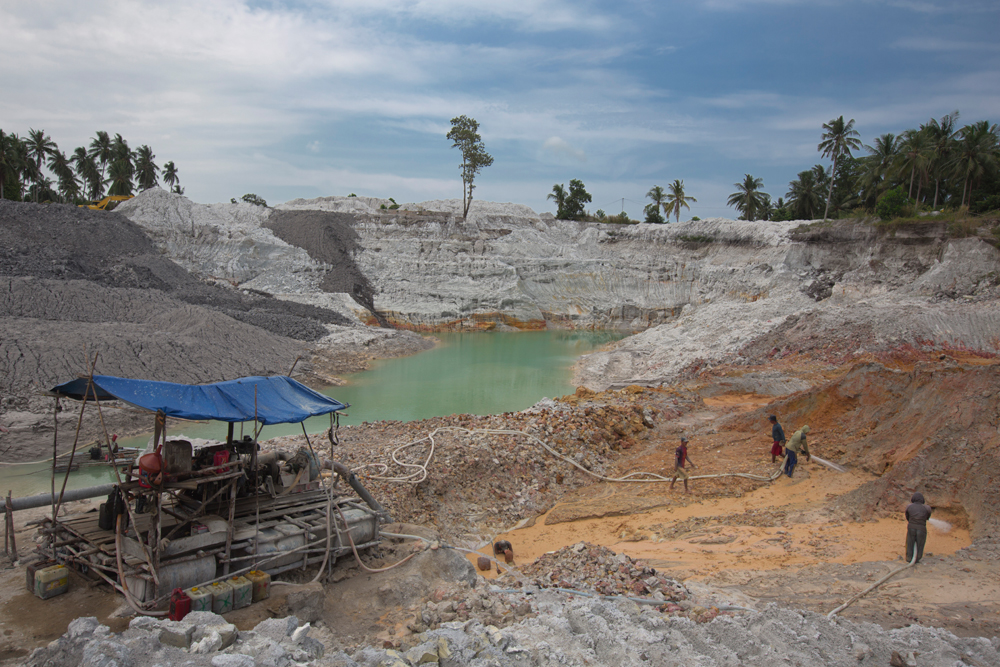
The island of the bank is all dotted with quarries remaining from abandoned mines. Flora and Fauna slowly die
The murdered shore
The environmental situation in the sea water area banks is even worse. Hundreds of homemade platforms get tin, on the contract they have 52 dinogament vessels owned by PT TimaH and other companies. The vessels constantly pump the ore from the bottom, and the sand and related waste is thrown back into the sea.
“When I was a child, the bank was completely different. 10 years ago there was a sea here, ”says Long, pointing to the coastal strip of rebel. Behind Long is a Confucian temple surrounded by forest. According to local residents, once the beach of Rezo was a continuous emerald-golden line, now it turned into a series of small binders formed by sand remaining from workings.
According to the results of a study conducted by the University of Belitung (Indonesia), the workings killed from 30 % to 60 % of the coral reefs of the island, as a result of which the fish was transferred here. Colossal damage was also caused by tourism. The Indonesia government does not make any efforts to restore the seabed, despite the fact that tining companies in attempts to get rid of illegal competitors (those, as a rule, do not have the necessary equipment for work far from the shore) are increasingly focusing on water production. According to Dr. Inon, "it will take at least 20 years to restore reefs, and then if the prey is stopped right now and completely."
From the pollution of the sea, local fishermen suffer more than others. According to the 41-year-old fisherman Tug Lin Xiao, 14 years ago he could fish just 4 miles from the shore. “Now I am forced to leave as much as 17 miles,” he complains, sitting on the porch of his two -story house in Rezo. But the hatred of Xiao has another reason for tin: 6 years ago, his 32-year-old brother Tsunt Lin Fang found his death only 300 meters from the House of Xiao, buried alive in a collapsed pit. Together with him two more people died, and two more survived. And although that “damned land” was soon sold, memories will never be erased from the memory of Xiao.
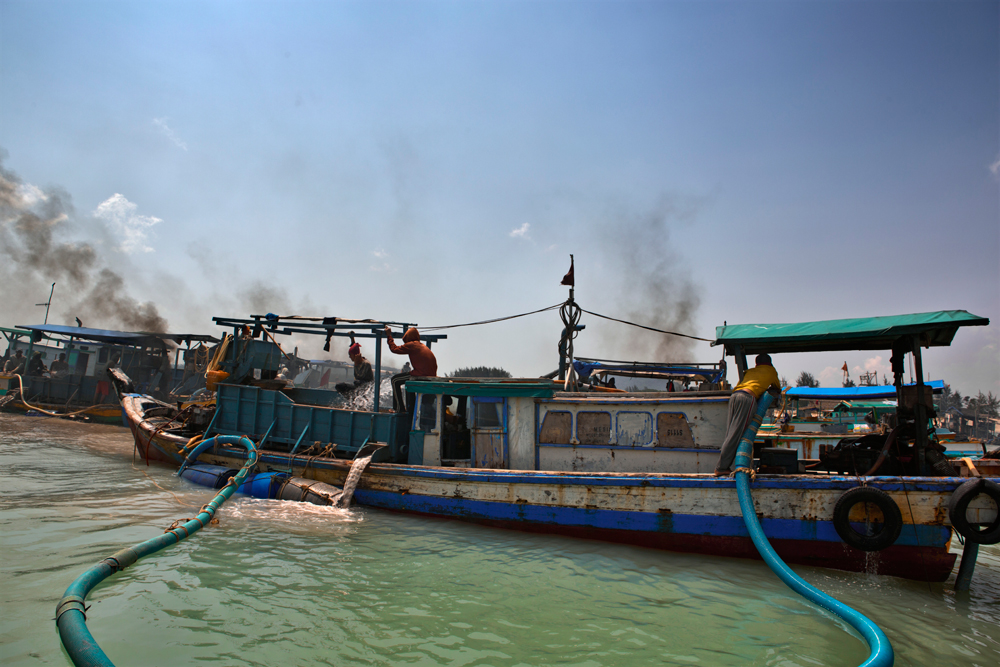
Tin is scooped up with pumps from the bottom, sea water is drilling and dirty. Sungai Liat, Bank Island
Development without the future
Tin production at the bank began back in the XVII century. And since 1814, Dutch colonists began to bring here to work at the Chinese mines. Today, the descendants of those workers are inhabited by many villages on the island. “Any Chinese village was once a place for Olov’s production,” says 36-year-old Bambang Yusman, a local businessman, whose ancestors arrived on the island about 300 years ago.
Yusman is a lively embodiment of island contradictions: he is the owner of a tourist hotel and at the same time one of the largest shareholders of PT Timah on land. Yusman sharply criticizes the destruction of the sea, but sees nothing bad in thousands of mines on land: “There is a real tin fever. Some families demolish their dwellings and seek tin under the ruins. Tin and the bank are one. This is part of the culture, and the locals believe that nature will cure itself. ”
Sometimes, by the way, it seems that the inhabitants of the island became victims of evil irony. The extraction of Olova led to the economic development of the island, gave funds to the existence of thousands of families and attracted investments. Enterprises, shops, hotels and restaurants open. Many beautiful houses on the island were built with money from the extraction of tin. But money is money, but whether the island has a future - this is the question. According to the fisherman of Xiao, tin -powerly destroys the ecology: “There are no longer coral reefs, jambs of fish and mangrove forests.”
Dr. Inon draws even more gloomy pictures of the future island. According to his forecasts, “the harm is done for many decades, if not a century, forward. Some species of animals are already disappearing, like some valuable breeds of trees. If we do not take measures now, a real trouble will happen to this island. ”
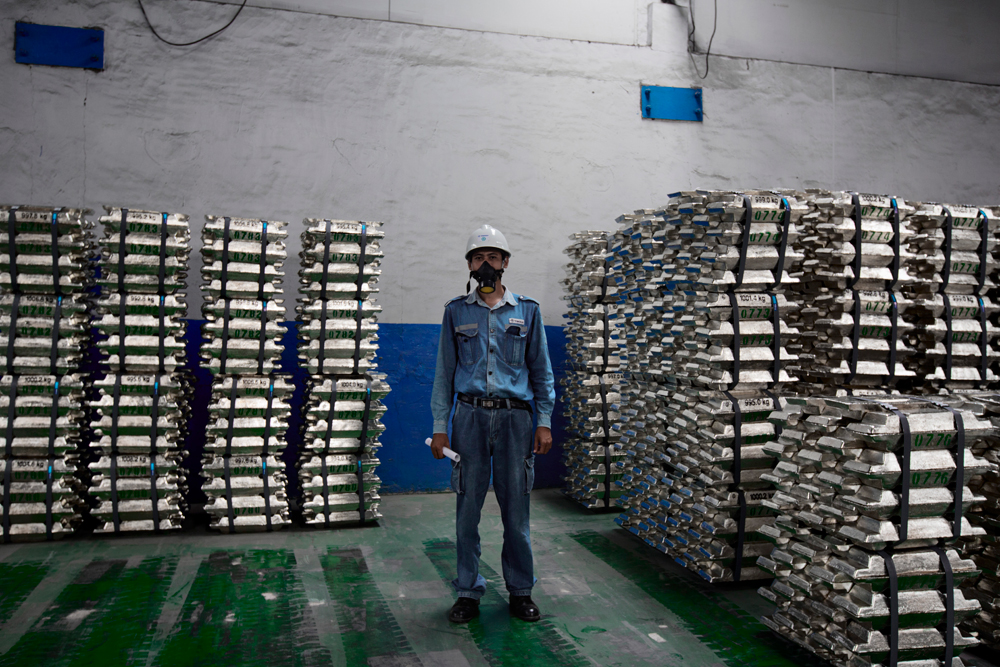
Tin ingots are ready to export. Factory of the State Corporation PT Timah, Mendok, Bank Island
Its own "roof"
A special topic for conversations of local residents is the participation of law enforcement agencies in the “roofing” of illegal tin. The police and coast guard officers are often visited at sunset to the Reso zone, where the ore mined during the day is sorted. Many Shakhters claim that the police are gathering a bribe there.
30-year-old Asram Somat, the father of two children from the village of Pemali, is one of several missiles of ore at illegal immigrants, and buying through an extensive network of private collectors. Somat collects and sells up to 3 tons of ore per week by several independent retainers at an average price of $ 16 per 1 kg. His business is absolutely legal, but Somatu, according to him, has to pay about 1 million rupees (about $ 100) of the police - “otherwise there are no problems.”
In 2012, ecologists from the Friends of the Earth (FOE) called on the largest mobile phone manufacturers to divide with tin respiratory responsibility for the environmental situation at the bank. From production to the conveyor, raw materials go from four to eight steps of processing, and this sharply complicates the possibility of tracking its origin. “The farther you are from the mine, the more difficult it is to take measures,” explains Agung Nugrojo, spokeswoman PT Timah.
At the sunset, young workers from ponton platforms return back to the Rebo, having firmly pounding in the same wooden boat. Tired, but satisfied, they carry buckets, filled to the top with an ore, which became the basis of their whole life. The tin is weighed, after which he is quickly taken by the receiver, and the miners return to the village - a number of houses covered with straw and bamboo, blown between the shore and forest, paired hundreds of meters from here. “To be honest, I am also worried about the local ecology,” Long admits after a long pause, starting his small scooter loaded with tin. “But I will have to work on the mine until the end of my life.” I can’t do anything else. ”
About 40 mining companies producing 90% of Indonesian tin operate on the island of the bank. Of this amount, 95% is sent to China, Europe or Southern Asia. The origin of the metal for legality cannot be monitored. Although 90% of the license in Indonesia belongs to the PT Timah state corporation, in 2012 it managed to produce only 28 thousand tons of tin, while private traders - 70 thousand. At the same time, according to private companies, PT Tima also boughts an illegal tin.
Photo: Matilda Gattoni