
Translated material
Particles of the universe
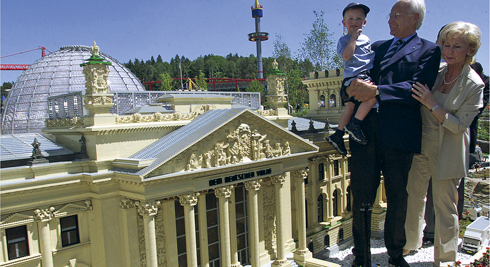
The first "Legoland" in German Bavaria in 2002. For the construction of the Reichstag and other buildings, 50 million cubes were used
Cubes in an adult way. The traditional spring festival will be held in April in Moscow Fans of the LEGO designer. Cities, castles, space stations, cowboys of the Wild West, adult enthusiasts of a children's game are erected from multi -colored plastic details. What is the secret of the popularity of the simple invention that captured the whole world, ”the New Times found out
A familiar castle built from Lego cubes rose in front of friends. Only this time, the path under the feet was strewn with dull gray pebbles, and not with multi -colored candies. Tamara Kryukova. "Magician for two hours"
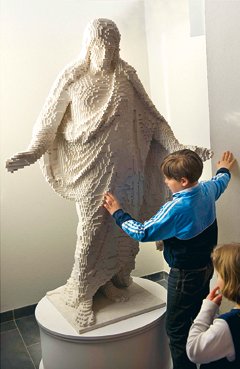
30 thousand details, a year and a half of the work and the blessing of the pastor were needed by the inhabitants of the small Swedish town in order to scream Lego-Status Jesus Christ in full growth. The work was completed to Easter, and on a bright Sunday the parishioners turned their prayers to the freshly grown son of God. Naive, childish? But is it not said in the Gospel: “If ... you will not like children, you will not enter the Kingdom of Heaven” (Matthew 18: 3).
To be a child, play the creator, build your “paradise” without brick and concrete already here, on earth, is the main charm of Lego. Just a little fantasy - and go! 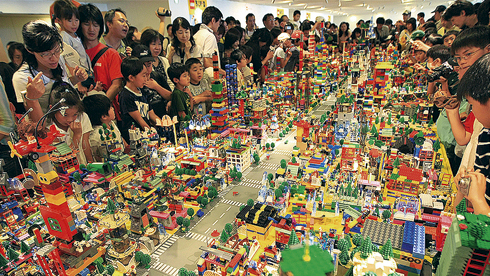
From ladder to constructor
Usually the very first designer in the child’s life is simple wooden cubes. With the manufacture of such a designer, a carpenter from the poor Danish family Ole Kirk Christiansen began. In 1932, he opened a small company for the production of ladders, ironing boards and wooden toys. Ole Kirk came up with the name for his company a little later, in 1934. It formed from the expression of Leggodt. Translated from Danish, this means "exciting game."
Today, 8000 people are working on the creation of designers at 37 LEGO enterprises. Designers are sold in 130 countries of the world, and at a speed of about seven boxes per second. But at the very beginning of the case, the Carpenter Christiansen did not go so magnificent. And then he decided to engage in the production of wooden cubes. Kirk Christiansen took his own 12-year-old son Gottfried. 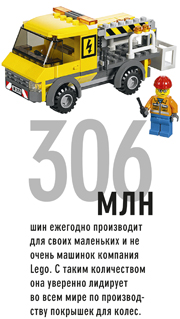
Alas, in 1942 the factory was completely burned down. But the Christiansins were not discouraged and after a couple of years they resumed production. In 1947, the cubes began to be made from plastic, and then the details acquired pin with each other. So the first “real”, in our understanding, appeared, designer Lego.
In 1963, cubes began to be made from a special ABS plastic, which is still used. It is non -toxic and safe. In addition, today a special element is added to it so that the cube accidentally swallowed by the child is displayed on the X -ray.
A toy for major
Lego sets literally scattered around the world when the company has its own airline. Fashion for plastic designers came to Russia almost last. Thirty years ago, at the end of the USSR, the toy was in a terrible shortage. Igor Makarov, one of the administrators of the Russian fan forum LEGO, found his first Lego-human, found in the sandbox. “It was in the mid-80s, and the little man was a curiosity to me,” he recalls. - Although then I played with him with pleasure. He became, so to speak, a partner of nesting dolls and Samodelkin. ”
In those years, LEGO designers in the country were considered toys for young major. Only children of diplomats and trade representatives played in them. Parents brought Lego sets from Europe, mainly from West Germany.
The first specialized store opened in Moscow only in 1986 in GUM. It is funny that Moys Laursen, who came to open the store then, remained to live in Russia. Today he is the general director of the Russian representative office of LEGO. In order to actively "bred" in Russia, it took the company for 10 years. Here is notable, but high -quality and most often made in Denmark, and not in China, the designer is bought with a bang.
Success story
Fans of colored cubes assure that the cause of the popularity of Lego is the presence of Success-Story. “This means that the designer is familiar with several generations at once in one family,” Makarov explains. Among the international Lego-publicity, the 66-year-old Danish fan Svend Eric Saksun is widely known. He devotes all the Christmas holidays with his family to the Lego game. Some of the cubes are already half a century, but they still keep shape and color. And they easily adhere to cubes made in our days!
Another component of success is a respectful attitude to fans. Once the company invited 250 fans of enthusiasts to help create a new set from the train series. Joint works were born by the designer Santa Fe Super Chief Train, 10 thousand of which were sold out in just two weeks even without special advertising. 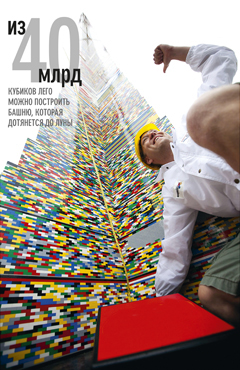
But the three whales on which Lego stands are the series “City”, “Castle” and “Cosmos”. The first "castle" was released in 1984. The "medieval" series is still the most popular. Very often, the series are based on famous films and cartoons: Star Wars, Batman, Harry Potter, Indiana Jones and dozens of others.
In addition to the designers, the company also produces numerous Lego Axuars, which causes a stormy delight of young and adult fans: magnets, backpacks, penalties, ice cream molds, piggy banks, cutlery ... In 2009, even LEGO board games appeared on sale. True, the game field first needs to be built, but during the game it can be rebuilt as you like.
By the way, about “whatever” ... By the 50th anniversary of the invention of the designer, a box with six multi-colored cubes of 2x4 was released, that is, with eight goats, each that can be interconnected in 915 103 765 in ways. This is almost a billion of combinations! As fans themselves assure, playing is much more interesting, improving on the go, and not following clear instructions.
LEGO can also be boasted by the designer with the largest number of details in the world - Taj Mahal. It has 5922 cubes. Imagine what a flight for creativity?!
Tower to the moon
Every year, Lego holds festivals for fans around the world, including in Russia: in St. Petersburg, Tver, Kazan, Moscow, Novosibirsk and other large cities. Festivals usually take place in the summer, when heat, everything happens in the open air. Tents are placed, thousands of details are brought, crowds of fans of the designer gather and a real holiday begins.
Lego has several thematic programs, some are organized in conjunction with stores. But the company holds some shares, as last year’s “construction city of dreams,” independently. Sometimes fans all together build a tower at such a festival.
 |
The first tower erected by fans in 1980 in England was 13.1 meters high. In Russia, the tower was erected four times. The largest of them, 25-meter, collected in the late 90s in Moscow, even got into the Guinness Book of Records. Today, the highest Lego-building is considered a tower in the Chilean capital of Santiago-31 meters. It took three days and 550 thousand cubes to set the record. By the way, the capital of Chile became the 37th city, where such a large-scale Lego-building was carried out.
Nonth Games
In the West, Lego designers have long been used in schools as didactic material and are actively implemented in the school curriculum. In Russia, students are allowed to play the designer only in additional classes after lessons. Which, however, does not prevent the children from being aware of the "Legovian" new products.
Now we are starting to spread such a direction as Lego-Robotics. The most advanced Lego computer series is called Mindstorms. The robot design uses a special block - a programmable controller. He can perform programs, respond to the world around him (using the signals of connected sensors), receive signals by the IR channel and via Vluetooth, and independently give commands through wireless channels. The revived Lego-human can collect things, bypass obstacles, climb up and perform other simple actions. And here it all depends on the imagination of their owners. The last “fashion of fashion” in robotics - using several programmable robots, create a machine that can assemble other models from Lego.
Often, championships for command construction and programming of various robots are held. The Russian leader in such educational robotics - Chelyabinsk region. Local young designers successfully represent the region at all all -Russian and international competitions.
Cubes - van!
By the way, adult fans of the assembly competition almost do not hold. More precisely, there are contests, but there is no competitive moment in them as such. This is more like a congress-exhibition in order to jointly create a masterpiece.
In Russia, such events are held by two communities of fans - “Dubbrick” and “Phantoms”. One in the spring, the other in the fall. Whether this year there will be an exhibition "Fantoms" is not yet clear. "Dubbrick" will definitely take place on April 22–24.
Such a thematic separation, like “today we have the whole exhibition - space”, is not at the festival. There are several thematic expositions at once - and “space”, and “castle”, and “city”. In addition, separate places are allocated to accommodate "informal" works.
The most impressive model of the first Dubbrick festival in 2009, according to those who visited there, was a landscape collected from an unimaginable number of cubes (almost a whole van), which were temporarily provided by Lego. The last year's congress was remembered by the fans unusually large, by Russian standards, expositions: a multi -tier city, “castle”, “Wild West” and “Star Wars”.
The toy itself wages its earthly war for survival. World Wide Web and Computer Games tighten both children and adults. But yet, while parents begin to develop their kids not from the joystick, but from cubes, a multi -colored plastic empire, it seems that it does not threaten.
You can encircle the earth five times with the number of cubes that annually migrate from the shelves of stores to children's rooms. Of course, having previously fastened them into one tape.
A star named Lego appeared in the constellation of a small bear by the 65th anniversary of the company's existence. In the same year, the 17-year-old Danish composer Frederick Mugle wrote “LEGO symphonic fantasy”.