
Translated material
Andrey-2
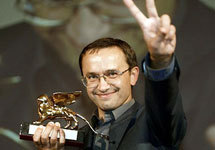
On Saturday, September 6, the 60th Venice Film Festival ended in more than a joyful and flattering way for us: Andrei Zvyagintsev, “Return”, received the “Golden Leo”. Another Russian participant - the film by Alexei German Jr. "The Last Train" - was awarded the jury as a promising debut, but Zvyagintsev should still be considered the main triumph.
Zvyagintsev was born in Novosibirsk, played in a local Youth Theater, studied in GITIS, shot advertising, and made his debut as one of the directors of the Black Room’s collection project, an entertaining, but little noticed anthology of the “Nooir”, with firing, betrayals and an abundance of quotes from their favorite directors. “Return”, the first full -length film by Zvyagintsev, on the contrary, was seen by many: except for Venetian, they wanted to have three more large international festival in their program - in Locarno, Montreal and Toronto. And although the phrase that the respected festivals “fought” for the picture of Zvyagintsev was more like a figure of speech, rather than a real description of the processes that were really exceptional, the case is really exceptional.
“Return” is a road drama about how two wild -eyed teenagers unexpectedly who had long left their father - unusually cool, but seemingly somewhat played into his steepness. Father is taking boys on a mysterious journey seemed to look at some waterfalls, but in fact, completely not there. The criminal background of history does not fully understand, as well as its mystical component. Whether the dad was actually a big question, and the buried treasure, which is a genuine cause of the trip, behaves like the Hitchcock McGaffin or, if you please, as an indescribable suitcase of Marseellus Wallace: it moves the plot, but ultimately remains behind brackets. European criticism generously compares the “return” with the works of Tarkovsky (whose “Ivanovo childhood” once also won the Venetian competition), and the benevolent part of the Russian one is more and more with Jarmush.
The undesirable question was asked by the reasonable question: why the delight of festival seamers (and now the jury members) was awarded just such a Russian film. Indeed, the “return” seems to be a skillful dummy of a European festival hit than a real film of flesh and blood. And the real tragedy associated with him (the performer of one of the main roles, 16-year-old Vladimir Garin drowned a few months ago in the very lake on which the main part of the “return” was shot) only emphasizes the obvious prudence and “doing” of the film. Zvyagintseva will be more correctly compared not with Jarmush, but, for example, with Stephen Sodaberg, who is also famous for its ability to make various genres from the original from the original - from arthouse hits ("sex, lies and video") to socialist hits ("Erin Brochovich", "traffic"). However, to have in the asset of their own Sodaberg for the film industry is highly useful.
Whom the language will not turn to blame for insincerity is Takesi Kitano, whose film "Onyichi" deservedly received a prize for the best directing. Kitano (last year brought to Venice the “dolls” - his first work, in which he himself does not appear on the screen), probably resigned to the fact that even the enlightened festival audience is not so much interested in his ideas as the aesthetic pleasure received from looking at his amazing person. In his new film, Kitano is painted white and plays the role of a blind fencer traveling in Japan in the middle of the 19th century, helping siry and offended, and for life earning gambling and manual therapy. But one of the most popular Japanese movie heroes: since the beginning of the 60s, more than twenty films have been shot about him (with the now deceased artist Sintaro Katsu in the title role). He inspired Noyce's Phillip to create the extremely popular film "Blind Fury", where the blind warrior was played by Rutger Hauer. In the new version of Kitano, as usual, lightningen, deadly and comic at the same time - the reasons why he will be the most beloved eastern director in the West for a long time.
Last year's Venice festival was first remembered by the scandalous resignation of his President Paolo Baratto, dismissed by the Prime Minister of Italy Silvio Berlusconi, and the unwitting boycott from the progressive cinema, which followed her. For this reason, a fair number of movie stars refused to come to Venice; Therefore, for a long time, the jury was not able to form for a long time: a number of famous filmmakers were responding with a polite refusal, and Quentin Tarantino (who was not supposed to know where Italy is at all), being invited to challenge, spoke out in the sense that he did not want to be a vine of a poisoned well. However, the efforts of the new Venetian manager Moritsa de Hadelne (who had been over 20 years of led by the Berlin festival) about the outrageous intervention of the ultra -right in the world of arts was forgotten, and the boycott was canceled. The festival, in particular, was visited by Woody Allen (with the new film "Anything, Not that"), Kristina Ricci, Anthony Hopkins, Nicole Kidman, George Clooney and the team of the new film by Robert Rodriguez "Once in Mexico." Quentin Tarantino was not for this, not for fundamental reasons, but simply because again, for the umpteenth time, did not manage to mount his film "Kill Bill".