
Translated material
Elections in the USA
Photographer and journalist Evgeny Feldman analyzes the results
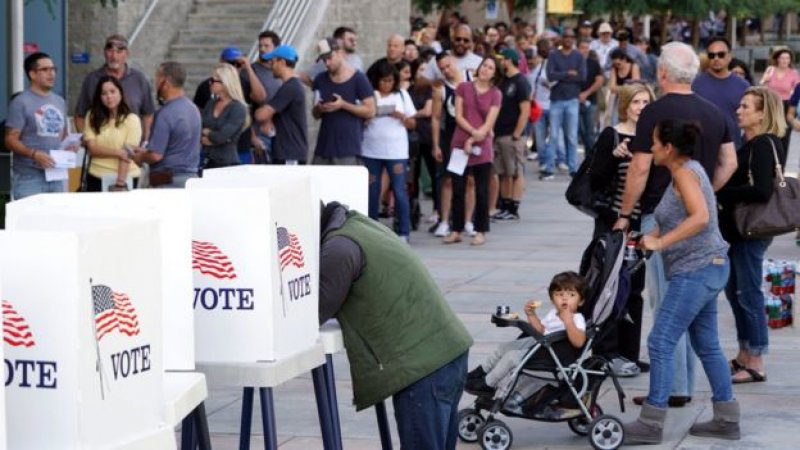
Photo: Twitter / Topby News
The American political system is extremely stable - any radical test turns into the victory of the institutions. Paradoxically, while the electoral infrastructure in the United States is terrible. November 6, the day of the most important preliminary elections, therefore began with such news:
- In Texas Arlington, voting computers broke and did not have enough paper ballots;
- In South Carolina, the old sensory screens did not succumb to calibration: they could count the touch of the name of one candidate on the screen for the vote in support of the competitor;
- In Ohio, the confusion in the lists led to the fact that a number of voters were informed that they had already voted by mail;
- In the capital of Georgia Atlanta, it was necessary to defend three hours to get to the urn for voting.
All such linings - those of technical and/or random nature - attract the attention of the whole country, because with a bicoparty system, the outcome very often depends on the appearance. The main task of politicians during the campaign is to mobilize their supporters, but the outcome is often solved precisely because of such queues, bad weather or changes in the voter lists. There was even a special site collecting donations for the delivery of pizza for the lines to polling stations.
The appearance is important, the following figures are important: the lobbyists spent $ 30 million on its increase among the groups of voters they needed. In previous intermediate elections, in 2014, this amount was more than three times less - $ 8.2 million.
House of Representatives
Democrats were very optimistic regarding the elections to the House of Representatives: the lower house of the Congress was re -elected every two years, the first intermediate elections after the change of the party ruling in the White House often win the opposition. Another factor that spoke in their favor is a grandiose advantage of the campaign budget: the democrats spent one and a half times more opponents on the elections to the Lower Chamber, and the total expenses for both the chamber are over $ 1.2 billion. Both amounts are about twice higher than the budgets of previous intermediate elections.
As expected, the Democrats managed to regain control over the House of Representatives: they probably eventually receive 227–228 seats out of 435 (at 19:00 Moscow time on November 7, Democrats have 220 seats - nt.). Jerrymendering, an unfair cutting of the districts - unlike racing to the Senate, where the entire state, here every 10 years of the districts, is reconfigured, is very affected by the elections to the Lower Chamber. The democrats also interfere with the fact that their voters live mainly in cities - and provide them with a firm advantage, but in a fewer districts. For equality in the number of places, the democrats would be necessary in total to gain about 6% more votes. Their result in reality means an advantage of 7–8% - the actual numbers will become clear within a couple of days.
However, those districts where the Democrats did not have enough slightly enough. In a number of hopeless districts, they managed to impose a struggle - both due to the radicality of Donald Trump, and thanks to strong candidates. For example, in the sixth district of Kentukki they became Amy McGRES. She was the first woman-pilot of the fighter in the combat mission, her advertising video shot at the air base collected 2 million views. She eventually lost to the republican candidate, but seriously plucked him: he gained 51% of the vote - and this is in the district, where Donald Trump won two years ago with a margin of 16%!
Democrats can be disappointed with the outcome of the elections - they did not have a few percent to turn the “blue wave” into “tsunami” in accordance with long -standing dreams. If the total balance of voters in areas for a couple of percent to the left - they could take dozens of districts like the sixth in Kentukka. On the other hand, such “stretching” of the districts who have chosen democrats - from confidently “blue” and left -handed in recent years to the “red” with unexpected victories now - could be a problem for them. For many democrats who struck in conservative districts, the condition for competitiveness was, for example, a promise not to support Nancy Pelozi’s candidacy for the post of speaker of the Lower Chamber. Pelosi in recent years has been the head of the opposition faction, and its approval rating is even lower than that of Trump. Now the democrats faction will be more controlled and more monogamous ideologically.
Nevertheless, in general, their success means strengthening systemic and institutional pressure on Trump. For example, the possible decision of the White House to abandon the new sanctions against Russia will now be found not jokes on Twitter or speeches on rallies, but by the bill - on the introduction of sanctions or depriving the Trump part of control over their introduction or cancellation. In addition, now they can begin parliamentary investigations of various accusations against Trump or close to him. However, a relatively small advantage of democrats also means their likely rejection of attempts to declare impeachment. Another important success of the Democrats is that after defeats in the Congress during the presidency of Obama, and even more so after the Victory of Trump's Victory, the Democratic Party, who has fanned the Democratic Party as an organization, appeared a clear reputation of the losers, which, even under the result, as a result, can only look at the triumph of an organized opponent. The democrats did not get relative to many forecasts in the lower house, but this is still success - all the more noticeable against the background of the sad outcome for them in the Senate and in races for the posts of governors.
Senate
The likelihood that the Democrats would regain themselves and control of the Senate seemed minimal. Reality turned out to be much worse.
Of the hundred seats, the Republicans controlled only 51. The vice president breaks a draw in the upper house, but the conservatives could not afford the loss of even two votes. That is how, for example, they lost the opportunity to cancel the Obamovsky health care reform.
At the same time, senators are chosen for six years-therefore, now only 35 were chosen. Forty-two existing Republicans are re-elected in other groups, so they needed not to lose and so convenient races for them to maintain the status quo.
In fact, it all ended with a disaster for opposition: the Democrats, in addition to the lack of victories, lost places from Indiana, Northern Dakota, Missouri and Florida (there, however, the votes will be recalculated according to the long -standing Florida tradition). Voting in the Senate elections is much more “strategic”, and even the ideological conservatives who disagree with the president support the Republicans in the elections. For example, in order to conduct candidates for judges of the Supreme Court. All three losing democrats are united by the fact that they voted against the scandalous nomination as a judge of the Supreme Court of the accused of harassment of Brett Cavano - in fact, voters in the “red” states punished senators for following the party line on such a strategically important issue.
The only of the Democrats who won in today's struggle for a place in the Senate is the Texas of Beto O'RURK. Yes, he lost his race to the incumbent topic of Cruz, but was the leading of the first two hours in the course of the vote, lagged behind the red “red” state by only a few percent, raised $ 70 million per campaign (and half of them with minor donations), collected a huge audience on social networks and enormous fame throughout the country. The progressive liberal, who showed that he can compete with the Republicans even in the south - he can now consider himself a real contender for the nomination from the democrats in the presidential race. In the end, the last democrat, successful in the traditionally conservative staff (then it was Arkansas), was Bill Clinton.
But before the candidates began to nominate for about another six months, but for now there will be 54 Republican in the Senate, and they will have the opportunity to hold even vulnerable and radical candidates to the Supreme Court or Cabinet of Ministers - the possibility of democrats is now almost reduced to zero.
At the same time, it is difficult to evaluate the outcome of the elections to Congress from the point of view of the White House. The ability to carry out any radical laws now for the president is almost zero. Tax reform, a rollback of healthcare reform, building a wall on the border with Mexico - at least two years all this is obviously impossible. On the other hand, Trump's work is certainly the main reason for the success of the Republicans in Indiana: the president rally there four times. And the decision to drag Brett Cavano into the Supreme Court, despite the accusations, and to use the confrontation with the democrats during these hearings for the galvanization of their voters was accepted precisely in the White House.
Trump masterfully uses any conflict within the political system to his benefit - and the war with the House of Representatives, which he will engage in the next two years, will probably become one of the key points of his rhetoric during an attempt to re -elect for a second term.
Governors
Governor races do not directly affect national policy and even more so on the US international relations, but much more clearly reflect the realities of the current, polarized atmosphere - and strategically greatly affect future elections of different levels.
The governor’s elections were most interesting in Georgia (Georgia). The Republican Brian Kemp and Steisi Abrams, the first black woman who had ever received a nomination for the governor's post came together.
According to surveys, the outcome seemed unpredictable. This is largely due to the fact that Abrams, related to the new wave of progressists, at the same time built on questions that interest those in the middle: she talked about the development of infrastructure and support for small businesses.
Georgia in recent days has become the center of a real battles. The Oprah Winfrey, the legendary TV presenter, who unexpectedly actively acting with political speeches, but denying its presidential ambitions, came to support Abrams.
Since one of the problems that brought Hillary Clinton to defeat was a low mobilization among African American voters, Winfrey addressed them: “Everyone who decides not to go vote is exhausted by their family, dismisses their heritage, their suffering and their dreams!”
Republicans answered with all their power-Vice President Mike Pence flew to George, two rallies with the participation of Donald Trump, who promised that, in the event of victory, Abrams would “destroy the state”, will turn it into “refuge for criminals-migrants”. Camp himself took off an almost caricature advertising video: “I eat a pickupa: suddenly I have to take home illegal immigrants! I have a weapon, and no one will take it! Want an unspoken conservative? I'm! "
The central predictably the racial question became. The fact is that according to the laws of Georgia, when the voter is registered for voting, his application is checked and compared with documents, and in the case of any discrepancies in writing - for example, in the absence of a hyphen, reducing the average name or a typo in the application - the request is frozen and the vote does not receive the right to vote. Therefore, those who changed the address or did not go to the same elections may simply not fall into the voters list in the next vote. So, over the past six years in the state with 10 million inhabitants from elected sheets, a million people have disappeared. Most of them are Afro- or Latin American, which means supporters of the Democrats. Fifty thousand voters, mainly African Americans, eventually remained outside the lists.
Both candidates for the governors have a direct relationship to this issue: Kemp as a state secretary leads his election commission, and is an ardent supporter of the implementation of these strict rules, and Abrams, on the contrary, has fought for the inclusion of all who have the right to vote in the lists of voters. Camp answered in the last days before the elections, announcing the start of the investigation in the case of trying to hack voter registration systems by democrats. And in the evening, on the day of elections, a group of democrats turned to the court-they demanded to remove Kemp from office for the duration of the vote in the elections where he participates.
The struggle of Kemp and Abrams has become a symbol of this particular fight for the entire system: in addition to Jerricedery, the Republicans are very helped by various laws aimed at tightening voting rules (for example, placing additional police patrols or a requirement to present a complete set of documents). As a result, Kemp confidently won-with a margin of slightly smaller than the two previous governor-republican. As in the case of elections to Congress, in the context of general polarization, a sharp activation of democrats also led to the mobilization of their opponents: those races that in a more calm situation would definitely win and remained with the conservatives.
In general, it was the governor's races that brought the most surprises. Polls predicted the victory of the democrats in Florida and Ohio - and a close struggle in Georgia. Everywhere in these races, the Republicans spoke stronger than expectations - although now, when it is still unknown how the voices were distributed among different groups of voters, it is difficult to find one reason for this.
From the news:
• In Colorado, the Governor was elected Jared Polis, he became the first gubernator in the history of the United States.
• in the state of Michigan in a referendum approved the legalization of storage and use of marijuana; In Northern Dakot - they rejected the proposal to decriminalize it. Nevertheless, now every fifth American lives in the state with legal marijuana.
• From Michigan and Minnesota to the House of Representatives, the first Muslim women were elected, and from Kansas - the first woman of Indian origin.
• In Florida, the referendum adopted an amendment to the state constitution, allowing the convicts for serious crimes to vote in the elections after liberation.