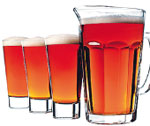
El as a triumph of the national spirit. This drink is often confused with beer. And this is a big mistake. Including because the ele is a whole culture
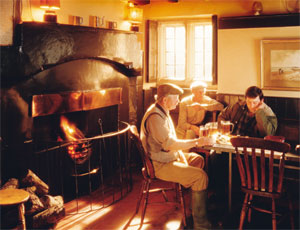
So passed in an hour hour. And in the hearth, the fire is not auging. There was a conversation. The songs rattled. El became more wonderful. Robert Burns
El is now a synonym for beer. British encyclopedia
Call this to any of the almost 70 thousand activists of the Society for the Struggle for a real ale calling itself Campaign for Real Ale (abbreviated Camra), and they will sincerely be upset. El will explain the activists of society, this, of course, is beer, but not all beer - El.
El against the camp
This is what their official explanation looks like: “There are two wide categories of beer - El and Lager. These are products of different fermentation options. The camp is obtained as a result of "lower fermentation". The yeast is besieged at the bottom of the container, and fermentation goes at a relatively low temperature. After that, the product is brought to cooled special containers for a long time. El is a product of "riding". The yeast rises the "hat" up. This process is shorter, more energetic and goes at a higher temperature. ”
But El differs from beer not only by cooking. Real ale, as reminds of the same Camra, is a natural product - it is delivered to a pub in barrels (they are called CASK in this case). In the mugs in the pub it is spilled with a manual pump. In the barrels, he continues to wander - this is the so -called secondary fermentation. It is this, as Camra insists, that determines the special taste and smell of ale, unlike the camp. In such an interpretation, El turns out to be called “Living Beer” in the Russian beer. The camp is delivered to the beer already ready in barrels, which are called differently - KEG. The German word “camp” itself means “warehouse”. That is, the camp is a beer from the warehouse, where it was already ready for a long time.
It is believed that the camp is a foreign invention, and the original English beer is El, from where, obviously, the tendency to call the ele any beer in general comes.
Eli, like the camps, are further divided into many options. Camra calls the following: Bitter, Mild (literally “soft”), Stout, Porter, Barley Wines (literally “Barley Wine”), Golden El, Old El. El is boiled with a variety of taste additives.
Taste and color
Confusion is possible. Brown -tops and pubs greatly put a hand in this confusion, then selling El as beer without clarification, then giving a camp for ale. Sometimes by their own ignorance, sometimes quite consciously. There are a lot of grounds for this confusion, and all of them come from the fact that El and the Lag are overlapped according to some other signs that they borrow from each other.
For example, by bitterness. Hops gives the bitterness of beer. Meanwhile, until the XVII century, El was cooked in Britain without hops. Then they began to cook with a hop. Now there is no neo -grown ale at all, and sometimes they think that only ale is bitter. Camra, as we have seen, calls Beatter an ale option. But in another explanation we read the following list: Beatter, Dark Beer, Stout, El, Dark Lag, Porter. Here El, Bitter and Stout are different drinks.
An even less reliable sign is color. Indeed, in general, Eli is darker than the camps. But amber camps are becoming more and more. The same applies to taste additives - caramel, fruit. And finally, the fortress. Again, in general, Eli is stronger, but the camp may be strong. Here, for example, is a favorite beer strongly succumbing to Tenrents (Scottish-American). In Russia, he would be called strong, or fortified.
Verbal fermentation is known, of course, not only in the British Isles. The famous technology in Germany was created, for example, in Düsseldorf, and there the complete analogue of Elya is called "Altbier). Seductively understand this as "old beer." The German ALT is the old one, which then corresponds to the old El - Old Ale in the English classification. Although, probably, this does not mean “ancient”, which means that the drink is maintained for a relatively long time. But there is another version: ALT is actually the rest of the Latin altus, which means “tall”, and thus refers us to the top fermentation. Interestingly, in English advertisements sometimes write Ale/altbier.
If, after all of what has been said, the impression was that El is exclusively barrel beer and we must go to the pub, then we hurried in vain. El can be in a bottle. That is, secondary fermentation is possible in a bottle, and Camra gives the manufacturer a certificate, confirming that the bottle contains the equivalent of a real ale. This is a very important certificate, because usually after moving into the bottle, beer stops fermentation. Real ale in bottles is not pasteurized and not artificially gas. The certificate is placed on the label of the bottle and looks like this: Camra Says this is real ale, which does not need to be translated into Russian.
In addition to certificates, experts also offer other ways to distinguish a real ale from a false one. Look for the word BottleConditioned on the label. This means that the drink is brought to condition in the bottle. It is recommended that you look at the bottle of light to find out if there is a yeast sediment in it. Well, there is also a catalog of Camra, which is sold in all its online stores.
The disappearing culture
An attempt to surround El cult and create an eternally festive ritual with an ethnic shade on its basis is a relatively recent initiative. It arose mainly due to the fact that El steadily retreated in the competition with the camp. The camp as a product was better adapted to a large -scale economy and a unified lifestyle in large cities. But the point is not only this. El loses popularity. Two -thirds of young people aged 18 to 34 years have never tried El. Enthusiasts are close to panic. If the matter goes further, after a couple of decades, El will simply disappear forever. Why do young people prefer a camp? We will try to understand this by the nasty method. Let's see what a typical consumer El looks like.
Well, of course, El is preferred by the elderly regulars of village pubs. The first thing they tried was El. I recall the novel by the English writer John Boynton Prostli (1950s). A young worker saves someone from a fire. The press makes a hero and a celebrity from him, he is brought to London, settled in a suite hotel, bring him a menu and a luxurious wines, and he asks for a barrel beer - El.
This idyll is in the past. In the Big City in the direction of Elya, one who wants to choose something exactly to taste is looking or, conversely, is prone to constant experimentation. And besides, he still instinctively resists advertising.
But the pub cannot provide a wide selection of Eli. Large brewers carry exclusively to the people. And the mass consumer is very obvious. In addition, a pint of ale (568 milliliters) costs nearly 3 pounds. Should they take risks for the sake of an experiment? In addition, urban youth goes to pubs company and conformna: that everyone drinks everything. When the people ask why he doesn’t drink El, 30% replies: “None of my roots drink it,” and another 17% say: “Nobody advised us,” that is, they did not see Elya's advertisements.
In a word, the sociality of Elya is different. It corresponds to other habits, other conversations, another regime of drinking - to another human character. To restore El as the main social drink means restoring an entire culture that is more independent, or something. This is unlikely to work out. But to take a reliable niche in the El market can and should.
Somewhere in the late 1980s, NewCastle Brown Ale, now exported in 40 countries, suddenly came into fashion. Then new and new labels began to appear. First in specialized stores, and then large supermarkets. And finally, now you can buy ale on the Internet. It is sold with chic, like exotic high -quality wines. By mail, you can order a box or dozen bottles of different Eli.
Here, for example, is an incomplete collection of Eli, cooked in the county of Hampshire (in brackets semi-transmission-semi-exploration of the name). "1066" (the year of the battle of Gastings, with which the post -breeding English story begins); Ankle Biter Bitter (bitter biting ankles; they say, swallow - and jump in place, as it happens when you want to bite a dog); Bewitched (fascinated); Good King Censlas (the good king of the Central Belief; whose king was not able to find out, but it sounds a little in the Slavic manner); Grim Reaper (gloomy reaper - either death, or a farmer from a hangover); Hampshire Hare (Hampshire Hare); Heaven Can Wait (the sky will wait); Indian Summer (Babier Summer); IRON SIDE (Iron -bearing - this is the name of Cromwell cavalry); King Alfred's (El King Alfred); King's Ransom (royal ransom); Laughing Leprechuan (laughing dwarf); Mayhem (with a deadline, literally - applying injury); Merlins Magic (Chara Merlin). Uf! History, ethnography, geography ... reads as a poem. The abyss of imagination. And I was also limited to the explanation of the names. And if you add to this a description of Eli with all infinitely diverse attributes - shades of color, taste, smell ... and such bottles of ale in the market are more than 500.
They cook them on tiny breweries, where two or three people often work, or even one master, and he works somewhere else and is engaged in brewing like a hobby. So on the verge of commerce, entertainment as a festival of stomach, art and ritual in combination with regional patriotism continues to exist and strongly the manufacture of ale - one of the most noble and poetic elements of the British cultural heritage.
It smells delicious-it is clear that El is boiled somewhere nearby.