
Translated material
A long echo of war
Poland cannot forgive the Soviet-German conspiracy of 1939
On September 1, on the day of the World War II, Prime Minister Vladimir Putin will come to Poland. “Putin’s participation in international events in Gdansk is provided, dedicated to the 70th anniversary of the beginning of World War II,” the press service said. The Poles took this news very ambiguously. According to a survey of the Newsuk-Polsk weekly, every third Pole believes that the premiere of Russia has nothing to do in Gdansk at all. 20.7% of respondents argue that its very presence will be an eloquent gesture. Approximately the same number of statements about the declassification of all documents on executions in Katyn, and 13.1% want to hear an apology for the Soviet attack on September 17, 1939
In Poland, they prepared in advance for this date. The International Scientific Conference “Genesis of the Second World War was held in Warsaw. Historiography, new research - new views. ” The conference, convened by the Ministry of Foreign Affairs of Russia, Poland and Germany, sought to at least to some extent to formulate the "joint version of history." So far, it turns out badly. For the Poles, the Molotov-Ribbentrop Pact is still a symbol of the fourth section of Poland. In Finland, according to the diplomat, Mark Reim, this document is considered as “the handshake of two devils”. No less discussions on a different fundamental question: who wanted war and who is the main culprit of its untying? The Polish President Lech Kachinsky, for example, considers the Soviet Union to be a state that "very significantly contributed to the outbreak of war."
Pain
The independent non -governmental organization Center “Cart”, which is engaged in documenting and distributing modern history of Poland and Eastern Europe, is preparing for the anniversary of the Molotov -Ribbentrop Pact on Pilsudsky Square in Warsaw. “Together with the Institute of National Memory, the Center gathered all the well -known certificates of victims of repressions during two occupations - German and Soviet,” says the head of the center of Zbignnev Gluza. “Installation on the square,” he says, “is called to become a monument to all categories of repressed - those who were deported, resettled, shot, stolen to forced labor, forcibly included in the foreign army ... Separate will be a section on the Katynsky crime. All this will be called "each of the 12 million." So much, we believe, there were victims of both totalitarianisms - a million repressed by the Soviet side and 11 million - German. We were already accused that we were preparing a provocation for Putin's arrival. But this is not an act of prosecution, but to give honors to all the victims of repressions. We do not condemn our neighbors, but we only want to bow to the crippled generation. ” As a result of joint work with the Russian Memorial, 26 volumes of the names of the repressed names were published, many of them in Russian: they were transferred to the Polish-Russian “Group on difficult issues”.
* * This group was created several years ago, and after a 3-year break, resumed its work in January 2008. At the end of May 2009, the third meeting of this group took place, the following is supposed to be held in the fall in Moscow. The co -chairs of the group are the rector of Mgima Anatoly Torkunov and the former Foreign Minister of Poland Adam Rottfeld. Resentment
An incredibly acute reaction in Poland caused the plot “Molotov -Ribbentrop Pact. Declassified materials ”, which was demonstrated on June 21, 2009 on the TV channel“ Russia ”. In the Vesti Week program, Poland appeared indirect the culprit of the unleashing of the World War. The evidence was given on January 26, 1934, the Polish-German “Declaration on the Non-Correction of Power”, and as an illustration, a portrait of the Fuhrer in the working office of the then Minister of Foreign Affairs of Poland, Jozef Bek. In the same plot, the historian and member of the presidential commission on countering attempts to falsify history Natalya Narochnitskaya said: “The sphere of influence of the Soviet Union became territories that were another 20 years before that were the territories of the Russian Empire. And that part of Belarus and Ukraine, which for some reason Pilsudsk and today's Poles call Eastern Poland, was actually part of the Russian Empire and was captured by Poland, which took the section of Ukraine and Belarus in the early 1920s. ” The official Warsaw in her response was limited to a document called the "reaction of the Embassy of the Republic of Poland in Moscow." It notes that the material of the Russian television channel “without a doubt is a striking example of falsification of history”, contains “superficial and false allegations”, and the hope is also expressed that the subsequent work to the 70th anniversary of the beginning of the Second World War will be “devoid of statements that distort the historical truth and insulting to the feelings of the Polish people”.
Consequences
The fact that the events of 1939 did not become history is obvious. Three years ago, the current Minister of Foreign Affairs of Poland, Radoslav Sikorsky, and then-the head of the military department, compared the Russian-German project “Northern Stream” with the Molotov-Ribbentrop Pact. This was enough for the Poles to even reject the very thought of building a gas pipeline along the bottom of the Baltic. 70 years have passed since the day of signing the non -aggression agreement between the Soviet Union and Germany, but still in every Pole at the genetic level there is fear that his country will again be “between two monsters”. Even if we are not talking about military, but about economic expansion. “Prime Minister Putin, who believes that the collapse of the USSR was the largest geopolitical tragedy of the twentieth century, does not want to recognize the bandit character of the Pact. I understand him. Then he would have undermined the entire official Russian historiography of the second half of the twentieth century, the Kremlin interpretation of the “authority” of the aggressive post -war Soviet imperial policy, ”wrote the recently famous publicist Leopold Unger in the“ Vytock ”newspaper.
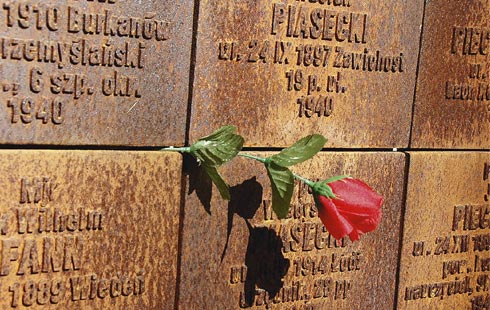
The officers who were shot in 1940 know the Poles by name, despite the fact that
that Soviet documents about Katyn are still considered secret
Photo of Pirogov Yuri/Photoexpress.ru