
Translated material
We beat our own
The Kremlin again believed that it could affect the outcome of the Ukrainian elections?
Enchanted egg. In Moscow and Kyiv, politicians, political scientists, journalists puzzle: why was the openly aggressive “open letter” of Russian President Dmitry Medvedev to Ukrainian President Viktor Yushchenko? The New Times studied versions of this emergency diplomatic incident 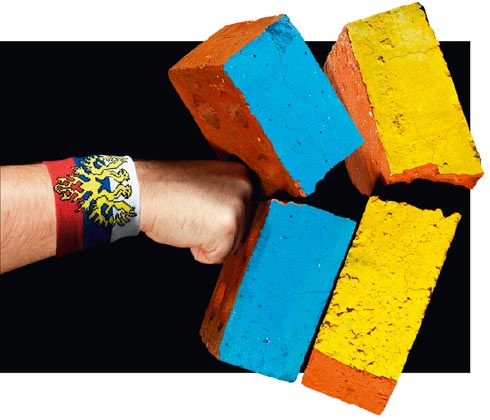
Out of the blue
The problems listed by Medvedev really exist. But recently it seemed that everything was developing as well as possible. Literally the day before the appearance of the video message, Ukraine carefully, on time, transferred to Russia the next monthly gas payment for gas. The Ukrainian Foreign Ministry gave Agreman to appoint Mikhail Zurabov the Russian ambassador, although some politicians in Kyiv were dissatisfied with this candidate.
Patriarch Cyril completed the triumphal ten -day trip around Ukraine. Literally on the very first day, President Yushchenko personally showed the proper honors and signs of respect. When the patriarch’s visit to Rivne was at risk of a breakdown, the Yushchenko secretariat hastened to make a statement that they did not see any obstacles to Cyril’s visit to this city in Western Ukraine surrounded by the president.
By the way, the day after the publication of the frank “collision” of Medvedev on Yushchenko, the Patriarch (a multi-hearted church diplomat, by the way) sent a message to the president and prime minister of Ukraine with gratitude for the assistance in holding a patriarchal visit. Together with the conciliatory “clarifications” of Foreign Minister Grigory Karasin and the presidential assistant for international affairs Sergei Prikhodko, this suggests that the professionals grabbed their heads after the Medvedev’s speech and tried to somehow soften the effect. After all, this really looked like, frankly, like a kitchen hysteria.
A disguised message, but why Medvedev, seemingly not inclined to public nervous reactions, began to “beat the dishes”? Maybe there was some kind of pragmatic goal after all?
Here are a few versions.
The first, perhaps the simplest, is that the “message to the Kievans” actually has an internal addressee. On the eve of a possible new round of economic crisis, an attempt is made to switch the attention of Russian citizens to a completely different topic.
The second version is conspiracy. Something that we do not know about, in the most important sphere of Russian-Ukrainian relations-gas. Perhaps the Ukrainian side managed to achieve some breakthrough in negotiations with the EU regarding billions of European loans for the reconstruction of the gas transmission system of Ukraine. For Russia, this is a sharp knife. But there is no information in support of this version.
The version is third, even more conspiracy, although not without reason. Medvedev actually plays along with Yushchenko in the struggle for re -election to the post of president of Ukraine. Yushchenko is the only candidate who is openly trying to build his election campaign around the confrontation between the genuine or imaginary threat to national independence and the sovereignty of Ukraine. Medvedev gave him a trump card. The head of the Ukrainian President’s Secretariat Vera Ulyanchenko hastened to say that Medvedev’s appeal “would once again remind Ukraine of the need for internal consolidation”.
But why play Yushchenko Medvedev? Supporters of this version say that no matter how hated by the Kremlin Yushchenko, he doesn’t care, paradoxically, the most profitable president for Moscow. He is unpopular, weak, conflict, he is a source of constant conflicts in the Ukrainian political elite, because of which the state machine cannot work normally. He managed to even spoil the relationship with the West. At the same time, it was possible to negotiate with Yushchenko: he surprisingly showed a willingness to provide a patronage of various kinds of dubious transactions like creating the notorious mediation company Rosucranergo in the field of gas trade between the two countries. Recall that the political opponents of Yushchenko call it the main source of corruption in the highest spheres. It is worth recalling something else: Rosukrenergo, which belonged to Gazprom, was created by 50%, when Dmitry Medvedev was still the chairman of the Board of Directors of the Gas Monopoly. The director of the company on the Russian side was one of the closest associates of Medvedev Konstantin Chuychenko, now the assistant to the president and the head of the Kremlin control department. Moreover, the recently influential Ukrainian newspaper Left Coast stated, referring to the unnamed eyewitness of Russian-Ukrainian negotiations on the settlement of a gas conflict in January 2009, that supposedly Dmitry Medvedev openly expressed discontent with the then decision of Vladimir Putin to abandon the intermediary services of Rosukranergo.
The above version has two obvious flaws: firstly, Yushchenko’s popularity fell so low that there were no chances for his re-election, according to most observers. Secondly, this version is too sophisticated. As experience shows, very often to analysts until the last moment it seems that the Kremlin plays complex political chess, and in the end it turns out that it clogs a primitive “goat”.
There is nowhere easier from here is the fourth version, which, perhaps, is the closest to reality precisely because of its external simplicity and uncomplication. The Kremlin again believed that he would be able to influence the outcome of the upcoming presidential elections, to bring the “pro -Russian candidate” to the post of president of Ukraine.
Putin's exact words that he said in the moment of insight are forgotten: there are no pro -Russian politicians in Ukraine, there are only pro -Ukrainian ones. To get involved in the new adventure of Russian leaders, most likely, the all kinds of Kremlin PR managers and political technologists who are eager to “master” multimillion -dollar pre -election budgets are once again convinced. It is enough to read the comments of the numerous "chicks of the Pavlovsky nest", which states that Medvedev’s message has already predetermined the agenda of the presidential election campaign in Ukraine.
It is characteristic that at first Viktor Yushchenko did not comment on the statement of the President of Russia. I just went on vacation. And only a few days later Dmitry Medvedev answered, admitting that he was disappointed with the “unfriendly character” of his message. “I can’t disagree that there are serious problems in relations between our countries, but it is surprising when the Russian president completely excludes responsibility for this from Russia,” said Yushchenko. It is even more interesting that on the same day Dmitry Medvedev signed a decree on the appointment of Mikhail Zurabov to the Russian Ambassador to Ukraine ...