
Translated material
Putin's outcome
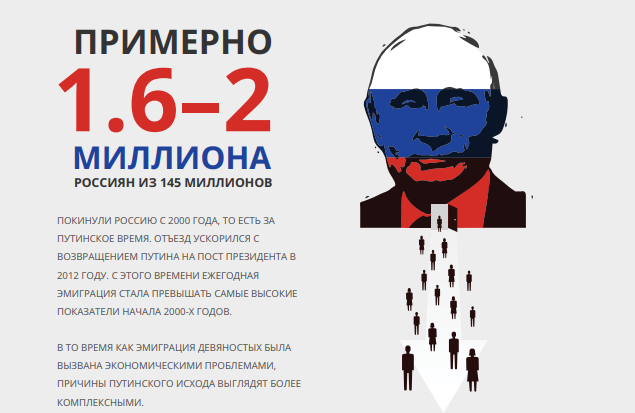
Up to 2 million people left for Vladimir Putin, after his “return” in 2012, the flow of emigrants intensified, and the share of those who left for political reasons doubled
Experts of the Analytical Center of Atlantic Council based on surveying 400 Russian emigrants who left no earlier than 2000 and now living in San Francisco, New York, London and Berlin, as well as pushing away from the results of work in focus groups, prepared the Putin's outcome: new brain leak Putin.
“Human capital leaves Russia. Since Vladimir Putin became president, from 1.6 to 2 million Russians moved to Western democratic countries and other places where they feel more freer and where their talents are the best use, ”the report said. Researchers note that this process accelerated with the return of Putin to the presidency in 2012, which was followed by the weakening of the economy and strengthening repression. At the same time, emigration began to acquire features of a politically determined brain leak.
In 2012, the Russians began to leave for Germany, USA, Canada, Spain with renewed vigor. Other countries have gained popularity: Estonia, Latvia, New Zealand, Mexico, Chile, etc. A new wave of emigration is characterized by increased education and enterprise compared to previous and with the population of Russia as a whole, researchers note. Speaking about the reasons for leaving Russia, participants in the Putin outcome call the growing corruption and deterioration of the political climate in the country.
Analysts especially note the two points: in 2017, the highest level of Russian appeals for political asylum for 24 years was reached in the United States, and in 2016, four times more were left to the far abroad countries than in 2011.
Who are they
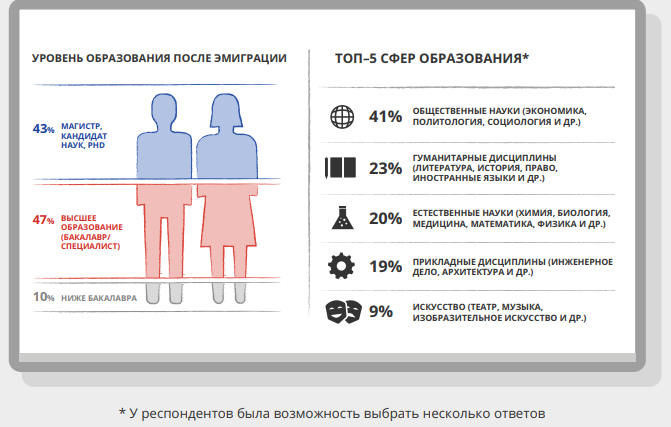
New emigrants are highly educated, and many of them have been educated in the field of social sciences (41%). Next are humanitarian disciplines (23%), then natural and applied sciences (20% and 19%, respectively), 9% studied in the field of art. Most respondents came to the west of the leading educational centers of Russia: 47% of Moscow and 18% of St. Petersburg.
Most of the respondents (58%) at the time of departure from Russia “earned enough to live comfortably in Russia”, and 72% were fully employed. 45% of the survey participants described their political views as liberal or very liberal.
“The focus groups performed perfectly document the ideas of informants about the“ Putin’s outcome ”as an emigration wave more political in nature than the previous ones. The survey gave high indicators of a critical attitude to the Putin regime, ”the authors of the study noted.
Despite the fact that almost half of the respondents emigrated until 2012, 68% are aware of the activities of Alexei Navalny, known about 2010 thanks to his anti -corruption activity and recently created the only All -Russian opposition network, the report said. Such an unsystematic opposition is approved by 72% of respondents, and only 12% did not hear anything about it.
Of the respondents, 69% opposed the Putin's “vertical of power” and 91% against the Kremlin control over the media; 86% believe that the Putin's leadership "takes care of their own interests." 65% believe that since the return of Putin in 2012, life in Russia has become worse; 81% believes that as the president, another person who can offer alternative solutions to Russian problems should be elected as the president; 69% reacted positively to the participation of Navalny’s presidential election.
Participants in the focus groups have repeatedly denoted Putin as a “thief” and “international criminal”, expressing concern that in certain social and political circles in the West they perceive him too positively.
Water distribution 2012
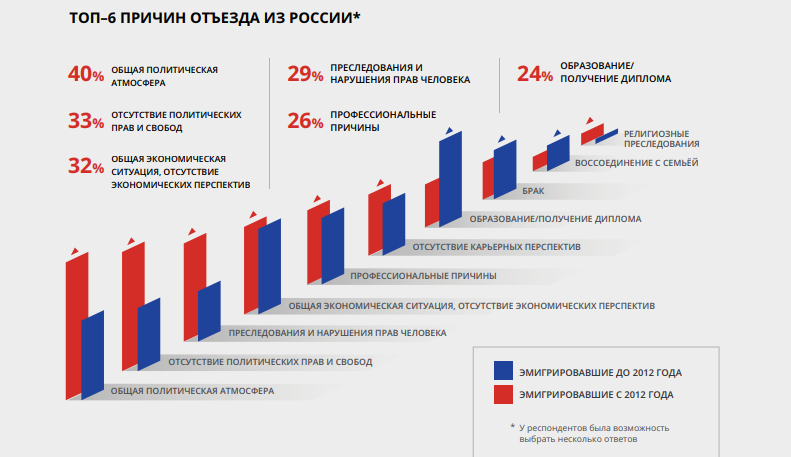
Researchers note the difference between those who left Russia until 2012 and after. Although the most mentioned causes of emigration for both groups are the “general political climate” and “lack of political rights and freedoms”, the frequency of their mention practically doubles among the second wave. “This should be considered as a clear sign of the politicization of new emigration after Putin’s post returned to the presidency in 2012,” the authors of the report say.
They note that obtaining education as the reason for departure fell from the first place for those who left until 2012, to the eighth for those who left after Putin’s return. “This clearly indicates that the growing concern with common political and economic problems overshadows personal career considerations,” analysts say, noting that in the group the “economically comfortable life” in Russia left after 2012.
Will they return?
The new Russian emigrants as a whole are very positively tuned to the maintenance of ties with Russia. They are concerned about her future. At the same time, because of Putin’s policy, 88% of respondents are currently not planning to return to Russia. Only 5% are ready to return if the economic situation in it improves, and the political will remain the same. Much more (13%) could return to Russia if, on the contrary, political system will improve, even if the economic one remains bad.