
Translated material
For a magnifier!
The election campaign in Moldova goes to the finish line
For a magnifier! The election campaign in Moldova enters the finish line: registration of parties and candidates-one-mandate has completed. On July 29, Moldovans will once again try to choose a parliament that can approve the new president. Whether the Communists will hold the authorities - found the New Times 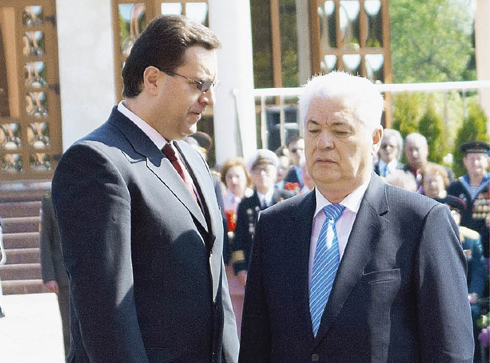
Who to be the next president of Moldova
The refusal of opposition deputies to support the candidacy of Prime Minister Zinaida Grechana, whom the Communists have experienced the presidency, returned Moldova to a state of election fever. * * Cadidate in the presidency should pick up 61 votes (out of 101) in parliament from no more than two attempts. In May and June, 3 opposition parties, represented by a 41 deputy, did not allow the Communists to approve their candidate, after which the parliament was dissolved, and early elections were announced in the country. Compared to the past elections held on April 5, the number of participants in the race was noticeably reduced. Then there were 21 competitor in the ballots, now - only 10 (8 parties and 2 single -mandate, participating in the elections along with parties, but the passing barrier is lower for them). The real chances of getting into parliament have 5 games. These are the Communists in power, led by ex-president Vladimir Voronin, who went into the opposition liberal and liberal-democratic (LDPM) party and the Alliance of our Moldova, and also did not overcome the 6 percent barrier of the Democratic Party into the parliament. Do not discount from accounts and democrats.
The failed coalition
Communists, who need to get 61 mandates in the future parliament, build a campaign to discredit oppositionists, accusing them of organizing riots in the center of Chisinau on April 7. Then, recall, the crowd burst into the building of the presidential administration, and then arranged a pogrom in parliament. The opposition, in turn, claims that the pogrom is a provocation of the Communists. Until the last moment, the opposition was discussing the possibility of nomination of a single list, which would include candidates from the liberal, liberal-democratic parties and “our Moldova”. But the opposition failed to agree on how this often happens in the post -Soviet space. In April, that is, three months ago, in total they gained about 35% of the vote, but this time the elections were scheduled for July 29. This is a weekday, and with a high probability of Moldovans working abroad, they will not be able to come to the plots in the embassies, and many residents of the capital will be away at this vacation time. It is these categories of citizens that form the basis of the opposition electorate. Conversely, the greatest activity in this period can be expected from rural residents who traditionally vote for the Communists.
Voronin’s associates and another reserve have: with their assistance, parties can go formally opposition, but in fact ready to cooperate with the Communists.
Increase in the magnifier
These are primarily the democrats (CDNP), who scored about 3%in April. Now their chances have grown significantly, since the barrier is reduced to 5%, in addition, the party leader Yuri Roshka received the post of Deputy Prime Minister, who oversees the power block. In 2005, it was the CDNP who entered into an alliance with the Communists, adding the necessary votes to them for the approval of Vladimir Voronin for a second term. Roshka does not disappear from the TV screen, and although he himself refused to run, his administrative resource may well help the party go to parliament.
Almost one hundred percent probability - and this is the main intrigue of the campaign - a democratic party will fall into the parliament, which also gained about 3%in April. The list of the Democratic Party is headed by one of the former leaders of the Communist Party-ex-speaker of parliament Marian Lupa. This popular politician went to the opposition, offended or pretending to be offended that the Communists, choosing a successor to Voronin, stopped their choice not on him, but at the premiere of Greek. At the same time, according to The New Times, the campaign of the head of the Democratic Party is financed by the well-known businessman Vlad Plahotyuk, friend and business partner of his son Vladimir Voronin-Oleg. From which local observers conclude: the position of the magnifier is not so radical, and it may well go for an agreement with former associates.
Who will lead?
Marian Lupa has already stated that his Democratic will in no case vote for a presidential candidate nominated by the Communists. This move can be explained exclusively by presidential ambitions of a magnifier. If the Communists with their long-standing allies of Christian democrats will gain a coveted 61 vote in total, then there will be no sense in negotiating with the former speaker. But if this does not happen, the alignment may be very curious.
“No one will hold on to the candidacy of Zinaida Grechanaya,” one of the communist functions told The New Times. “Marian Lupa may well become an alternative candidate who will suit us, the opposition, the Kremlin, and the European Union.” Doctor of Economics Lupa is really a politician for Europeans is more or less acceptable: in 1994 he studied at macroeconomics courses in Washington, in 1996-at international trade courses in Geneva, and from 1992 to 2000 he was the executive director of Tacis programs in Moldova. * * The program of the European Union to promote the development of economic, social reforms and democratic transformations. According to The New Times, in the case of his election, the posts of the speaker of the parliament and the chairman of the government will still remain with the de facto control of the country of the Communists. Formally, the change of power, which the youth, who published in the square after the April elections, achieved, with the reign of the pro-European-minded Marian Lupa, will happen, but in fact the status quo will be preserved.
Photo by Benemetsky Andrey