
Translated material
Thawed president
Does Dmitry Medvedev have an affair with democracy?
Presidential drops. The word "thaw" was replaced in a political vocabulary with the word "defrosting". This happened after President Dmitry Medvedev gave an interview with Novaya Gazeta, met with experts of the Institute of Modern Development, and then with members of the Human Rights Council. Will everything be limited to conversations or will come to real things - the New Times found out 
"Good idea"
The story began at the end of January, when President Medvedev at a meeting with Dmitry Muratov and the shareholder of the publication, the former President of the USSR Mikhail Gorbachev, promised that such a conversation would be held. This was shortly after the murder of the journalist of the "New" Anastasia Baburova and lawyer Stanislav Markelov. Before the G20 summit in London, the president confirmed his intention in an interview with the BBC. And the long -awaited interview finally took place. From it we learned that "there is a full -fledged political fight in Sochi." Dmitry Medvedev also spoke about the new process over Mikhail Khodorkovsky: “The predictability of a court decision, a court sentence for the president is illegal. This is a sign of violation of the law. And for all other free commentators, a personal matter. For civil servants and for the president, there is no predictability in any trial, including you mentioned, and should not be. ”
In an interview, the president once again emphasized that control over the Internet would not be introduced, he reacted quite favorably and Dmitry Muratov: “Good idea”.
The Pin-code for the president the next day, April 14, Dmitry Medvedev for the first time this year visited the Institute of Modern Development (Incor), whose chairman of the trusteeship of which he is. The president came to the meeting, accompanied by an impressive retinue: the heads of the Ministry of Economic Development of Elvira Nabiullina, Minister of Health and Social Development of Tatyana Golikova, economy assistant Arkady Dvorkovich and adviser Leonid Reiman. The institute was represented by 11 experts (see a certificate in the fields). The main topic of discussion was the situation in the labor market. Medvedev did not hide: he is concerned that the number of officially registered unemployed in Russia has already reached 2.2 million people, despite the fact that the government predicted such a figure only by the end of the year. The director of the Independent Institute of Social Policy Tatyana Maleva said that the practice of “hidden unemployment”, when people prefer not to dismiss, but pay meager salaries, is vicious: this only prolongs life ineffective enterprises and does not stimulate workers to look for other places for their forces or to retrain to new professions. Maleva believes that it is necessary to support highly qualified workers, but having low income: those 40%that sociologists attribute to potential recruits in the middle class. The main tools of such assistance are educational grants, long -term training loans, educational certificates that will allow those who want to undergo professional retraining in employment centers.
IMEMO Director of the Russian Academy of Sciences Alexander Dyankin spoke about the European experience of combating unemployment, in particular, how the Spanish authorities acted in the early 90s, where 20% of the able-bodied population had no work. Inzor, a member of the Board of Incras, in his speech, said that the country cannot do without social modernization and restructuring of the current archaic structure of the labor market. And for this it is necessary to carry out reforms of education, healthcare and pension provision .²
Natalya Zubarevich, the head of the regional program of the Independent Institute of Social Policy, spoke about the situation in the single -industry towns, including those where the city -forming enterprises died or are at death. One of the proposals: the state will be an intermediary who will look for vacancies in other regions of the country and, possibly, even compensate for travel to new places of work for those who are ready to move to the shift method: live where they live and go to work where there is work. It is curious that all the speakers have prepared presentations, but Medvedev preferred paper printouts to the screen. In the course of the speeches, the president actively commented on them, and when critical comments were made to the Ministry of Health and Social Development (in particular, regarding the reliability of unemployment data in the regions that the Ministry of weekly laid out on his website), asked the head of the department Tatyana Golikova substantially to answer each of them. The practical result of the meeting: we agreed that Incor will cooperate with the Ministry of Health and Social Development on an ongoing basis, regularly directing his proposals not only in the labor market, but also on pension reform and medical insurance reform.
After listening to the experts and promising to take into account their considerations, Dmitry Medvedev moved to a nearby Italian restaurant L'Albero. 4 According to The New Times, he was compiled by Leonid Reiman, Arkady Dvorkovich, Tatyana Golikova and Igor Yurgens. They say that during lunch, the head of Incor discussed with the president the possibility that the institute on a permanent basis would inform him of the socio-economic situation in the regions. For this, it is proposed to use a unique computer program that allows you to analyze the situation of almost 5 thousand indicators. They say that the president received a Pin code from the hands of Reiman, which allows you to use this program.
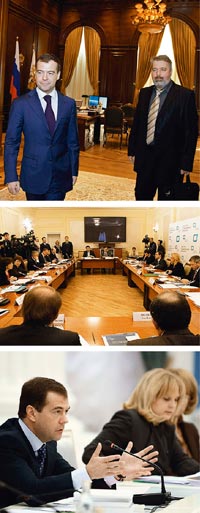
Bakhmin in the Kremlin by the “defrosting” of relations between the authorities and society can also be considered a meeting of Medvedev with members of the Council for Human Rights and the Development of Civil Society. On April 15, an action took place in the Kremlin, which was hardly possible during the reign of Vladimir Putin. Irina Yasina, the head of the club of regional journalism, and in the past - the head of the Open Russia Foundation, then financed by Yukos Mikhail Khodorkovsky, spoke of Natalia Moral, which is not allowed into the country. Journalist Svetlana Sorokina - about the case of Svetlana Bakhmina. Alexander Auzan criticized the course held by the authorities from 2004 to 2008, the formula of which is loyalty in exchange for economic benefits. “During this period, the period of the conjunctural economic rise - such relations were acceptable for the state,” said Auzan. “For civil society (a significant part of it), such a strategy was unacceptable.”
Most speakers talked about the problems that the Kremlin did not want to hear about a couple of years ago. Human rights activist Lyudmila Alekseeva complained about riot police on the dispersal of peaceful shares of protest, head of the Russian Center of Transparency International, Elena Panfilova - about a rampant of corruption, former judge of the constitutional court Tamara Morshchakova - on the imperfection of the judicial system, a member of the Union of Committee of Soldiers' Mothers Ida Kuklin - about problems Army, president of the publicity protection fund Alexei Simonov - about attacks on journalists, in particular, about recent incidents, when the leaders of the Solidarity movement Lev Ponomarev and Stanislav Yakovlev were beaten.
After each speech, the president, as during a meeting with the editor of Novaya Gazeta, said: “Thank you”, “I see” - and added: “Who would like to continue?” And at the end of the meeting: “I was interested, I have not talked with you for a long time, although we have known a significant part, and when I worked as the head of the administration, we had our own history of communication. In conclusion, I would like to tell you once again that we will definitely continue this kind of meeting and, perhaps, not even in the format once or twice a year, but more often, because there are too many problems. ” And, according to the sources, he ordered the Kremlin (kremlin.ru) to be posted to the Kremlin’s website, including part of a part closed from the Kremlin pool from the Kremlin pool.
The Week Week ended on April 17, when, at a meeting with the leaders of United Russia, the First Deputy Head of the Presidential Administration Vladislav Surkov informed party leaders that the opposition needed to conduct a discussion.
Words without deeds participants in meetings with Medvedev in different ways evaluate their results, but converge in one thing: the president is configured to dialogue with society, but the case has not yet been going on further than the dialogue. All words about “good ideas” remain words. Some associate this with the fact that Medvedev still does not control the situation in the country, and primarily security forces. Therefore, he is trying to enlist the support of independent media, intellectuals, small and medium -sized businesses. Others - develop the theory of two police officers. Allegedly, during a meeting with Nicolas Sarkozy, Vladimir Putin said: "I am a bad policeman, and Medvedev is kind." On the eve of the G20 summit, Dmitry Medvedev was asked to comment on the premiere’s words, but he joked: “I think we are both good police officers.”
Finally, there is a version that all this is not liberalization, but the usual cover operation, the purpose of which is: to show that the regime is changing for the better. This is done to improve relations with the West, which Russia seems to still have to ask for new loans. Obviously, the seriousness of the intentions of the head of state can be confirmed only by real steps. At one time, such a step was taken by the general secretary of the CPSU Central Committee Mikhail Gorbachev, who ordered to return from exile to Gorky (now Nizhny Novgorod) the main enemy of the Soviet regime, academician Andrei Sakharov. It was a signal to the country and the world: a thaw began in the USSR. President Dmitry Medvedev has not yet given such a signal.
... And to the question of how the head of state has changed over the past year, one of the present at the current meetings replied: "Previously, the president snapped a foot under the table, now he stopped."
1 term, launched by president of the Institute of National Project Alexander Auzan.
2 Evgeny Gontmamer wrote about this in The New Times in No. 8 of March 2, 2009.
3 of her article on this subject, The New Times published in No. 12 of 30mart 2009.
4 The price of a business lunch of 4 dishes is 1200 rubles.
Who was present at a meeting with the president in Incor: Igor Jurgens, chairman of the board of the Institute of Modern Development;
Andrei Blokhin, adviser to the Deputy Chairman of the Government of the Russian Federation, chief researcher at the Institute of People's Economic Forecasting of the Russian Academy of Sciences;
Alexander Budberg, Member of the Board of Incor, political observer "MK";
Vladimir Gimpelson, director of the Center for Labor Studies of the State University;
Evgeny Gontmamer, scientific director of the Center for Social Research and Innovation;
Alexander Pyunkin, director of the Institute of World Economics and International Relations of the Russian Academy of Sciences, member of the Board of Trustees of Incor;
Tatyana Maleva, director of the Independent Institute of Social Policy;
Vladimir Mau, rector of the Academy of National Economy under the Government of the Russian Federation;
Natalya Zubarevich, head of the regional program of an independent institution of social policy;
Lilia Ovcharova, Deputy Director of the Independent Institute of Social Policy;
Alexander Oslon, President of the Public Opinion Foundation.