
Translated material
Tuva: Soviet curse
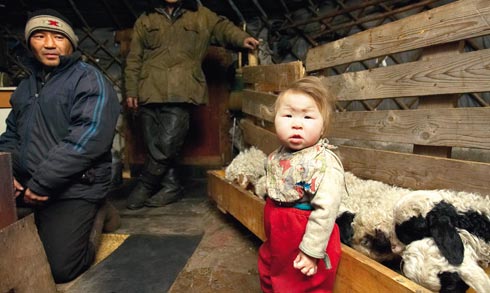
Two emergencies in a row shocked Tuva, a small republic in the south of Siberia. First, the drunken employee of the UBEP shot his colleagues and committed suicide. Two days later, the second misfortune happened - the traffic police officer opened fire on schoolchildren. The political and social landscape of the republic studied The New Times
Cases of the unlawful use of weapons by the police became almost a routine, but the execution of the drunken Ubepets of his own comrades in unknown logic attracted the attention of President Medvedev, and he demanded from Minister Nurgaliev to figure it out. The first thing was the head of the Tuva Ministry of Internal Affairs Viktor Lesnyak from his post. It is clear that it was required to report to the president - this measure has no other meaning to the thorough analysis of the incident.
But further more: in a day, on October 25, at the village of Kyzyl-Mazhalyk, an employee of the Tuvan traffic police shot at the young man at the wheel-it seemed to him that the boy pulled out a jacket “something reminiscent of a gun” from his jacket pocket. The eleventh grader died in the hospital from a through wound to the neck. The girl who was traveling with him in the car miraculously remained alive. On October 29, the Tuva Ministry of Internal Affairs stated that the traffic cop acted within the framework of his authority, after which the shooter was released home for a recognizance not to leave.
The Moscow Commission of the Ministry of Internal Affairs will now understand the professionalism of the Tuvan police. Tuva prosecutor Pavel Bukhtoyarov publicly admitted that last year the number of serious crimes increased sharply here. The most profitable types of “business” in the republic are drug trafficking and cattlecock. The Tuva Ministry of Internal Affairs holds the action "The whole world to fight the Kaigals!" - So they call cattle, but everyone in the republic knows that police often cover this traditional lesson. On the only road connecting Tuva with the outside world, there is a special checkpoint, where the cars are inspected, but the carriers are not afraid: according to eyewitnesses, the cars are not inspected too carefully. Tons of Anashi, which are sometimes confiscated, is an inevitable tribute to anti -drug campaigns initiated from the center. Behind the drug trafficking are influential local clans, on which the well -being of law enforcement officers also depends.
Clan policy
In Tuvan society, clan, feudal, Soviet-chin and criminal traditions were bizarrely intertwined. In the political life of the republic, only in recent months a relative lull has come-after the confrontation between the head of government Sholban Kara-ool and the speaker of parliament Vasily Oyun ended in May. The latter lost. Tuvan politics is the struggle of clans. For 15 years, Tuova ruled the Oorzhaki undividedly, then Moscow replaced them with the Alliance of Ondarov, Mongushe, Oyunes and Kara-Oolov. The Oyuns tried to push competitors, but the most famous Tuvinets, the “gray cardinal” of the republic, Sergei Shoigu, intervened. The alliance resisted. But the lull is deceptive: the growth of unemployment and poverty embitters the population, and this is fraught with both the collapse of the alliance and the “riot” of the clans pushed from power. Moreover, the dominant families of the families are not so hot. The Kara-Ool brothers fell into unpleasant stories: they arrested one for the transportation of drugs, the second-for a drunken fight. The prime minister himself is accused of misunderstanding state reasons.
Soviet curse
Tuva has just celebrated the 65th anniversary of joining the USSR. The independent Tuvan People’s Republic (TNR), formed with the help of the Bolsheviks after the Civil War in Russia, did not last long. In 1943, hunger, hundreds of families erupted in Tuva, including those whose feeders volunteered to the Soviet-German front died. Local authorities turned to Moscow with a request to accept Tuva in the Union - it was an attempt to save the people from death. On October 13, 1944, the TNR became part of the USSR, having received the status of only an autonomous region. And then - already mass mobilization for the front. And hunger, rampant until 1947.
The leadership of the TNR reasoned: the USSR is a great and developed country, having joined it, the Tuvans will get the opportunity to develop economics and culture. But Tuva was not very needed by the Soviet Union. The Soviet government built schools and hospitals, but autonomy was financed on a residual principle. Attendants worked at large enterprises, the illiterate Tuvans were taken there only with black -sided. Social stratification has actually occurred on a national basis. It is not surprising that in the 90s, interethnic clashes began. The Tuvakobalt plant was closed and looted; The remaining large enterprises of Tuvaasbest and Tuvaenergo work on maximum worn equipment. The carbon incision "KAA-Khem" breathes slightly. Most of the republic’s enterprises are unprofitable: the cost of cargo delivery is too high.
Now the federal government has adopted an ambitious plan for the economic development of Tuva. The railway should finally stretch there, Tuvinsky coal and copper ore will go to world markets. The Tuvans are waiting for this, but they doubt the realism of plans. And the point is not only in the crisis that devastates the budget. The Soviet curse seems to gravitate over the Tuvans.
After joining the USSR in Tuva, a traditional way of life was destroyed, but the new one was never created. Little Tuvans, sent to boarding schools, did not receive professional knowledge and skills. But with other “fruits of civilization”, children from the Ool - Tuvan settlements - met in full: with moonshine, anashoy and stabbing.
Mass alcoholism and drug addiction are the two largest social troubles of the indigenous population. A wild hemp occupies vast territories in Tuva, it has become a leading agricultural culture and for many to earn almost the only way. Crime in the republic is twice as high as the average Russian indicators, unemployment exceeds 17%. There is nothing to do in settlements. Revenues - 8313 rubles. per person - half as lower than the average in Russia. In oolars, tuberculosis, hepatitis and sexually transmitted diseases are rampant. Another scourge is suicide. According to WHO position, a critical level of suicide frequency is 20 people per 100 thousand people. In Russia, this frequency is approximately 36 people. In Tuva - 56! So Tuva’s economic development projects are faced with a problem: who will build new enterprises, who will work for them? Illiterate, untrained people?
At the same time, in cities the situation is not so hopeless. In Kyzyl, the Tuvans work, study, interest in education is growing. There are almost a quarter in Krasnoyarsk universities of the young Tuvans, there are a lot of them at the University of Ulan Bator. These young Tuvans-non-one, perfectly speaking Russian, studying foreign languages, computers, etc.-when and if they return to Tuva, they may try to change the local lifestyle. But so far it is too far a prospect.
The Tuvan People’s Republic arose on the territory of the former protectorate of the Russian Empire (Uryanhai Territory) in 1921. Mongolia claimed the territory of the young state, border disputes were not resolved even after the diplomatic recognition of the TNR of the Mongol People's Republic. Perhaps this was one of the reasons why Tuva was accepted into the USSR. In addition, in 1944, Stalin was inclined to transfer to Mongolia to China after the war, and Ulan-Bator still considered Tuva to be his rebellious province. The "father of the peoples" did not want to give Tuva to China.