
Translated material
Together against evil
Everyone who at least once shot in this war at the Nazis has made his invaluable, human contribution to the victory (this material was first released in the special issue of the Allies in 2017)
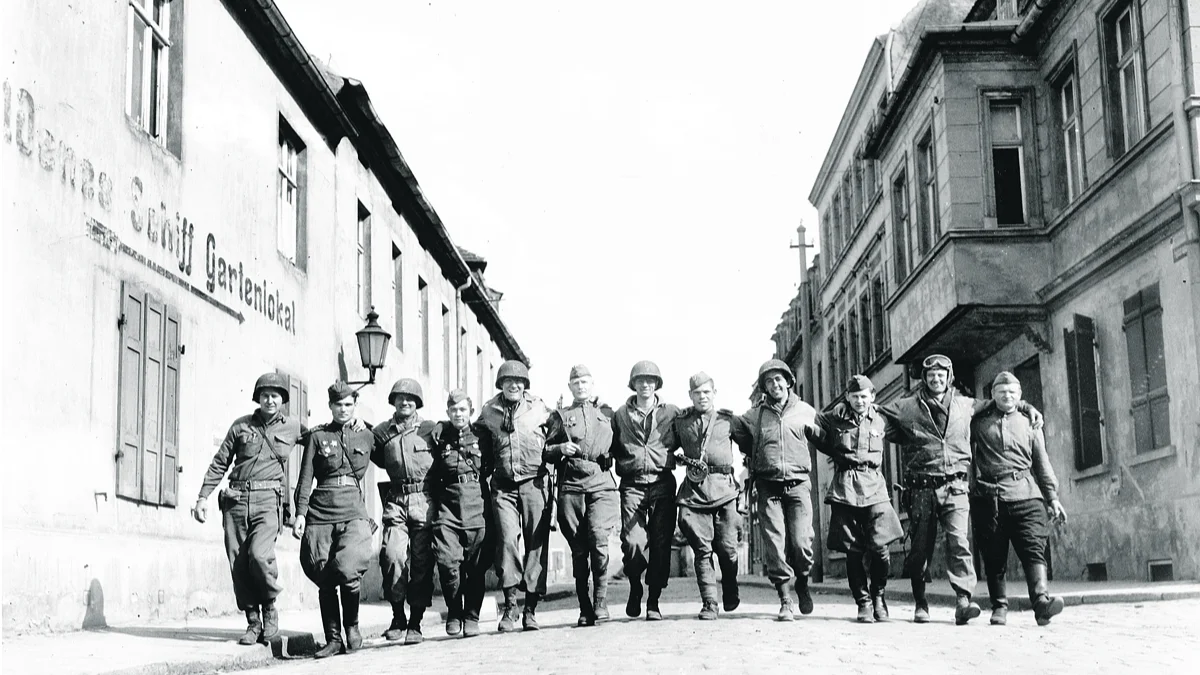
After meeting on Elbe. Soldiers of the 58th Guards Rifle Division and the American 69th Infantry Division. TORGAU, 04/26/1945. Photo: Bildarchive
This material was published in No. 47–48 (2624–2625) of May 6, 2017. We published it in an anniversary issue. You can buy it here
We talked many times about what the Red Army was accomplished in the struggle against fascism, talked about its infantrymen and pilots, about its famous and nameless heroes. But now it's time to talk about the allies who fought with fascism on land, in the air and at sea. The time has come to tell about the English pilots who bombed Germany, about America’s entry into war and American supplies on Lend-Lease, about landing in Normandy, about the war in Asia.
The time has come to talk about Britain, who had been standing against fascism alone for a whole year, and about America, which invested all its industrial power and the life of the Texas and Vermontian guys in the struggle against evil, - the time has come because the anti -Western propaganda hysteria in our country reached a higher degree and captured many brains and souls.
The propagandists in the maintenance are accused of the West for poorly helping the USSR, did not act like that, or did it. They are trying to belittle our allies, claiming that the technique that they supplied to the Red Army was rubbish, and Lend-Lease did not help.
They dismissively talk about the war of the British and Americans in Europe, Asia and Africa: "We would have won without them!"
This is a lie. Standing above the shoulder of a hungry, wet through the Red Army, they spit in his jar with an American stew, which he eats in the trench: “Think, stew!” Never from those who fought did not say badly about the stew, nor about the American “Stodebekkers”, or about “Dodge three quarters”, which was a non-cut 76 mm guns, nor about the fighters of the “AeroCobra”, on which the aces of the Red Army Pokryshkin and Rechkalov flew.
Slims and madness overwhelm the brains. Having tied up with black and yellow ribbons, they consider themselves the heirs of victory, but do not understand that each generation has its own and special battle with evil. Those we are proud of, won their battle. Our evil is next to us. It is today. It is different.
"We can repeat!" - Cars with such stickers rush along our streets, and at the wheel they have those who do not know what they say. Repeat what? Hunger in Leningrad? Unpassed soldiers in the Tver swamps? Four offenses on Rzhev, in the streams around which the water was red from the blood that was saturated with the earth? Repeat the burned villages, from which there were skeletons of furnaces, children with people transparent from hunger, refugees, in the summer shoes of those who left Minsk and went to Ufa so? In all this drum fighting, gleeing flags, pouting the cheeks, exaltation of themselves, the horror of the war disappears.
They boast of victims, boast of spilled blood, reproach others that they shed less, bewitched by exploits that they did not perform, disarm the children in military uniforms and build a funny Reichstag to play what you can’t play.
This is not a memory, this is vulgarity.
The war went around the world, and therefore is called the world. The war went on the vast spaces of the globe, in the fields near Moscow and in the jungle of Burma, in the sky above the La-Channel and in the open spaces of the Atlantic, in the sands of Libya and in the snow of Norway. Everyone who at least once shot in this war at the Nazis, everyone who spent at least one day in the trench (and was killed on the second) or at least once climbed into the cabin of a bomber flying to bomb the enemy, made his unique, invaluable, human contribution to the victory. Everyone introduced it, Russians, Belarusians, Ukrainians and one hundred peoples of the USSR, whom I can’t list here, the British, Americans, the rebels of the Warsaw ghetto, the Poles from the Kraiova Army and the Army of Anders, the Czech saboteurs Gabchik and Kubish, who exploded Heydrich, the French historian Mark Blok, who participated in resistance and the hasty Gestapo. An unthinkable list of millions of names and surnames, many of which remained on grave slabs, and many have not been preserved, disappeared in the darkness of time.
From there, from the other side, watching our lives with dumb eyes, they are not waiting for Swara with the allies, not spitting in a jar of American stew, not cynical propaganda, when the victims and torment of war become a stand for the authorities, but understanding, knowledge, unforgetting, respect.
We must know that there were not only the defense of Moscow, but also the defense of London, not only the feat of Soviet teenagers who rushed to the machines, but also the feat of American women who stood near conveyors, not only Stalingrad, but also El Alamine, not only the Kursk arc, but also Montekassino, where the Americans, the British, the Poles, New Zealanders, the Indians fought.
And we must know that our grandfathers fought not alone. Together with the Belarusian partisans, albeit separated from them, hundreds of kilometers, fought the legendary Nepalic Gurks, known for their fearlessness and that they never retreated.
And together with Kokryshkin and Kozhedub, who was flying in the sky of Kursk and Kuban, fought by the Argentinean double-voltage Kenneth Charny, who was flying over Malta during a huge, occupied two years of battle for the island.
Almost no one knows about this battle. We know about the northern convoys, but we do not know about the Maltese, in one of which there was an American Tanker Ohio with gasoline. He was set on fire from the air, right on his deck exploded a wound bomber Yu -87. But the team did not leave the burning ship, and the destroyers did not leave it. They brought a tanker to Malta.
Kenneth Charni shot down 17 German aircraft. In the USSR, for this he would be awarded the title of a hero.