
Translated material
Nebinaric sport

Journalist Farid Bektemirov - about why and how sport should abandon gender separation
The ideas about gender division in modern sports are rapidly changing. Last week, the International Swimming Federation said that the transperson who made the transition after 12 years from women's competitions will completely exclude it, but will create a separate category for them, becoming the first international federation conducting competitions among transgender people. Meanwhile, inside FIFA, according to journalists, there are debates to allow transperson to women's football tournaments. Farid Bektemirov explains why these decisions will not correct the situation as a whole and why a real problem is not the participation of a transperson in competitions, but an outdated division of sports into female and male.
"Unjust advantage"
The attitude to transpersons in sports is a rare question where in Russia unanimouses are manifested by conservatives and liberals, loyalists and opposition, right and even many left.
With the inflame of panic on this subject, for obvious reasons, state propaganda is especially zealous. She sees here an easy way to demonstrate the dichotomy of Russia and the West even more brightly, to emphasize the radical, unshakable difference between our "traditional values and scrapings" and their "obscurantism, decomposition and erasing of the foundations."
The participation of New Zealand Lorel Hubbard, the first open transgress at the Olympic Games, in the weightlift tournament in Tokyo caused a violent reaction in the pro -government media, even though the athlete performed unsuccessfully. The spectacular image of the bar was impressed even by Russian President Vladimir Putin, who a few months after the games at the annual press conference expressed his indignation to what he saw, recalling that he himself "adheres to the traditional approach that a woman is a woman, and a man is a man."
The head of the Russian state almost literally repeated the rhetoric of another famous defender of women-ex-president of US Donald Trump. He in February 2021 stated that "girls and women feel that they are forced to compete with biological men, and this is bad for women's sports."
However, criticism addressed to Khabbard was only the next stage of the transfer rhetoric of conservative and right -handed figures around the world. Almost any achievement of transgresses in sports, regardless of how insignificant and short -term it was, caused many speakers and statements about how "transgender people kill female sport." Upon closer examination of each of these cases, of course, it turned out that nothing like this was happening.
The Canadian cyclist Veronika Ivy (previously known as Rachel McKinon) really won the world championships in an amateur (!) Veteran (from 35 years old), but was much more likely to inferior to its main CIS-rival. The American Fallon Fox won five battles in MMA (in second -rate competitions), but managed to lose to the Tsiszhen region once, with a technical knockout. The Australian Hannah Mowsi, despite her truly impressive dimensions, did not get into the national team in Gandbola in large tournaments, and in Australian football it achieved success only in regional competitions.
Neither the dominance of transperson, nor about the end of women's sport, we are talking now and close. Any statements about this are primarily propaganda and moral panic . Since 2004, transperson is allowed to participate in the Olympic Games, but in almost 20 years only one transgress, the already mentioned Lorel Hubbard-managed to take part in the Olympic competitions (another-Chelsea Wolf was allowed to play the BMX-FRISTILA, but remained in the reserve). And even she, perhaps, is the most successful transature in history at the moment (on her account silver of the World Cup), did not affect the distribution of prizes in the games.
The question of a possible “unfair advantage” of transperson in women's sports is extremely complex and ambiguous, and that is why it requires not panic, but a calm and thoughtful discussion. Yes, the average person who has passed the conditionally “male” puberty will have more durable bones, a larger volume of lungs and heart, longer limbs and, accordingly, a more impressive muscles than the conventionally “feminine”. That's just the keyword here is average. This fact does not at all mean that specific transgresses will certainly dominate all the cisengans in one form or another of the sport.
For example, hormone therapy, which is most often undergoing transgresses and which was mandatory for them by the rules of the International Olympic Committee (IOC) until November 2021, leads to very radical changes in the body, in particular, the loss of muscle mass and a set of fat, which itself hardly positively affects sports results. In particular, this work of French scientists allows us to understand how great the testosterone is in the results of women's competitions.
The studies of transgender scientist and runner Joanna Harper, who demonstrate that transgressers, a year after hormonal therapy, can compete with cisznes without a noticeable advantage, for example, in running or cycling. The Dutch researchers Louis Guren and Matiys Bank also come to similar conclusions, which, however, clarify that the trans-sportsmen, even after a year of therapy, has a significant muscle mass.
There are studies showing a more complex picture and notes that an approximate equality in the results cannot be achieved in such a short time. But we must not forget that all scientific papers have their own restrictions, and this topic is clearly not investigated. Something similar to scientific consensus exists only on the question of whether it is necessary in principle to exclude transgresses from the competition: here science speaks a solid and unquestioning “no”.
Someone, of course, will notice that the new recommendations of the IOC , which canceled the mandatory hormonal therapy for transgresses in big sports, can radically change the situation. However, even in a statement by medical specialists who criticized the new position of the IOC, which many media , including in Russia , were submitted as crying to destroy women's sports, in fact there was a much more balanced position.
The IOC was criticized that this difficult issue was given to the excess of international federations that have no resources and knowledge to make fair decisions. Moreover, scientists are afraid of both extremes - not only the possible inclusion of transperson in women's competitions based on self -identification alone, but also that transgresses will be completely banned from participating in women's competitions (which, by the way, is a much more likely scenario, which has already been realized in cycling , rugby , and now swimming ). You must admit that this position is strikingly different from the opinions of various right -wing forces in Russia and in the West, requiring once and for all to expel transperson from women's sports.
However, even if we accept the argument about the “unfair advantage”, which is called, for a pure coin, deeper philosophical issues arise. Why do we pay so much attention to the alleged gender advantages, while completely ignoring any other advantages of athletes as genetic (for example, a disproportionate huge scale of their hands and a special bend of the ankles of Michael Felps), and social (access to better equipment, nutrition, medical support, and many Russians or, say, Vietnamese could be excellent Formula-1 riders, but most of them will never even see a car)? Sport has never been about “absolute justice”, why is it precisely to the gender aspect that we are so jealous? Why, in the end, do we still divide sport exclusively into male and female?
Why male sport is more popular than female
The answer “We care about the rights of women” does not look too believable. Yes, a clear gender separation of sports allows women to participate in tournaments and win, but at the same time holds them within a certain framework, preventing female sports from developing outside their “corral”. In the vast majority of sports, women earn less men (rare exceptions - tennis, figure skating, rhythmic gymnastics). There are fewer money in women's sports, less popularity, less attention of the media and fewer opportunities for growth. Moreover, the higher the level, the stronger the separation (the Brazilian football player Neymar earns tens of millions of dollars, his compatriot and the Martha football star can only dream of such contracts).
The TOP-10 athletes in 2021 earned in the amount of 166.6 million dollars, and the top 10 athletes-991.6 million 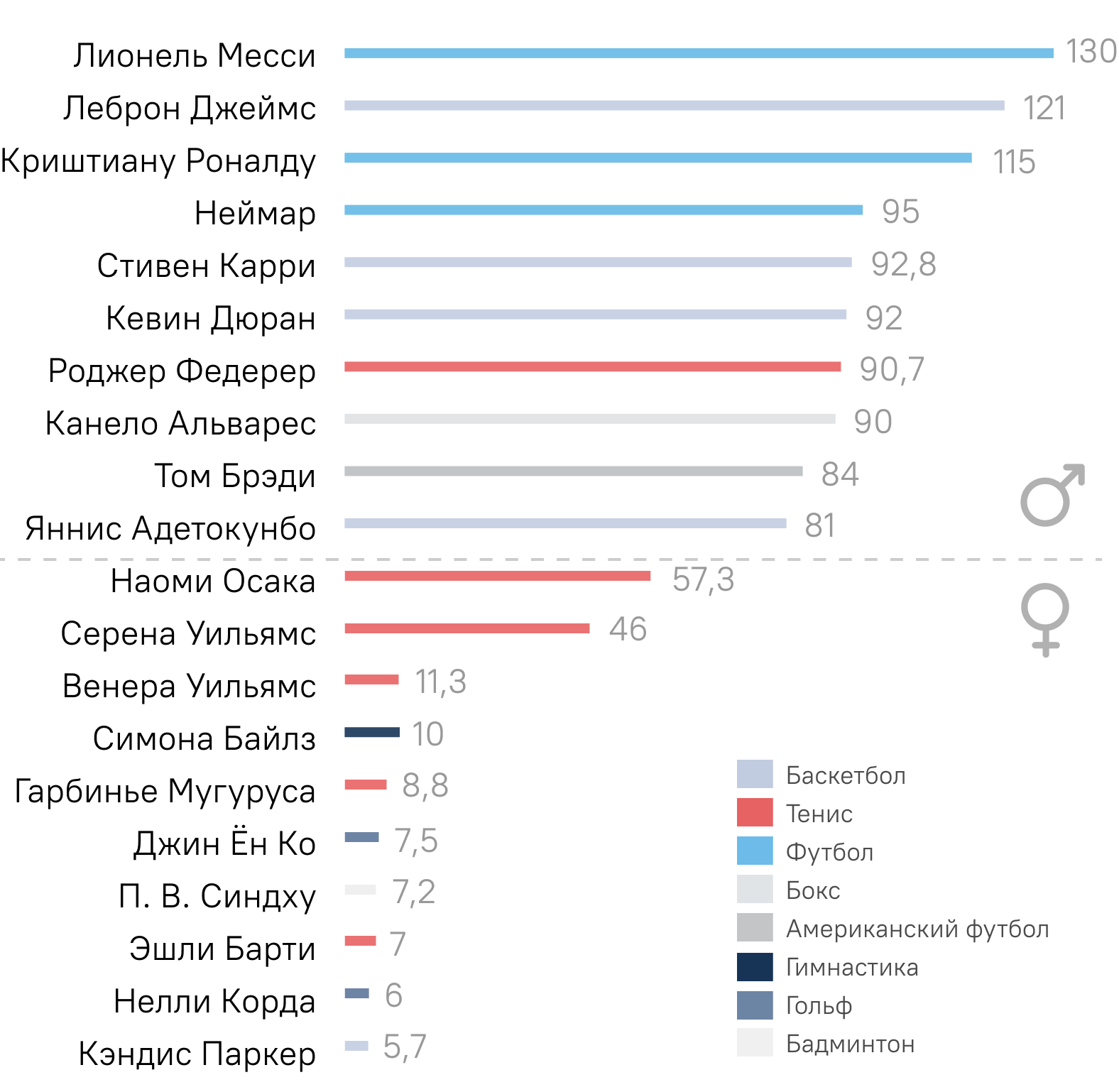
Sources: Statista, Forbes
You can try to explain these differences in the “natural” causes and invisible hand of the market - they say, the level of female sports (say, the same football) is corny lower than male, therefore it is not so popular. However, in this logic there are noticeable gaps. Firstly, if the audience and sponsors paid attention only to top athletes in their forms, in boxing or MMA there would simply not be weight categories. No one doubts that Khabib Nurmagomedov or Floyd Mayuer will lose almost any heavyweight without a chance, but this does not prevent them from being among the most popular and successful athletes in the world.
It is much more logical to recall that the gender separation of sports initially proceeded from patriarchal considerations and was formed in times far from equality. Baron Pierre de Cuberten, the same “father of the Olympic Games”, was generally against the participation of women in the Olympiads, believing that the only worthy role for them would be a rewarding of male participants. And although women's sport (in particular, tennis and golf) appeared at the games more than a hundred years ago, women had to take every new discipline with battle. For example, they were able to participate in basketball competitions only in 1976 (men participated since 1936), in a hockey tournament-in 1998 (men-since 1920), and in ski jumping-even in 2014 (men-olimpians in this form were ahead of women from the 1924th, performing since the 1924th).
Just imagine that the Beijing Olympics held in February was the most genderly balanced in history, however, in it women made up only 45% of all participants and played five sets of medals less than men (46 versus 51). All other games were even more gender asymmetric.
In men-sportsmen, a huge handicap was and remains in the development and attracting attention to a particular sport. This is especially noticeable on the example of chess, where the physical data of the participants are less important than in most other species, but women rarely get to the level of top-line male grandmasters (although there are examples-it is enough to recall the Hungarian chess player Judit Polgar). However, girls are historically given to the chess sections much less often than boys, and no institutions take measures to correct this position, therefore, a sample from which new Judit Polugar may appear, significantly less sample from which the Magnus of Karlsena and Vichy Ananda appear.
In addition, this initial handicap becomes in a sense of a self -filled prophecy. Initially, the great popularity of male sports gives him the most to the further growth of popularity. The study of how female and male sports is illuminated on television Professor Cheryl Kuki notes that the perception of how interesting women's sport is, including directly from the media: “Male sport is naturally more interesting, since he has the best production, the best lighting, the best commentators. When you are watching the broadcast of women's competitions, fewer cameras are involved in them, less installation, less instant repetitions, so, yes, they may seem more slow and less exciting. ”
Simply put, female sport (in most species) is less popular not because it is worse, but because it is female. So, marginalized.
Another scientist, a specialist in the fields of physiology and dietetics, Staisi Sims emphasizes that sports science is built around men. According to her , the main studies that make possible nutrition and effective training are carried out on men and for men, while the female body is considered an “anomaly” and its features are often not taken into account ( in the context of physiology the terms “female” and “male” in the text are used conditionally. “Female” implies the body with vagina and ovaries (although this can be, for example,, for example,, for example, the body. Transmukes), "male" - with a penis and testicles - approx .
Also, in many sports, distances for women are made shorter than for men, without any clear reasons, except for the desire to emphasize the inferiority of women's sports. Say, in skating sports at games, the maximum distance in women is 5000 meters, and in men-10,000, in ski jumps, women jump from a 90-meter hill with a springboard, and men from a 120-meter, individual race in the biathlon of men flee 20 km, and women-15 km, and so on.
“There are no scientific reasons why women cannot fight at the same distances as men,” says the nutritionist and lecturer of the Chinese University in Hong Kong John O'railly. “These distances are not based on data on physiology or scientific knowledge about the lack of any abilities in women.” In his opinion, there is no reason to believe that women, despite the average lesser mass, are not able to run 10,000 meters or jump from a higher springboard.
It is also worth adding that attempts to protect women's sport from transperson are also hit by cisennes - in any case, according to those who do not fit into the usual ideas about femininity. Among the most egregious examples are the South African athlete Caster Semyon , a two-time Olympic champion, which was actually expelled from sports at the peak of a career, finding one of the Intersex-options in her.
Once again: an athlete, who was defined as a woman who had lived as a woman and identifying herself as a woman, was expelled from female competitions based on her genetic advantages, while the genetic advantages of Michael Felps never bored anyone. Even in the decision of the sports arbitration court (CAS), the removal of the seed was recognized as discrimination, however, softening the sharp wording with the words about the “necessity and rationality” of this discrimination.
Finally, like many other manifestations of Patriarchate, the existing binary division also harms men too. Firstly, supporting traditional , often very toxic ideas about masculinity as something related to aggression, violence and conflict. Secondly, not allowing men to make successful careers in traditionally “female” sports like rhythmic gymnastics and synchronous swimming (there are still no male disciplines in both sports at the Olympiads).
How to make sport non -bureau
If there is no binary division, discriminate against women's sport as an institution will no longer work - women, men and non -warn people will participate in all categories, simply with different representations.
Moreover, a more inclusive approach to the separation of sports competitions is possible now. Scientists offer at least two methods on how to make sport non -bureau and not requiring division precisely according to the gender.
The first is the formation of new, more complex categories, including a number of physiological criteria. A group of researchers from the University of Otago in New Zealand proposes to include growth, weight, maximum oxygen consumption, past and real testosterone levels, the presence of testicles, transgender transgender time relative to puberty, as well as characteristics that do not change with hormonal drugs: bone strength and bone structure, lung volume and heart size.
Based on these data, the algorithm should group athletes into classes for competitions. For different sports, various variations can be used, but in the end, for example, on a hundred -meter can you see four different finals with neutral marks A, B, C and D.
The system is actually similar to some existing classifications such as weight categories in boxing, age -related in cycling or disability types in paralympic forms, but, of course, more complex.
“Time to have only two sports categories for our entire society has long passed. Sport does not keep up with time. Пора обратить на это внимание», — говорит в интервью Wall Street Journal одна из новозеландских исследовательниц, специалистка по физиологии Элисон Хизер.
Другой метод — изменить сами правила спорта, чтобы люди могли соревноваться друг с другом независимо от гендера. Стефани Ковальчик, старшая специалистка по обработке данных в Zelus Analytics, говорит, что наиболее существенная разница, связанная с полом, в элитном теннисе заключается в подаче. Нейтрализовать эту разницу можно с помощью форы. По мнению Ковальчик, если дать Серене Уильямс оптимизированную ракетку или дополнительные подачи, она может рассчитывать на победу даже в матче против Роджера Федерера.
С командными соревнованиями все несколько сложнее, поскольку дать фору или разбить на категории целые коллективы довольно сложно, однако и здесь есть выход — смешанные коллективы. Нечто похожее на самом высоком уровне уже существует, скажем, в теннисе, санном спорте, фигурном катании и биатлонных эстафетах, но эту идею можно расширить и на другие командные виды — в футболе, баскетболе или волейболе смешанные команды и зачеты вполне имели бы право на существование.
Обманчивая простота
We will summarize. Бинарное разделение спорта по гендерам вредит многим цисженщинам. Вредит многим цисмужчинам. Вредит трансженщинам и трансмужчинам. Вредит небинарным людям. И, конечно, вредит интерсекс-персонам, вне зависимости от того, цис- они или транс-. От него, как и всегда в патриархальных и капиталистических структурах, выигрывают лишь избранные единицы.
Почему же мы до сих пор, 126 лет спустя после проведения первых современных Олимпийских игр, делим спорт на женский и мужской? Ровно потому же, почему определяем гендер ребенка, не спрашивая его, сразу после рождения (или даже до). Просто потому, что так проще.
Understand me correctly. Я не утверждаю, что мы должны отказаться от гендерного разделения в спорте полностью. Я лишь говорю, что можно и нужно сделать его менее значимым и категоричным. Возможно, разделение спорта на женский и мужской — наиболее привычный для многих способ, кто-то даже мог бы назвать его «естественным». Но большинство аспектов спорта не просты и не естественны.
Многотомные правила футбола или хоккея (и это если не вспоминать про бейсбол). Сложнейшие тактические схемы. Система скаутинга, отбирающая талантливых игроков по десяткам характеристик. Нечеловеческие нагрузки. Сверхъестественный контроль за телом. Допинг и борьба с ним, требующие создания целых научных институтов.
Профессиональный спорт — явно не та область, где имеет смысл цепляться за простоту как за последний аргумент.
Играть в футбол босиком на пляже с импровизированными воротами из камней и без разметки, конечно, просто. Но зачем это делать, если у нас есть инструменты и технологии для создания многофункциональных стадионов, качественной спортивной формы и высокотехнологичного снаряжения? Точно такие же инструменты и технологии у нас есть и для отхода от архаичного деления спорта на женский и мужской. Для того, чтобы включить в него как можно больше людей и побороть дискриминацию.
Самое время начать ими пользоваться.
The author’s opinion may not coincide with the opinion of the editorial office.