
Translated material
Duma in khaki
How the law on the serf army turns into a target the State Duma itself
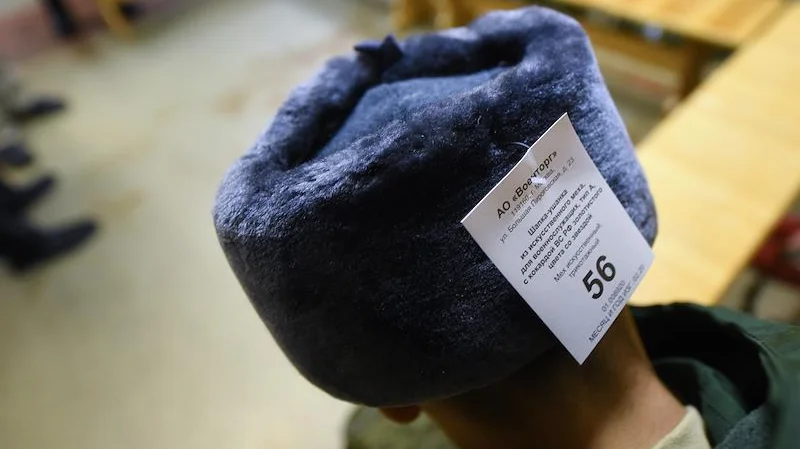
Photo: Alexander Koryakov / Kommersant
"... The sovereign free walking people come to the headquarters and chief officers for the removal of them in soldiers, and whoever will not be suitable for soldiers, to write in bonded slaves, and who will not appear, to beat with a whip, and to lend stigmas to hard labor, to the gallery forever."
Decree of Peter I of 1723
The surprise on which its chairman Vyacheslav Volodin insisted in the State Duma, when adopting in three readings of the Law on Electronic A summons, surprised the deputies themselves. “In order to adopt a whole law after we listened to television interviews and watched amendments in two hours - this has never been in my memory. This is a disrespectful attitude towards us, deputies, ”Nina Ostanina expressed general discontent from the Communist faction.
And who promised that in the presidential administration, where was the speaker a speaker to the Duma Volodin - the former first deputy of its head, used to respect the legislative power? And why respect her so much if, having growned, the deputies immediately approved these amendments unanimously?
The strict procedure for turning bills into laws is actually undergoing destructive shelling from his side for the first time. This is a serious general (not only Russian) problem that rests on the congenital flaw of parliamentarism: for careful work on the laws that requires the accounts of the opinions of different groups of voters, you have to pay the speed of decision -making, or even a red tape that individual “sires and peers” can provoke.
This contradiction was the first in the 20s of the last century by the German lawyer and philosopher Karl Schmitt. It is not by chance that the chairman of the Constitutional Court Valery Zorkin in one of the public speeches after the beginning of his referred to Schmitt, calling him "an outstanding philosopher and lawyer, whose ideas are becoming more and more relevant."
True, he forgot to inform the listeners that Schmitt welcomed the Nazis' coming to power and led a powerful theoretical base under the fascist model of the state.
But this does not cancel the theoretical significance of his doctrine of “emergency” and “sovereign” (more about this on the “free space” website for September 22, 2022).
The controversial for Western democracies is only Schmitt’s assertion that the state is normal, and democracy is a deviation from it, a kind of temporary insanity. But for our godless country, this statement sometimes seems historically true. So, in any case, this is seen by the chairman of the Constitutional Court, who directly says,
That the tradition that prevailed in Russia “for thousands of years” and continued by the Bolsheviks was a more reliable “cross” than the law, and serfdom in the Russian Empire in 1861 was canceled prematurely.
In the Kremlin, Dr. Zorkin heard: the law on electronic summons with related prohibitions on traveling abroad, to drive a car and God knows what - returns the “scraping” of serfdom, in any case, for the male part of the population of the Russian Federation. The Constitutional Court would be authorized to consider the issue of compliance with the amendments of the Constitution, but can only do this at the request of the President, the Council of the Federation, the State Duma, the Government, the Supreme Court, the legislative and executive authorities of the constituent entities of the Russian Federation or one fifth members of any of the chambers of the Federal Assembly.
So from this side, nothing threatens the new serfdom. The threat hung, on the contrary, over the Duma itself, the constitutional court, etc. And this is not “German tanks with crosses”, the appearance of which scares Russians on their native fields. On the other hand, Karl Schmitt made his way to the Kremlin with a quiet sapa.
If a state of emergency becomes the norm, why playing democracy?
The Duma consisting of 450 are not decisive loafers, each of whom receives the salary of the minister, and the speaker-the prime minister, and the apparatus of assistants, and the benefits, and the building itself in Okhotny-is expensive.
The same courts that rewrite accusatory conclusions, the same is the authorities of the representative power in the field. And there someone can also bury, as she did, though not too consistently, Nina Ostanina. While Russia remained a member of the Council of Europe, these scenery was needed for export, but for a long time not for internal use. And after a divorce from Western democracies for the state, forced to exert the Armed resistance of NATO, parliamentarism and the separation of powers are too expensive clothing, which is no longer in fashion and does not warm.
Here it is, it turns out, the vile plan of the "ukronacists": to destroy Russian democracy. Is it still able to resist or not?