
Translated material
Acute art
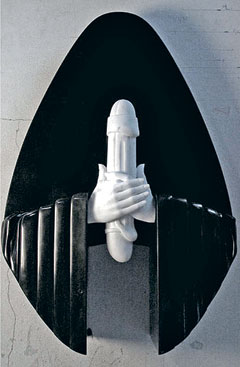 |
| The works of Aidan Salakhova are not prohibited, but not very accessible |
Union of random things. In Venice, the 54th international exhibition of art was opened-the famous Biennale, the oldest in the world, which has been held since 1895. What is more in it - fashionable or relevant, the New Times was versed
The trends of the Venetian Biennale can be studied on swelling bags that are distributed in many pavilions. There are inscriptions on these bags both simple-mindedly-advertising and frankly political, for example, the call “Freedom of Ai Weiway!” Just in the days of the Biennale of the Chinese dissident artist, the British Royal Academy of Arts was elected to the honorary members of the British Royal Academy of Arts, but this seems to have not embarrassed the Chinese authorities, who for the third month holding Ai Weiwei behind bars.
Art is inseparable from politics today. The Italian pavilion - traditionally the most ambitious in Venice - was preparing in a scandal. Its curator was a friend of Berlusconi Vittorio Sugby, a TV presenter, a politician and an art critic who publicly admitted that he hates contemporary art (while he considers all art modern). He offered 200 Italian intellectuals to take one author for the pavilion. As a result, a real art svalka turned out, where professionals are almost with amateurs. Many, however, refused to work with a character close to Berlusconi (in Russia a similar demarche would look extraordinary), although he made the statement “Art is not a“ goat of nostra ”, but in parallel showed the“ Mafia ”exhibition.
However, can the art of one country be better than art as a whole? One of the main messages of the curator of the current Biennale Biche Kuriger is that the artists have no specific homeland is in question in question is the very existence of national pavilions. When you read about the artist that he was born in the country X, lives in Y, and represents Z, you involuntarily think about the conventions of state borders. It is much more important than the border of time, it is not for nothing that the main exhibition, Illuminazioni (“Illuminations”) in Jardini, opens with three huge Tintoretto canvases. However, the classic did not help the exhibition gain internal harmony and detect connections between individual exhibits. Which, of course, does not mean that there are no interesting exhibits.
 |
| "We" Marcio Kattelan |
The acute art, although the graph “nationality” in art seems to have already been canceled, it is easier to look for an interesting in national pavilions, whether it is a murderously white aesthetics of an abandoned apartment recreated in the Luxembourg pavilion Martin Faypel and Jean Behamel, or the witty exhibition of New Zealander Michael Paechey, who made a huge bull look at the pianist.
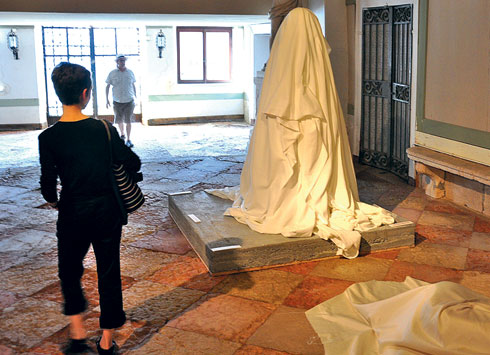
The scandal in the Azerbaijani pavilion turned out to be loud. Before the opening, it was visited by the President of Azerbaijan, who, as Kommersant writes with reference to The Art Newspaper, considered several works by Muscovites Aidan Salakhova from her Destination project too controversial in terms of religion and morality to show their public, at least at VIP opening. It was assumed that they could offend the feelings of believers, as they deal with sacred symbols, and are also frank in erotic terms. True, before they were selection of curators, including Beral Madra, the ideologist of Istanbul Biennale, a person directly involved in the culture of Islam. As a result, four photographs were removed at all, and two sculptures were covered with bedspreads (taking them out at the last minute it would be too troublesome). The artist herself claims that the matter is only in the state of sculptures, and soon they will be discovered again.
It is difficult to hide the real acuteness. Sometimes in the literal sense of the word: a beautiful special project Glasstress is devoted to the art associated with glass. If you do not be careful in the halls, then you can feel how dangerous and even bloody are beautiful on yourself.
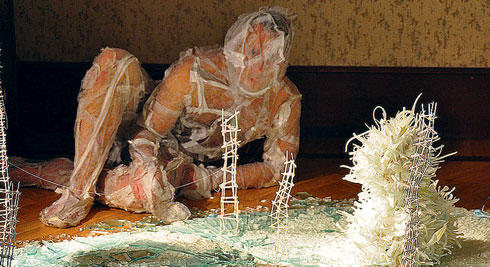
The installation-performance of Marya Kazu “They were there” (special project GlasStress) , Russians among the equals this time from Russia are not lost among thousands of works. Filling out the Russian Pavilion built in 1914 by Shchusev, his commissioner Stella Kesaev from Stella Art Foundation entrusted the philosopher and criticism Boris Groys. He decided to expose his favorite Moscow conceptualists-Andrei Monastyrsky and participants in the collective actions projects (artists and invited guests have been traveling from the late 70s to the nature or to the city center where they hold conceptual promotions). It turned out an exhibition, which for the first time in many years is not ashamed - working, stylish, substantial.
The retrospective of Dmitry Aleksandrovich Prigov is also close to her at the University of Foscari. It looks ideal: finely selected work, accurate placement, when the works are left a lot of air and the exhibits do not squeeze each other, and most importantly - the figure of the artist, whose significance only increases over the years.
The only Russian author, mainly the Biennale project, Anna Titova, was somehow lost in the arsenal, whose enfilads are more contraindicated in art than for him. An attempt to visit the I Miss My Enemies exhibition on the island of Judekka ended in failure: despite the day of the vernissage, it was closed a quarter of an hour earlier, a group of punctual spectators remains only to write angry notes in front of a closed door. But the Modernicon project, which was previously shown before in Turin, curators Francesco Bona and Iren Calderoni, is definitely good at modern art. It is noteworthy that, as in the case of Titova, the not those authors who determine the Moscow-Pother art scenes are represented here, but rather her outsiders: Anna Parkina, Sasha Auerbach, Anastasia Ryabova (although there are Dmitry Gutov, and Pavel Pepperstein and Olga Chernysheva). Our photographers at the World Belongs to You (“The World belongs to you”) in the Palazzo Grassi - Sergey Bratkov and Boris Mikhailov are also noticeable.
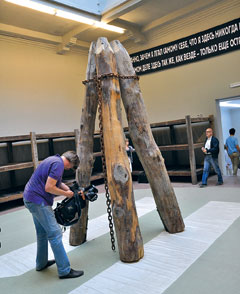 |
| Andrei Monastyrsky surrounded the pillars with bunks, to which the Venetians tie their boats. So the country of Repin met with the country of Tintoretto |
Formally, the exhibition in the Palazzo Grassi was prepared by the Fund of French billionaire Francois Pino. In Grassi, the Fund shows temporary exhibitions (Permanent collection of Pino, the owner of Christie's and Gucci, is located nearby, at the old customs near San Stefano). It can be seen here that the curator’s hard hand is: the exhibits are not crushed by quantity, but they are carefully selected and together resemble a kind of art system. This is a sample of a single taste - not in the sense that the taste is perfect, but that it does not break up into many separate works.
Formally, the exhibition is not included in the Biennale program, as well as a number of bright projects, without which the Venetian summer is nevertheless unthinkable. It seems that context is no less important than the main event.
One of the most beautiful exhibitions takes place at the Fortun Museum. What exactly is the TRA is dedicated to, it is difficult to understand without a catalog. But 300 works are so good on their own and they are located with such taste that you walk on the four floors of the building as bewitched. As a result, you guess that these are eternal plots - time and space, theater and staging, but the witnesses are not abstractly, but in relation to the house of Mariono Fortuni (1871–1949), a Spanish designer who worked in Venice. The most important thing here is the studio of the fashion designer itself, for each exhibition it is slightly updated. This is a fabulous impression when LCD monitors and modern art objects stand in ancient windows interspersed with genuine things of the 19th century.
It seems to be terrible in the light chaos of the main exhibition? After all, it is dedicated to the eternal - light and enlightenment, although far from the actual policy, but recalls important issues, including the self -identification of art?
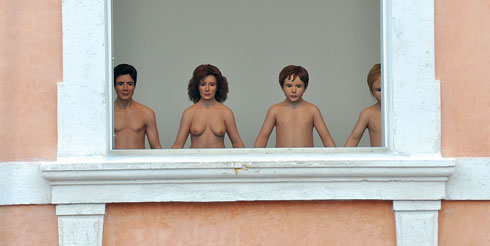
It is better to look at some works from another hall (“Family Romance” by Charles Ray) Kurator Biche Kuriger is trying to present as a guardian of art from business raids. This has been able to more than once as a curator at the Zurich Museum, where she did a number of wonderful projects, and the work as an editor-in-chief in the influential art magazine “Parket” did not pass without a trace. But, firstly, art has never been able to escape from money at least not far from money. Any alternative is dreamed of selling the manuscript, and the meaning of the artist today determines auctions (in this sense the “most valuable” among ours - Ilya Kabakov, sold at $ 6 million; this does not mean that watching his new quails in old works is interesting and informative). Secondly, if an alternative is declared, it should be stated in a clear language, even if it is a language of such a confusing phenomenon as contemporary art. The prepared chicken exhibition does not differ in clarity. There are many interesting works, but are they formed into a single whole? Is it possible, in principle, such a whole today, when art is increasingly understood as a fashion accessory or, even more impressive, as a reliable means of investing extra money? However, each large exhibition poses these questions, and the type of critical whining after each Biennale is approximately the same.
The problem of style is the main in the era of electronic mass media and that illusion of equal rights of all and everything that generates the Internet. For art, this visibility of democracy turns into the problem of a qualified gaze. The artist is trying to please the potential customer, but there is a problem with the customer himself. Biennale, it would seem, is an ideal situation when a professional environment tries on a mantle of an independent arbiter. But then it turns out how difficult it is to live in the world without the “main” idea, whether it is the idea of enlightenment or any other, even a marginal determining artistic framework. Whether it is a personal matter for everyone, but it is the boundaries that create geniuses. It is not surprising that in 2011 we again needed Tintoretto.
Venetian Biennale
It has been taking place since 1895 in Jardini (Gardens), where the national pavilions and part of the main exhibition preparing the invited curator are located (its other part takes place in the arsenal). Throughout Venice, exhibitions of a parallel program are scattered from more than 50 countries that did not manage to settle in the gardens at one time.