
Translated material
The right to dignity
Philosopher Jurgen Habermas gave a lecture in Moscow
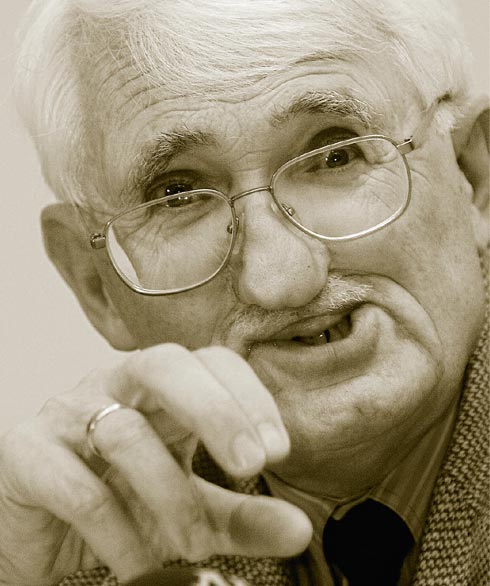
Photos of AFP/East News "The suffering of people undergoing persecution, deprivation and discrimination is not their natural destiny." The great German philosopher Jürgen Habermas, who came to the celebration of the 80th anniversary of the Institute of Philosophy of the Russian Academy of Sciences and to participate in the World Day of the UNESCO philosophy, made a lecture in Moscow in which he reminded that observance of human rights is inextricably linked with respect for human dignity. The main ideas of Professor Habermas recorded The New Times
The first article of the Universal Declaration of Human Rights says: "All people are born free and equal in their dignity and rights." The same words are recorded in the German Constitution. The connection between human dignity and human rights is actively discussed today not only of thinkers, but also by politicians and the general public.
After September 11, 2001, the Ksima Kant, after terrorist attacks on the United States on September 11, 2001, adopted a law on ensuring aviation security, which gave the state the right to knock down a plane captured by terrorists in order to preserve the lives of people who are on Earth. However, in 2006, the German Constitutional Court recognized this law unconstitutional.
The court ruled: it is impossible for the safety of people who are on the ground and threatened to sacrifice people's lives on board the airliner. And if the state decides to destroy the plane, then its actions detract from the human dignity of passengers and violate the famous Mayxim Kant: "Never treat a person as a means, but always as a goal."
This philosophical concept of human dignity, which has existed since ancient times, has gained widespread and legislative consolidation in the documents of the international level and national constitutions after the Second World War. Mass crimes against humanity committed by the Nazi regime put into the focus of the attention of the world community not only the problem of protecting the rights of the individual, but also the issue of protecting human dignity.
The limits of the state between human rights and human dignity are an implicit, but conceptual connection that appeared along with the development of the first legal systems. Intuition tells us that the emergence of the concept of human rights is associated with the resistance of people with oppression, humiliation and despotism, emanating from the state or powerful social groups. Saying today that “no one should be tortured or cruel, inhuman or humiliating his dignity or punishment,” we immediately hear the echo of the groans of countless sacrifices.
The concept of human dignity is a key, a logical connection between the most important human rights related to his personal integrity, freedom of economic activity (including the protection of property rights) and freedom of religion. It is these rights that are called to prevent the state’s intervention in the private life of people.
Together with the democratic rights that guarantee the participation of citizens in the activities of the state, they form the so -called “package of classical civil rights”. However, not all people have the opportunity to use it equally. A person can form his individuality in a specific cultural environment and not be discriminated for this only on condition that the private and economic rights of human rights are sufficiently protected and guaranteed by the state.
The source of self -esteem began to actively develop in ancient Rome. It was then that there were such phenomena as individual and group honor. Starting from the Middle Ages and the early Renaissance, this concept began to be associated with specific status groups - knights, priests or professors of universities who began to appear in a set in connection with the economic and political development of states.
Therefore, the moral law assigned to a particular social group began to be clothed in a legal form. And this transformation is paradoxical, since the concept of human dignity initially protected the interests of high -standing, power groups. But in the end, all other groups fell under her protection. And this new, rather abstract concept of human dignity was freed from corporate characteristics. But the most important thing that happened at this time and further over the centuries: the fact that all citizens begin to recognize the subjective rights of a separate particular person to serve as a source of people's self -esteem.
Millions are worthy, but if people recognize each other's rights, does this mean that the dignity of different people weighs the same? Yes, because people in such a society begin to value not the status of a person, which develops in the system of vertical connections, but the merits of an individual and its contribution to the community of people. So, to replace the idea of the superiority of one person over another came the concept of the absolute value of the personality and its uniqueness.
But it should be noted that the respect of human dignity and the observance of his rights occurs only in democratic societies, the struggle for human rights continues around the world, including Western countries, not to mention countries such as Iran, China, Russia.
And every time a person is pursued for political beliefs, they put him in prison or deport from the country for this, the state belittles his human dignity. The suffering of people undergoing persecution, deprivation and discrimination is not their natural destiny. The duty of the state is to respect the dignity of each person. The Universal Declaration of Human Rights, incorporated in the constitution of many countries, imposes legal responsibility to the state institution for violation of these rights. Examples of how the state detracted the dignity of man - especially during the war and political repression - were forever imprinted in the collective memory of mankind.
Jurgen Habermas - 80 years old.
A representative of the critical Frankfurt philosophical school.
As a professor at philosophy and sociology, he taught in Heidelberg (1962–1964) and Frankfurt (1964–1971, 1983–1994) universities.
From 1971 to 1980-Director of the Institute of Max Planck in Starnberg.
The author of three dozen books, including the “Crisis of Legitimation” (1973), “Communication and Evolution of Society” (1979) and “Theory of Communicative Action” (1981).