
Translated material
Submit a bet
The Russian Central Bank for the second time in the last month reduced the refinancing rate - to 12%. Actually, this is a global trend: the National Bank of the whole world in a crisis energetically reduce bets to facilitate money access to money. And in the USA they even discuss the possibility of negative bets. The New Times sorted to the strategy of creditors and borrowers 
The mountain moved to the Russian Central Bank to start reducing the rate earlier two factors interfered - high inflation and fears for the ruble: cheap money undermines the confidence of investors in national currency and disperse prices. As for the course of the national currency, it has stabilized in the last 2-3 months, and the further fate of the ruble is tightly connected with the price of oil. From the experience of previous years, it is known: a barrel is growing - the ruble is strengthened and vice versa.
But a strong increase in prices - perhaps a global phenomenon in the midst of a powerful reduction in demand - the factor is quite man -made, caused by a “controlled” ruble devaluation and a low level of competition. In addition, the Russian consumer market greatly depends on imports, the price of which in rubles has risen significantly in recent months. Even in the fall, during a sharp reduction in solvent demand, food valued in Russia fifterly faster than in the EU. And in January-March, in the countries of the Russian trading partners (among them there are many developing), prices grew about three times more slowly than ours, experts of the development center calculated.
It was the rapid increase in prices and the low level of trust in the ruble that the Central Bank still did not give the opportunity to please banks and companies with a decrease in bets. However, even now a decrease in the base rate does not turn into the immediate cost of loans. Banking sector experts explain this to several reasons. Firstly, in April, lowering the rate, the Central Bank at the same time increased the deductions to the compulsory reservation fund (for the same 0.5 percentage points), which means that the need to reserve additional funds to banks did not disappear anywhere. Secondly, the cost of raising funds for banks has not decreased: at the unstable auctions of the Central Bank, banks still receive money at 15-16%.
In general, 10-12% of enterprises can only dream of loans at pre -crisis rates. It is almost impossible to get a loan from a Russian bank at a loan than 20% per annum, despite the reduction in the rate, experts of the banking sector say. It is no coincidence that only 22–24% of enterprises considered loans at the current rates available for themselves in April, the data of the Institute of Economics of the Transitional period testify. Without reducing interest rates, it is impossible to launch lending, but this is also a matter of “long” money, said President Alfa Bank Peter Aven. Although the state gives banks quite a lot of money, all these funds are a maximum of 6–9 months, while borrowers need loans for more than a year, he adds.
The way down
The National Bank of Developed countries began to reduce bets much earlier. From 5.25% in the summer of 2007, the rate of the federal reserve system of the United States was reduced by the beginning of 2009 to 0.25%. The European Central Bank persisted longer, due to the acceleration of inflation, he began to lower the rate only last October. However, the ECB rate has traveled from 4.25% to 1% (see table).
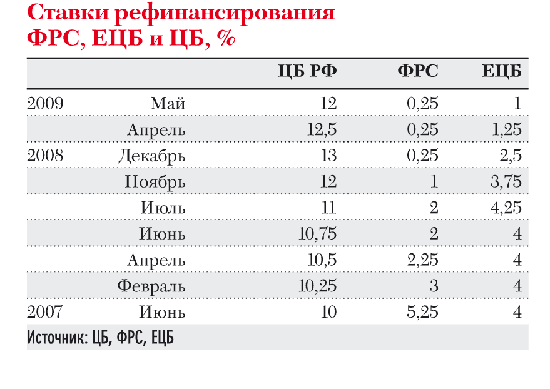
By this, the National Banks, who want to revive frozen lending, did not limit themselves. They sharply expanded the lending of banks both without collateral and on security of assets, under which there was nothing to think of funds in the National Bank a year ago. The ratio of basic money and reserves to GDP in the USA, Eurozone and Japan increased, according to the IMF calculations, from 7% in 2007 to 11% to the beginning of 2009. But all these measures are not yet very helping to cope with the crisis - by the end of last year both in the eurozone and the USA has stopped by the increase in loans.
Banks have reasons not to rush with loans. Forecasts of the development of the economy, individual sectors and companies are extremely unclear. In addition, the banks and their borrowers have already accumulated more than sufficient amounts of debts. Now is the time to pay debts, and not take new ones. While the burden of losses will not be distributed between borrowers and creditors, the growth of lending will not resume, said Oleg Vyugin, chairman of the board of directors of the MDM-Bank. Lending needs “long” money, but who can give it when it is not known what will happen in October, adds MMEVB President Konstantin Korishchenko, referring to the well-known forecast of Deputy Prime Minister Alexei Kudrin about the threat of a second wave of a crisis caused by an increase in “bad” debts of banks.
Below zero it would seem that the Fed’s rate (0.25%) is already so low that there is nowhere to lower. It turns out there is where. It is time to establish a negative interest rate, wrote in April at New York Times Grevori Mankue Harvard University, author of popular textbooks on macroeconomics. The best medicine against the recession caused by insufficient demand is to reduce the rates that encourage companies and households to spend more. Why, in this situation, the Fed does not lower the rate, say, to minus 3%? I took $ 100 - in a year you give $ 97. Undoubtedly, such conditions will prompt firms and consumers to occupy and spend. Nobody, however, wants to credit money on such conditions: it is more profitable to hide the money in a stocking. However, Manku with his students offered ways to revive a loan at negative rates. For example, to introduce a cash tax paid by those who keep savings “under the pillow” without returning them to the economy.
Manku's proposals caused a violent reaction in American economic circles - mostly negative. Some considered that the professor of Harvard was just joking unsuccessfully. Meanwhile, if you set the rate, paying attention only to current economic conditions, it should have been minus 5%. This is no longer a joke of Manku, but serious calculations from the closed report of the Fed, which was written by Financial Times. So who knows: maybe it is the negative rates that will turn out to be a revolutionary way to get out of the crisis?
GU-VSHE, Opec.ru