
Translated material
David Remnik - Evgenia Albats
“They never call me, I have never heard from the owner of the magazine: it is too contradictory or can bring trouble to the company. Not once "
The editor -in -chief of The New Yorker
David Remnik - Evgenia Albats
Why did the Bankroft family decide to sell The Wall Street Journal to a businessman with an ambiguous reputation-that correspondent The New Times did not fail to ask David belt, one of the most famous journalists of the United States and the chief editor of the cult magazine The New Yorker.
The reason is one, and it is obvious: the newspaper business is experiencing a crisis - and by no means in the USA.
According to various sources, American newspapers lost about 15 percent of the market - this is not so much.
Yes, but the problem is different in the stock market. This market requires a constant growth of profit. And if there is no growth, then your shares go down. Here, for example, Chicago Tribune is a company that owns the Chicago Tribune and Los Angelos Times and which was sold a few months ago, which had not been connected with a newspaper business in any way: she had excellent indicators in the ratio of expenses-expenses. If this was not a media company, but, say, selling napkins, or beer, or roses, the owners would be completely happy. But the whole trouble is that the newspaper market does not grow and, therefore, investors restore shares, and company owners - liquidate the bureau abroad, reduce the staff of journalists. In the same Dow Jones - we wrote about that in the journal - reduced almost two thousand people, a quarter of all employees.
Wall Street Journal is a wonderful newspaper. But the price of its shares is very low. And then Rupert Murdok comes and says: "I am ready to offer you $ 5 billion." And the Bankroft family, which was not going to sell the newspaper, thought: we are not so rich, why not sell. And then the case is done.
Journalists remain
- Just pray -
And the reputation of Murdok did not interfere with this?
Murdok offered $ 60 per share when the market price is 30. It is difficult to resist. A huge family - thirty -five only adult members, and dividends who would make you and me happy, not so big. Murdok has a fantastic capital at his disposal, he wants to make a Journal the center of his financial and media empire: the prestige of the newspaper will raise a reputation as his other possessions. And I do not think that he will decide to turn Journal into Sun (English tabloid), into a boulevard edition ... I know that Murdok is going to invest in the publication, while Down Jones is exactly because the price of the company’s shares was so low - she has been reduced all the last time. So everyone wins: bankroft will become rich, Murdok invests in an information business, and journalists-God forbid (the words that David belt said in Russian are highlighted.-The New Times). However, they have no choice: they can pray that it does not get worse. God forbid, he will save the state of journalists, God forbid, he will not intervene in the publication related to business somewhere in China. You will say: this is a deal with the devil. Well, the newspaper publication is an extremely cost event. And the situation with Journal is no exception. Exceptions are the Solzbergers family (the owners of The New York Times), the Gremov family (own The Washington Post), naturally - New Houses who publish the New Yorker and who say the belt: do what you consider necessary. And while we are successful, while we are quite profitable, we are in order.
In 1902, after the death of the founding father, Charles Dau, Dow Jones was sold to Clarence Volker Barron (he founded the famous Barron's Publishing House, which is part of the Dow Jones) and, after his death, crossed his son-in-law-Hugo Bankroft. In 1933, he committed suicide, and since then the Bankroft family has not participated in the management of the company. The family owns 64% of Dow Jones, 29% belongs to a variety of investors who supported the decision to sell the company to Rupert Murdoku.
David belt
The editor -in -chief of the cult magazine for the “egg -headed” The New Yorker with a circulation of 1 million 100 thousand (SIC!), He became famous after the release of the book “Grave of Lenin: The Last Days of the Soviet Empire” (1994), which he wrote as a result of the work in Moscow The Washington Post in 1987-1991. The strap received for it the most prestigious journalistic award - the Pulitzer Prize, the book became a bestseller and along with the works of Conquist, Pipe, Ulam entered the university programs of students studying the Soviet Union and Russia. Then the strap was briefly distracted by the biography of the great boxer Mohammed Ali, wrote essays from around the world, raised the circulation of his magazine for several hundred thousand copies, but Russia was and remains his passion - he comes here quite often (“this is my version of the beach,” he says), and his second book was called “The Battle for New Russia”. The journalist the belt became quite by chance: having graduated from the prestigious Princeton University, he came to the Soviet Union for six weeks - he was mainly interested in books. But then in The Washington Post the Moscow Bureau was released, and there were no people who wanted to take this place: “Russia is a very cold country, and living conditions according to American standards were very modest,” says the belt. - I was completely happy here, I adored this work - every day, every hour; Russia has become the main story of my life, my greatest luck. ” The New Times met with David belt in the National Hotel, from which the Mausoleum of Lenin is still visible, there are several, however, obsolete with the alapious shopping center on Mokhova. The last time we spoke in such detail with a belt 17 years ago.
The New Yorker magazine belongs to the Conde 'Nast Publications, which publishes, among others, and magazines such as Vogue, GQ, Vanity Fair. Since 1959, the company belongs to the Newhouse family.
This city
- saturated with money -

It is curious how you feel yourself in Russia now - in an expensive hotel in the most expensive city in the country?
Shock. Such, you know, a cultural shock. Once the corner is “Ritz-Carleton”, in which the night costs a thousand dollars, and a suite-one and a half thousand. And I remember how in this area, like in all others, it was impossible to find matches or onions, and there were still mass demonstrations - they demanded freedom. Now everything is. In addition to demonstrations. This is a real phantasmagoria - to observe this commercial hysteria around, everything is saturated with money. All the time I recall August 1991, when we walked here with friends and in the style that I would call at the same time Moscow and Manhattan - they are very similar - we said that there would be trademarks very soon ... It was such an irony, it seemed such an absurdity: here? shopping complexes?
There are shopping complexes, but Lenin’s mausoleum also did not go away.
This is wealth - it says a lot and - about nothing ...
That is?
You don’t remember this, because the New Yorker could not be bought in the USSR then, and I remember: American writers who were in a state of novel with the Soviet Union, and not the latter - the Appadike, Rose, wrote, returning from traveling around the USSR: “There can be nothing, but everything matters here (in the USA) - everything can be said and nothing matters.” There was such a simple and banal design. Today (those who come to Russia. - The New Times) The design is different: Moscow is dusting with wealth and luxury, and it seems: why do these Russians still need? Here there was an adaptation of various and conflicting things - authoritarian features, semi -democratic, European life, market. In comparison with the Soviet government, the current regime is much smarter. He, if you want, is brilliant, amazing. And this brilliance blinds - not everyone can see reality behind it. In the Soviet Union, "Echo of Moscow" or The New Times could not - you yourself know where you would be. I listened to the “echo” and thought: that would be such a political discourse, but with us, in the USA. But you need to know this country, have extensive experience, understand Russian, watch your television in order to guess that 90 percent of Russians receive distilled information of television channels. Of course, today's Russian television is much more colorful, more European, but in fact it is also Soviet television. But this is not striking. Therefore, I say that today's Russian regime-in comparison with the Soviet-in its own way, is brilliant.
You expected when you published Lenin’s grave that the situation would turn in the way it turned, that democracy would be buried, crushed by economic pragmatism - both local, and, by the way, Western?
It was a book. I wrote that I saw what I heard what I learned from others. But as a prediction - it was completely unable. But I did not seek that at all. I do not believe in the journalism of the fortune -telling (the American idiom Chrystal Ball Journalism into Russian is usually translated as “fortune -telling on the coffee grounds”), and the older I become, the more experienced, the more it becomes obvious to me. All these days I take an interview about the upcoming elections: what kind of predictions I have not heard! All - predict, and no one knows for sure. It seems to me that there is nothing in history, which would allow you to draw direct parallels: history is useful, but it does not know how to predict. They say: “This was the case during the French Revolution” or “It looks like what was in Germany in the thirties” - nothing explains anything.
When did you first have the idea that something is wrong in Russia, it is not there?
In 1993. I think that exactly then much went awry. Further-the Chechen war, the election of 1996, Yeltsin’s degradation, his environment ... although Yeltsin's attitude to the media was amazing. Yes, the media owned the oligarchs, but nevertheless they were quite free, and Yeltsin did not touch them. There was no independent judicial power, there was no balance of the authorities, but nevertheless the state did not allow itself to climb not into its territory. Then the 2000th and everything that followed him. We can say: those who lost in 1991 won today. KGB - won.
In 1993, the US Congress applauded the execution of parliament ... Maybe it was not worth it?
The 90s was such a hallucinogenic time: communism died, a tremendous problem called “Cold War” went into oblivion, words such as “stock market” appeared in Russia, the balance of power between the two superpowers disappeared, Russia was very weak .. And the USA, like the state, had its own national interests: states did not act according to the Boyskauty ethics-states pursue its interests. From this point of view, I completely understand the logic of the game that Putin plays today - the revival of the pride of Russians. And this is a brilliant game. Look at the situation with the pro. Well, everyone understands that the offer with the station in Azerbaijan does not lead anywhere - this is a dummy. But the way Putin did it, it was amazingly comical - yes, but also brilliantly, if we consider this from the point of view of psychological diplomacy. Now Russia is much stronger - primarily thanks to oil, gas, and the United States, on the contrary, is very weak. And the point is not only how the war in Iraq is going: this is Guantanamo and Abu Graib, and the incredibly low rating of Bush’s popularity - all this was used by Russian state television. And indeed: the USA is a huge power with an incredible muscular mass, but looks funny and weak ...
Abu Graib, Guantanamo,
- Secret prisons, -
Further - everywhere
 |
Well, I wanted to ask you about the publication of New Yorker about the bullying of prisoners in the Baghdad prison Abu Graib. Have you had problems with the White House or the publisher?
I'll tell you how it was. We have a reporter - Simon Hersh. He has long been not a young man and became famous thanks to his investigations of mass killings during the Vietnamese War. So, he called me and said: I have photographs and documents in my hands - Hersh took out hundreds of photographs of bullying the prisoners in the Abu Graib prison. Plus - the report of General Antonio Taguba, who made the official - the only and detailed - an investigation of what happened. The Ministry of Defense closed this internal investigation. But Hersh took out the text. Then we learned that (television company) SIB-ES also took out photos. But the Pentagon just crushed them wildly - so that they do not show them, because "it will have terrible consequences for our guys in Iraq."
The famous argument is “the country is at war, our soldiers are dying, and you, journalists ...”
In short, Si-Bi-ES found out that we are preparing the publication, and issued photos on the air-almost one day with us. And despite the pressure of the Pentagon. I received a certain number of hard letters from the Pentagon. I was very proud of this story of ours. But I felt sick, I felt terribly - it was a story about the behavior of our soldiers in Iraq, and this behavior was terrible.
And what, no one accused you of nonpatriotism?
Less than you would expect. On the Internet - it was, in Fox News - too: I, like everyone else, suffer from this perverted narcissism - I read and listen to criticism of myself. I heard. And what? As they say, this is the business that we have chosen. Dot.
And what was the reaction of the owners of the magazine?
No. They never call me, I have never heard from the owner of the magazine: it is too contradictory or can bring trouble to the company. Not once. I will tell you how I found out what the rules of the game in this company are. I became the New Yorker editor despite the fact that I have never been a anyone’s editor in my life - well, perhaps a school newspaper that was published twice a year. I never wanted to be an editor - I am a reporter, I like to ride, watch the world, talk with people, write about what I found out. Learn, study, study, as Lenin said. And so I become an editor, and Simon Hersh writes a story related to Russia, Kazakhstan oil, and in particular about the details of relations between Evgeny Primakov and Saddam Hussein. We make a check of facts, lawyers carefully read the article - well, everything is as usual. And I call the owner and tell what will be in the publication. I tell and - I shut up. And I'm waiting. At the other end of the tube is silence. I'm waiting. Because I know the principle of agreement that existed in the Washington Post between Ben Bredley, the editor -in -chief, and Katherine Grem, the owner of the company. And the principle was like this: no surprises. Katherine did not want to wake up in the morning and learn from the newspaper something that, as we say, could set fire to the forest around. No, she did not say “do not print”, but she wanted to know in advance what would happen. In short, the silence is finally interrupted, and I hear: "Oh, it sounds very interesting." Me: "Do you want to add something else to this?" “No,” he answers. “Interesting material.”
And the reaction of advertisers?
What do you mean?
Well, after publications about the secret prisons of the CIA, about the war in Iraq, about the plans of the White House to start a war in Iran - there were no problems with advertisers?
I have never heard that the advertiser was thinking about giving us a budget for the next year or not because of political reasons. Throughout my history, not a single advertiser left because he did not like something in the magazine in terms of politics. It happens that they say something like that-they express some quiet displeasure through the teeth behind lunch-but nothing serious. It happens that, for example, a manufacturer of German machines prefers that his advertising is not in the same issue of the magazine in which Gunter Grass writes about the Holocaust, about the SS. I understand this - such an advertisement will go in the room next week. I think that advertisers understand that, advertising their products in this journal, they reach the audience that they want to get.
What is the circulation of New Yorker?
One million hundred thousand ...
How many? The magazine for the "egg -headed" - and almost the circulation of The New York Times, a million hundred thousand - each number?
Listen, remember the times when you said when you hear about such a circulation: the poor New Yorker, no one reads them. Remember, when the circulations here were 21 million, 17 million - “labor”, “Izvestia” - how much? - 10 million ...
Journal cuisine
-From "Mom Papa"-
 |
 |
Today, when newspaper journalism becomes journalism of headlines with ten lines under them, such an incredible circulation of the magazine, where materials are 10 and 20 thousand signs ... Can you explain this?
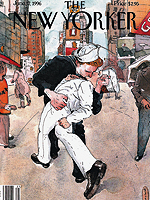
Nevertheless, we have a country with a population of 300 million, more and more people go to universities, get an education, and I think that people want to know. They just want to know and understand what is happening. And the New Yorker is such a strange place: there is not only the investigations of Simon Hershe, or Jane Meyer, or George Packer and others who write about Iraq, but this is also Oliver Sax, who writes about neurology, and this is the section “Walking around the City”, and these are very funny filmmakers of Anthony Leins, and this is very good literature, and this Humor, and these are caricatures-99% of our readers begin to read a magazine from caricatures, and the remaining 1%-lie that they begin with something else. I will reveal you the principle of the magazine. It is as follows: I am not trying to guess that Zhenya Albats or Viktor Smith, who, I know, my subscribers, want to read in the magazine. If I begin to guess their desires, then it will be a deception. I print what I myself am interested in reading, to me, my friends and acquaintances, which is interesting to my circle of journalists, writers, artists. И потом мы это «кушанье» подаем подписчикам. Понимаешь, вот еда может быть из «Макдоналдса», а может — из ресторанчика, где на кухоньке готовят сами владельцы: мама, папа, их родственники. Там даже меню толком нет, но зато все продукты — свежие и приготовлены так, как другие не умеют или готовят по-иному. Так вот, мы подаем нашим подписчикам то, что нам кажется сейчас самым свежим на рынке, и мы надеемся, что это понравится. И наши читатели нам доверяют — они знают, что мы им рыбу второй свежести не подадим. Люди изголодались по домашней еде — ну ты понимаешь, о чем я, они изголодались по чему-то настоящему, не в пластике, не в контейнере. Оказалось, что идея выпускать журнал, у которого нет на обложке — как ты это называешь? сиськи и попки? — нет фотографий знаменитостей или обнаженного тела, и, наоборот, на обложке — рисунки, а внутри — вполне серьезные тексты, это оказывается притягательным для миллионов читателей. Причем я вовсе не думаю, что все наши читатели нас покупают, потому что мы публикуем расследования по Афганистану или Ираку или казахской нефти. No. Успех журнала, как мне кажется, в том, что он рассчитан на разного читателя — как хороший обед: для кого-то важны закуски — салат оливье, для кого-то важен только десерт, а кто-то ждет главного блюда.
Сколько был тираж, когда ты стал редактором?
800 тысяч примерно.
И несмотря на эту «кухню мамы-папы» в журнале очень много рекламы…
Not enough. В Москве могло бы быть больше. Вы живете в культуре, которая сейчас сошла с ума на потреблении. Тратить, тратить, тратить — это мантра нынешней Москвы, и рекламный рынок здесь фантастический.
New Yorker — прибыльное издание?
Yes. Но поскольку это частная компания, я не могу говорить о бизнес-стороне журнала. Последние пять лет мы приносим вполне приличные деньги. И, кстати, представление, что все рекламодатели — консерваторы, а потому они скорее понесут деньги в Fox, — неправильное. Я ничуть не исключаю, что в этот раз (в 2008-м) Wall Street проголосует за демократов. Представление 50-х, что все эти ребята в черных костюмах, белых рубашках и синих галстуках голосуют за республиканцев, — это уже давно не так, страна изменилась. К тому же структура экономической элиты в США самым серьезным образом поменялась: это больше не те старого стиля банкиры, собирающиеся в Гарвардском клубе на Манхэттене, — это те же 32-летние ребята Силиконовой долины, у которых есть частные самолеты, и они отнюдь не политические консерваторы — особенно по таким вопросам, как Ирак или охрана окружающей среды. Ровно потому Ал Гор, или Хиллари Клинтон, или Барак Обама — они получают очень много денег.
2008-й:
— Хиллари Клинтон против —
Рудольфа Джулиани?
И кто победит?
Я знал, что ты меня об этом спросишь. Я должен тебя разочаровать: ситуация меняется так быстро во время президентской кампании... Еще шесть месяцев назад казалось, что сенатор Маккейн — самый очевидный и самый сильный кандидат от республиканской партии. Честный, пресса его любит. Так вот, к моменту, как это интервью будет напечатано, на Маккейне можно ставить крест. Он кончен. Why? Too old. Слишком привычный — до оскомины. Голосовал за войну в Ираке — и причем он поддерживал войну по принципиальным соображениям, он не прав, но он-то голосовал сообразно своим принципам. Но: деньги в него не будут вкладывать. А кампания без денег — это как армия без пищи: никаких шансов взять города.
И если не Маккейн, то кто?
Джулиани и Мит Ромни — мормон, республиканец из штата Массачусетс — такое несочетаемое сочетание. Джулиани — это тоже такой странный республиканец, которому теперь придется забрать назад все его либеральные заявления, которые он делал, чтобы стать в свое время мэром Нью-Йорка. Сегодня он на все вопросы отвечает одним: «11 сентября, 11 сентября, 11 сентября»... «Что делать со здравоохранением?» — «11 сентября». «Что делать с тем-то...» — «11 сентября...»
А у демократов?
Романтичный и очень привлекательный Барак Обама, интеллектуал, который был сенатором... так, сейчас 10.15 утра — ага, он был сенатором два года, а до этого он был в законодательном собрании Иллинойса — Чикаго область, и он выглядит даже моложе, чем на самом деле. Я брал у него интервью — он очень интересный персонаж, очень хорошо образован. Если его изберут — это серьезным образом изменит представление о мире вокруг нас. Темнокожий, рос в Индонезии — это будет чудо. Он поднял много денег. Но… И потом — мы никогда не выбирали президентом женщину. В Германии — канцлер Меркель, в Великобритании была Тэтчер, президенты Чили, Новой Зеландии… Это позор, что в США — только белый мужчина, протестант, за исключением Кеннеди, который был католиком. Но я могу совершенно ошибаться. Все станет понятно только весной 2008 года — после праймериз. Я думаю, что у Хиллари есть хорошие шансы.
И все-таки — демократы или республиканцы?
Ты все-таки хочешь заставить меня это сказать… О'кей, на июль 2007 года: Хиллари Клинтон и Джулиани, это будет старая ньюйоркская гонка, и я не думаю, что Нью-Йорк выигрывает. Но я не удивлюсь, если это будет совершенно другая пара.
Возвращаясь к тому, с чего мы начали — к газетному бизнесу… New York Times тоже может быть продана какому-нибудь пришлому олигарху, готовому заплатить любые деньги?
No. Ни New York Times, ни Washington Post не будут проданы, потому что ценности семьи Солцбергеров и семьи Грем таковы, что они не продадут. Хотя конкуренцию с интернетом выдерживать всем трудно. Но, кстати, их аудитория в интернете растет. Беда в том, что рекламная модель в интернете другая — это называется «один к семи»: интернет-реклама стоит в семь раз меньше, чем печатная. Но и расходы — несравнимые. И давай говорить честно: читать тот же New York Times в интернете удобнее, чем, сидя в метро, эту огромную кипу печатной бумаги.
Значит ли это, что все печатные издания уйдут в интернет?
Нет, во всяком случае, на наш с тобой век печатной истории хватит.