
Translated material
About censorship at rallies
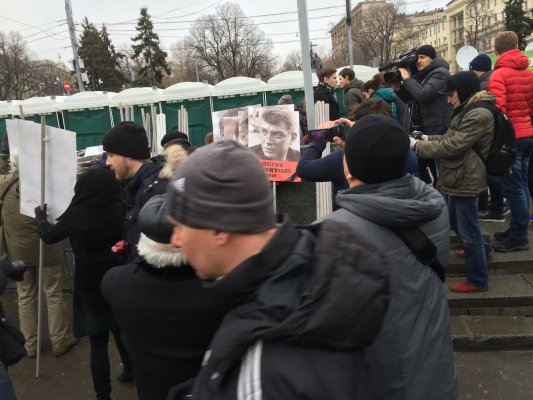
On the mourning procession of Boris Nemtsov’s memory on March 1, I took over the functions of participating in checking posters and banners at the entrance. On September 21, the experience of the march on September 21 showed that this is a narrow place where the police are completely arbitrarily rejected that, in the opinion of employees, for some reason is not suitable. At the organizational meeting in the city hall on the eve of the common language, it was not possible to find. The city hall insisted that the mourning march is completely different, not the same as the protest, and does not even have anything in common with him. We, in turn, insisted that the march of memory of the opposition policy, the victim, according to many, political murder, cannot but be political and opposition. As a result of the meeting, the organizers refused to promise the absence of protest slogans and calling for the participants not to bring them, but the city hall refused to take responsibility for the direct public ban on such slogans. Although the position of government representatives was quite wild: for example, they tried to assure us that the slogan “Nemtsova killed power” was violating the law. It seemed to me that they were really sure of this and other similar nonsense. This, alas, is an indicator of the level of legal awareness of colonels and generals in the authorities.
On the march itself, it was important to try to interfere with censorship as much as possible. Generally speaking, the very preliminary verification of the content of posters and other agitation, as well as the assessment by the authorities of the correspondence of the slogans of the declared goal are absolutely illegal. Roughly speaking, this is not their dog business. If they see that some poster violates, in their opinion, the law, they have the right to remove it in the manner prescribed by law and initiate the case. Preliminary censorship creates a dual situation. On the one hand, the poster is not removed, but simply not missed, there is no procedural design, and, therefore, there is really nothing to dispute. It is impossible to ignore the ban, since the police physically do not miss what they do not like, and the attempt to ignore them is fraught, at least, Art. 19.3 Administrative Code.
This practice is new, earlier she always managed to fight back, but from the September march of the world, the police lawlessly appropriated the right to censorship of visual agitation. Then we recorded prohibitions on the DVR and appealed them in court, but the case has not yet been considered. I think human rights activists and lawyers have yet to think over the fundamental strategy for the fight against censorship at rallies.
This time, a special passage with tents and four separate frames was built for agitation, and the police, despite our objections, were given an order to send all the agitation there, including Russian flags, parties of Boris Nemtsov and massive printed by large editions, posters already approved by the police.
Ilya Mishchenko shot everything that was happening at the censorship point on the video. And although the police began with very rigid filtering, reproaching us that we do not help them in lawlessness, but on the contrary, we provoke citizens, but in 3 hours we gradually reduced the barriers. Nevertheless, all the posters of Yabloko were subjected to filtering about the war with Ukraine, almost all posters demanding the liberation of Savchenko, and even Ukrainian flags were not missed at the beginning. Our objections to the uncertain of specific posters and other items did not have a direct effect, but it seemed to me that they played a role in the passage of subsequent posters of similar content. The legal nihilism of the junior police officers who carried out censorship was, by the way, rather, less than that of their superiors at a meeting in the city hall, although he was sometimes striking. So one man had a strange campaign object in the form of a cardboard box, glued with different texts about Putin suspended in the likeness of fishing rods. The inscriptions were quite mocking, in particular, they beat the well-known speech-la-la-la-la, but not directly offensive. After inspecting the box and verification of the sound of her void, the police were already allowed the passage, but then the most keen of them saw that the cross was drawn in the corner of each surface. "This is a coffin!" He exclaimed, and they were forbidden to carry the box. But the owner of the box was not inclined to humble himself. He tore off the crosses and received a permit for the passage. With a creak, but in the end they missed the banners and other symbols of the Narodnaya Volya movement, for which later, nevertheless, several of its members were detained and delivered to the Krasnoselsky Internal Affairs Directorate.
The flow of the people (the volunteers of the “White counter” initiative, counting on the framework of people on their heads, counted 51 thousand participants) and, accordingly, posters did not run up to 17 hours when the first column had already passed to the bridge. Therefore, at the beginning of the march, as I planned, I did not hit, and along with the security group closed the procession. The latter was carried the flag of Armenia, with a St. George ribbon tied to it in the sign of mourning instead of black, behind its absence. The owner of the flag we gave out a black tape, which he replaced the attached before that.
It is clear why, the march has collected more people than it usually happens on large protests. In addition to active and convinced supporters of democratic European Russia, those less active like -minded people who usually do not go to rallies and marches came, those who were primarily outraged and offended by the very fact of an impudent and cynical murder, even if they did not agree with Boris in everything, those who simply wanted to pay the last tribute to a person who was, if not in the first, then not in the first, and not in the second. The echelon of Russian politics over the past quarter century. The categories of success or failure are not applicable to the action on such a tragic occasion, but I want to thank everyone who came, and especially all those many activists who have prepared and conducted it in just a day.
The bright memory of Boris Nemtsov.