
Translated material
Pride - in half
Who actually built Olympic objects
The Sochi Olympics, as our power is convinced, showed the whole world what Russia is capable of: games have passed at a level, without serious shortcomings. But, as it turned out, this is far from one of our merit
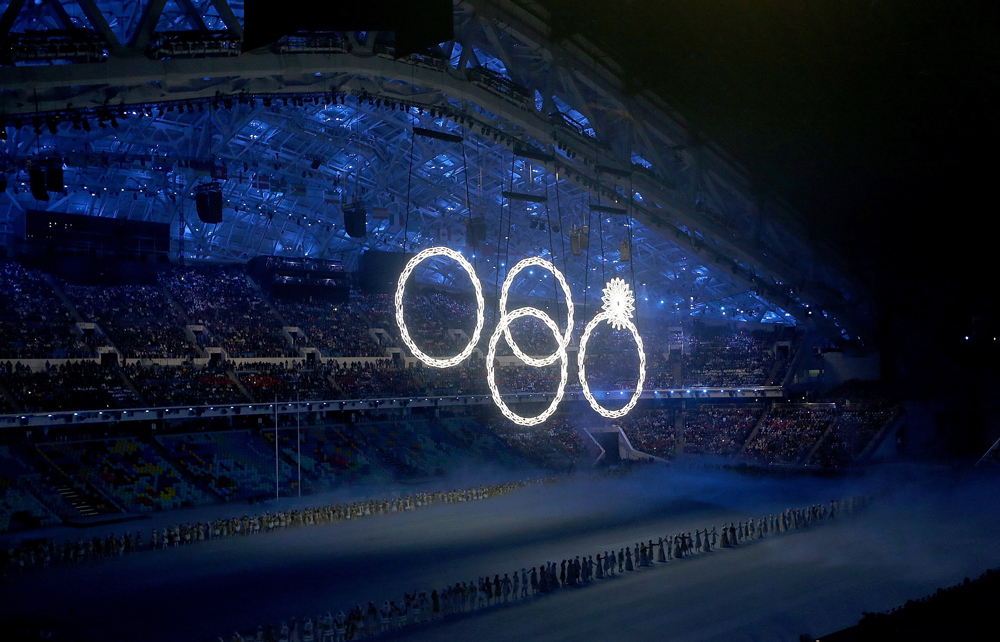
The Fisht Stadium, at which the opening and closing ceremonies of the Olympics were held, designed by the English company Populous
Already in a crowded flight Moscow - Sochi it was evident: all of Russia seeks to get to the Olympics - both in geographical and social sense. Here are healthy Siberians with red round faces and voluminous wives in leopard coats; And the francsed Muscovites in Bosco baseball caps and with Louis Vuitton bags, many children, many young people.
“Nikitos, I arrived! At first I have a baht in the mountains, I have an uncle, he is the head of the Investigative Committee in the Krasnodar Territory, - a tall guy of about 28 is loudly boasting on the phone by landing. “And then immediately to you. I'm flying away on Thursday. I don’t know how much, I am flying with Misha, on his plane. ”
As soon as you go out to the city, the Olympics meets you with volunteers, promoters of Coca-Cola (“Give Five,” raises his hand in a red jacket and smiles broadly, and you also smile in response and “give five”) and a lot of people in Olympic clothing, Bosco jackets and with unchanged blue-bacesses on the neck-passports fan. It is not necessary to wear them at all - they are needed only for entering the competition and free Olympic buses. But, apparently, people want to show that they are part of this big event, to feel involvement in the games, related to the rest. At the same time, it does not leave a strange feeling that all this is like ... the Kiev Maidan, as it was in December, when the first blood did not spill: the same cohesion, the same spirit, only without a revolution.
New city
Sochi has transformed not just over the past seven years - over the past month. All that they did not have time to complete, for a while they froze and closed banners, cleanly on each intersection, new traffic lights are given, marble walls shine in restored underground crossings; At every corner, at each stop, police officers are on duty; Warships stand along the shore (are those who are really responsible for the safety of games, No. 3 The New Times dated 03/03/2014, which spoke about their vulnerability for attacks of terrorists from the sea). Along the railway canvas, along which every 15 minutes the train that has become free during the Olympiad runs, men sit alone in a striped form of riot police. Even on ordinary, neolimpian routes, brand new buses drive instead of old broken grooves, in the evenings on the Sochi embankment of bars and restaurants are full of fans of touching - they go to the stage built at the seaport, where concerts are held every night, and on the plasma screens installed awarding the athletes. "Have you already sang" na-na "? - asks joyfully running out in the rain in one T -shirt a woman of about 30 years. - No? Well, they will be soon! "
Many of the various regions of Russia (Novosibirsk, Yekaterinburg, Rostov, Novorossiysk, St. Petersburg are only those who managed to talk to the New Times) are by no means fans, in the trivial sense of the word. It doesn’t even matter to them what competitions to go to - they just buy the cheapest tickets, the main thing is to be here, to be with everyone, to rejoice at the successes of Russian athletes and Russian medals, and for what these medals were received - the tenth business.
Of course, there are those who professionally discuss hockey or biathlon and are ready to spend money on watching an extra match. “Guys, we have three hockey tickets, 10,500 each?” - The man says on the train on the way to the Olympic Park, and then the forest of hands rises throughout the car. And on the way back, the father of the family, the 40-year-old businessman Ivan, calls his Perm and asks to send 15 thousand-he spent, did not expect that it would be so expensive: in Sochi, prices for food and accommodation are actually quite European.
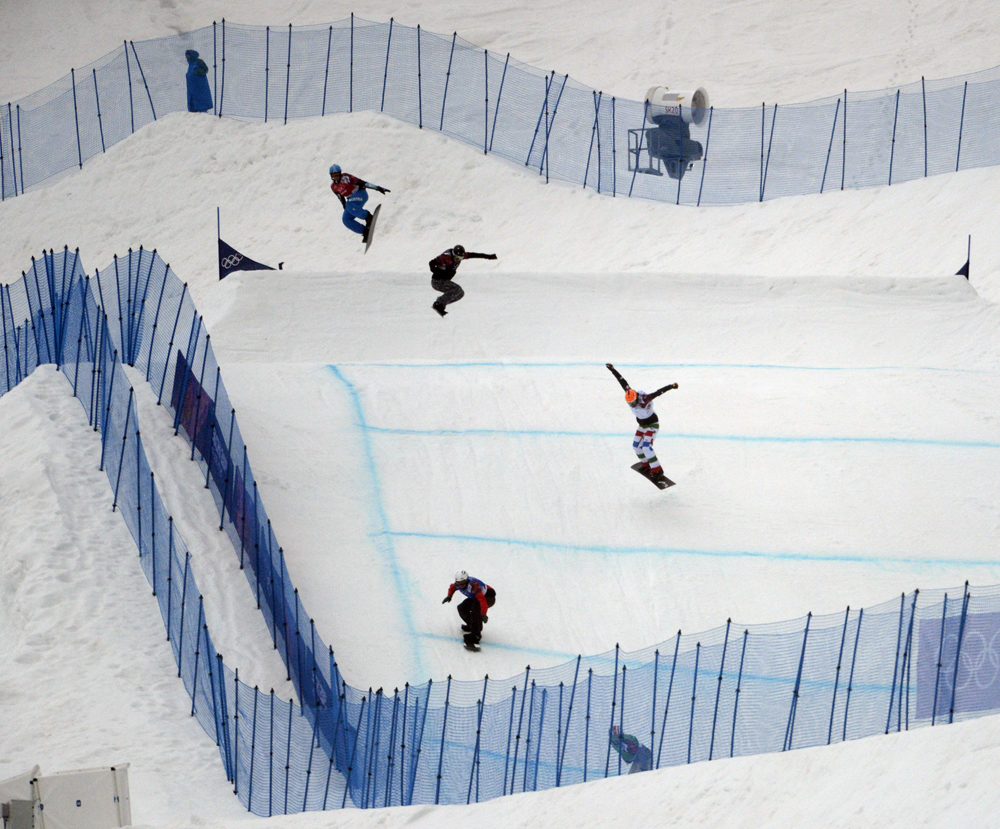
For artificial snow in a mountain cluster, Americans were responsible
Why do we need foreigners
In addition to the joy of Russian athletes, all fans who came to Sochi without exception, and many Sochors now and then slip pride in the Olympic construction site: they could, did, managed. “I haven’t seen this anywhere, although I drove throughout Europe,” Alena Petersburger said excitedly to the New Times, pointing to the stadiums of the Olympic Park. - So everything is beautiful, fashionable, modern! Russian well done! "
It should be noted that well done in this sense is not only Russians. Of all the builders involved in draft work, according to various estimates, up to 70% were migrants from the countries of Central Asia, as well as Serbia, Croatia, Turkey and even Greece. Many Olympic construction projects were led by specialists from the UK, the USA, France, Germany, Australia and other industrialized countries. Given all this, a picture with Russian pride can appear in a slightly different light: they worked in the literal sense of the word by the whole world.
As the New Times managed to find out, the scheme often (but not always) was as follows: the Olympstroy State Corporation, responsible for construction, chose contractors from among large Russian construction companies and design bureaus: Ingeom, Mosproekt-4, Mostovik, etc. And those, in turn, often concluded agreements with foreign firms that were already engaged in detailed project development, as well as control over their execution.
"
All this looks like ... the Kyiv Maidan, as it was in December, when the first blood still did not spill
"
| *More than $ 50 billion was spent on the Sochi Olympics, of which from 50% to 60% stolen - such data are given in the report of Boris Nemtsov and Leonid Martynyuk “Putin. Results. Winter Olympiad in subtropics " |
Why exactly such a scheme? Two main versions go to Sochi on this score. There are two reasons for this. First: with the help of Russian contract and a “foreign” subcontract, it is easier to organize various corruption schemes*.
“It is difficult for foreigners to give bribes,” Valery Morozov, the owner of the Moskonsprom construction company, explained The New Times, which also took part in the construction of the Olympic facilities, but was expelled from Sochi in 2010 after the businessman tried to convict one of the senior officials in pulling the bribes. - In the USA and European countries, criminal liability is provided for this; in England, the company's owner can be imprisoned for a period of 7 to 15 years. So an official who wants to purchase foreign equipment and get a rollback is needed a gasket in the form of a Russian company. ”
There is another important reason why foreigners are so fond of in Russia: we have no specialists or capacities for the construction of complex facilities, especially when they must meet the international requirements of the IOC or FIFA. “With the collapse of the USSR in Russia, the production of engineering equipment-refrigeration, for example, or air conditioning systems died, and we really do not know how to work with Western equipment,” explains Valery Morozov. “We have people who take money for projects in our design bureau, and then transfer these orders to foreigners.”
It is interesting that foreign companies supply engineering equipment usually do not take fees for creating a project, simply including these costs in the price of the equipment itself. Thus, Russian design bureaus leave these funds to themselves, and they become a corruption pillow to pay for officials.
Strength - in swimming trunks
For example, it was according to such a scheme that the Fisht stadium was built, at which the chic opening and closing of the Olympic Games was held: Olympstroy entered into an agreement with the Ingeokom family belonging to the businessmen, which, in turn, attracted third -party contractors, in particular, the British companies Populous and Buro Happold. Populous engineers and architects (by the way, worked in Sochi from the very beginning, helping Olympstroy to develop a plan for both clusters - mountain and coastal) advised the state corporation on many issues: how many objects, which are capacity, which buildings can be temporary and which are permanent. It was Populous who developed the FISTA project and followed how it is performed. And when in the summer of 2011 the team of Konstantin Ernst connected to work, whose proposals for the scenario of ceremonies suggested a cardinal change in the structure of the stadium, Populous experts on equal terms with Russians participated in violent discussions - what and how can be changed and what - in no case.
| ** In 2018, Russia will accept the next World Cup. |
“We then worked 12 hours a day without days off for eight weeks, finalizing and processing the project,” the Australian architect Damon Lavella, a leading specialist Populous, who managed the FISTA construction, told The New Times. - About six months on the table lay an option with a pushing roof. We could do this, but there was no time, moreover, the estimate in this case also also increased significantly. As a result, they left the roof, which, on the one hand, covered the stadium from a possible storm, and on the other, missed sunlight, so that real grass could then grow in the stadium. After all, this is the main requirement for stadiums in which you can arrange football matches under the auspices of FIFA ”**.
With the help of Russian contract and a “foreign” subcontract, it is easier to organize corruption schemes
"
At the same time, the draft materials for the construction of Fishta were Russian: cement was brought from the Krasnodar Territory, steel for the stadium frame from the Urals. “For me, the centennial tradition of Russians to work with steel was the discovery,” says Lavella. - In Europe, they try to build from hollow structures, and in Russia from whole. Here you can use more steel, but it costs cheaper, but in the end it turns out such a real Russian architecture, or rather, a mixture of European and Russian traditions. ”
The enthusiasm of the architect is explained simply: in Europe it is customary to save material. During the construction, the project of the building is first developed, which is then sent to the steel factory so that, in turn, it casts the necessary designs, from which the structure is then collected, as a Lego designer. In Russia, plants produce a standard set of steel beams, which are then cut and welded right on the spot.
On the one hand, this is much cheaper, on the other, it takes more material and, in general, this approach indicates more obsolete production schemes.
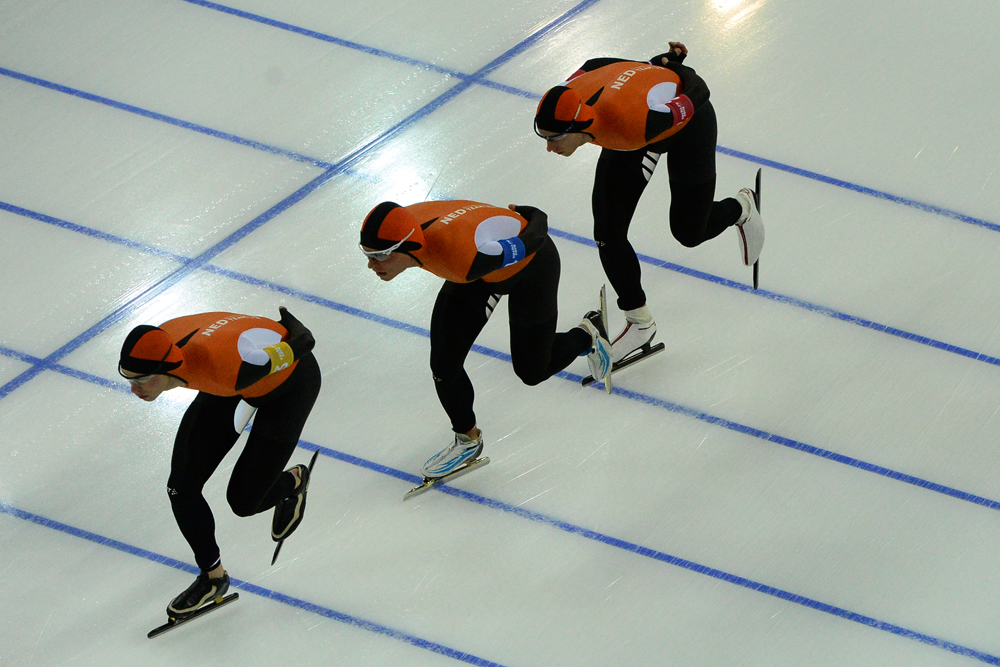
They say that the Dutch were more comfortable to compete in Adler Arena, because the ice was made according to Dutch technology
Snow is American
It is impossible, of course, to say that Russian specialists and companies did not work in Sochi, but, according to the interlocutors of the magazine, foreigners either played a leading role in the development of projects at all serious facilities or supplied equipment, most of which are simply not produced in Russia.
So, the stage equipment at the same “Fishta”, which was used at opening and closing ceremonies, was delivered by British companies Stage One and Unusual Riging, as well as the Canadian show Canada. The French company Supervision was engaged in the installation of screens in all stadiums. The project of the Adler-Arena skating center was prepared by Italians from Studio Zoppini Associati, the same Buro Happold (which also worked with the project of the new Adler station) was engaged in engineering. Finally, the ice coating on Adler Arena was made using the technology of the famous Dutch specialist Berthus Butter (by the way, it is precisely the fact that the Dutch made ice at the stadium, evil languages explain so many medals in the skating at the Netherlands national team).
The same picture is in a mountain cluster. For example, the systems for laying artificial snow on all ski routes were developed and supplied by the American company SMI, which, in turn, used the pumping equipment of the British company Torrent Engineering. As Ian Hani, the SMI project manager in Sochi, explained to the New Times, there are not so many companies in the market for the production of snow, and all of them are large international corporations: “The level of equipment, pumping stations, snow guns that we installed in Sochi, maybe it will really be overstated for ordinary commercial slopes. But we built it for the Olympics, so now there is the best equipment in artificial snow in the world. ”
According to Hani, at his disposal there were constantly from 25 to 30 engineers, specialists in artificial snow. Plus, IT specialists who came from the States, not only to work on a project for games, but also for the training of Rosa Khutor specialists who were to serve the installed equipment.
Ian Hani is sure: with the development of new slopes, Sochi will be excellent competition with European ski resorts. Just do not forget that artificial snow on Sochi tracks will still spray American guns.
Photos: ITAR-TASS, Antonin Thuillier/Ap