
Translated material
Governor's shooting
What awaits the governors
In Russia, a new series of resignation of the heads of regions is expected. Who and for what will fall under the distribution - calculated The New Times
The fact that the country will soon ride a wave of early governor's elections, the informed source told The New Times last spring. “The main task of the Kremlin is to protect itself to the 2018 presidential campaign,” the interlocutor of The New Times explained from among the current regional leaders. In other words, the Kremlin wants to insure him to be possible, if not to say, the conspiracy of the governors, when the aging Putin decides whether to stay in the royal chair or look for a reliable successor.
And what is the “rebellion of the governors”, Vladimir Putin knows very well: he hardly forgot the fall of 1999, when the then mayor of Moscow Yuri Luzhkov shot down the “Fatherland - All Russia” block and was preparing to storm the State Duma, and the Kremlin, promising Yeltsin, the fate of the Romanian dictator Chausheska, who, as you know, was shot.
The recipe for “cure for free-thinking”, as the source explained, in the Kremlin invented quite simple: it is necessary that the elections of governors take place shortly after the completion of the presidential campaign-and then the heads of regions in March 2018 will not be concerned about the fate of the homeland, but their own re-election. And their loyalty to the candidate Putin (or his successor) will be practically guaranteed.
Well, in order to achieve this goal, “only” should be redrawn by the schedule of the governor’s elections so that the term of office of most regional leaders does not end before the presidential election, but immediately after them. That's just for this and you need early elections.
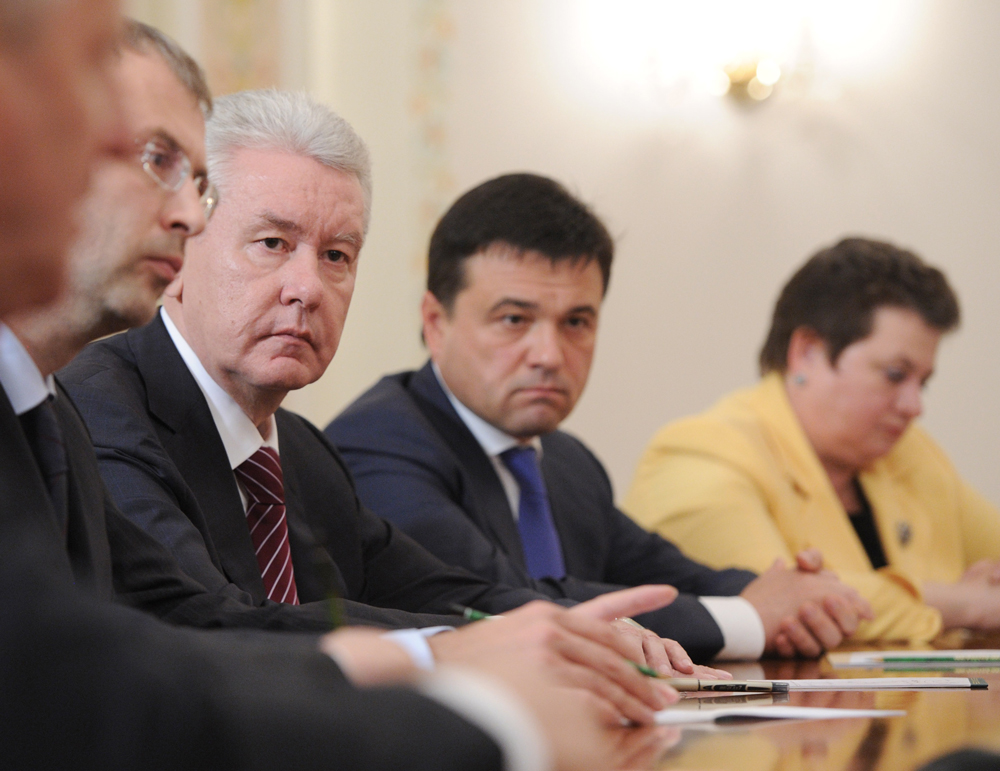
The participation of Sergei Sobyanin (second on the left) and Andrei Vorobyov (in the center) in the 2013 elections guaranteed their loyalty to the Kremlin in the spring of 2018
"Lame ducks"
By 2018, there will be at least ten of them in the regions-these are those governors who won the last elections on September 8, 2013 and, accordingly, their term of powers will expire in the fall of 2018. The mayor of Moscow Sergei Sobyanin, who was one of the first to feel a new scheme with early elections. If everything went according to plan, then he would have to be elected only in 2015, and, therefore, the next election of the mayor of the capital would have occurred in the fall of 2020. What would be very dumb for the Kremlin. Now Putin may practically not be afraid that the leader of a huge metropolis can stand into the ranks of the Anti -Cremlin Governor's Front.
In addition to Sobyanin, the heads of the Moscow Region and Dagestan Andrei Vorobyov and Ramazan Abdulatipov fell into the number of potential “lame ducks” due to the same early elections. And this can also be considered a good sign for the Kremlin. Indeed, in 1999, the then leaders of these regions, Anatoly Zhelov and Magomedali Magomedov, played a very noticeable role in the Luzhkovsky OVR.
By 2018, the governors who will win in the regional elections on September 7, 2014 will also have a rather shaky situation. On this day, chapters will be elected at least 13 regions-in 11 of them the elections will be held according to schedule, and two other constituent entities of the Russian Federation (the Stavropol Territory and the Ivanovo Region) will have to acquire full-fledged leaders instead of temporarily acting in September-October 2013 after the early resignation of their predecessors.
These regional leaders will go to re-elections in the fall of 2019, that is, a year and a half after the completion of the presidential campaign. This period, of course, is noticeably larger than the Sobyaninsky six months - but it is hardly enough to decide to participate in the Anti -Crelevsky conspiracy.
Particularly dangerous
Based on the above scheme, the most problematic category of existing heads of regions for the Kremlin is those who, according to the plan, have to be re -elected in 2017. By the beginning of the presidential campaign, the whole governor's life will be ahead of them, and the support of the Kremlin candidate for their plans may well not fit. Especially if in Russia a full -scale economic crisis promised by experts is awakening.
In this case, in order to buy the loyalty of governors, as in the well -fed zero, the federal center will no longer, and regional leaders will have to cope with the growing discontent of citizens. But for this, most of them do not have and is not expected for this: only 11 remains donor regions in Russia, while two-thirds of the taxes collected in places go to the center. And why, one wonders, in such a situation to the popularly chosen governor to maintain a “useless” president for him? It is better to bet on another candidate and be after his victory in the forefront of the beneficiaries of the next redistribution of property.

At the same time, the “group of 2017” is very numerous - it includes 20 chapters of the regions - and covers almost all of Russia, from the Smolensk region in the west to Primorye in the Far East. If 10 governors also join this group, the term of powers of which expires in 2016 (respectively, re-elections are coming to them in 2021-also a completely comfortable term for manifestation of independence), then the situation will become simply threatening for the federal center, because more than a third of 83 constituent entities of the Russian Federation can join the Anti-Cremile Alliance.
That is why the governors from Group 2016-2017, apparently, will include the most harshly as possible to the early elections-up to the establishment to those who do not want to negotiate “in a good way”, criminal cases.
Valileeing
Finally, the third category includes governors whose transition from the status of those appointed to the elected position is scheduled for 2015, and re-election for the second term, respectively, for 2020. Here, as they say, options are possible.
On the one hand, the Kremlin would be nice to persuade these regional leaders to early elections in 2014, thereby transferring them to the category of “half -hearted ducks”. Indeed, in the Group 2015 there are such iconic regions for Russia as the oil and gas-bearing Tyumen region with the Khanty-Mansiysk and Yamalo-Nenets districts, industrialized powerful Krasnoyarsk, Chelyabinsk and Nizhny Novgorod, as well as the most important national republics like Bashkiria, Yakutia and North Ossetia. And the accession of these regions to the Antikrevskaya Front would be a real disaster for the Kremlin.
On the other hand, 25 governor campaigns are immediately planned for 2015, and even part of them for 2014 will turn the nearest single voting day into a real nightmare. It will be completely impossible to keep track of the center in such a situation, even taking into account the highest skill of the “wizard” of Churov. And the lack of proper control will sharply increase the likelihood of various excesses like a victory in a number of regions unacceptable candidates for the Kremlin. So in this case, presidential political technologists may have to make a choice between bad and worst.
Reserve option
It turns out that it will not be so simple to put into practice theoretically seemingly simple scheme of “suspension” of governors through early elections to the Kremlin. Therefore, the approach, most likely, will be differentiated: one head of the regions will be offered a relatively painless early re -election, while others will be ruthlessly replaced. Accordingly, real resignations - with the appointment of the “voluntarily” governors of the temporarily acting - will alternate with the resignations of the imaginary, when the head of the region submits a departure and is immediately nominated in early elections (as it was, for example, with the same Sobyanin). These imaginary retirees, apparently, will include primarily the leaders of the largest and economically successful regions, where an unscheduled replacement of the governor can lead to a complete loss of control over the situation (which, in anticipation of the presidential election, can turn into no less problems for the Kremlin than the disability of the governor).
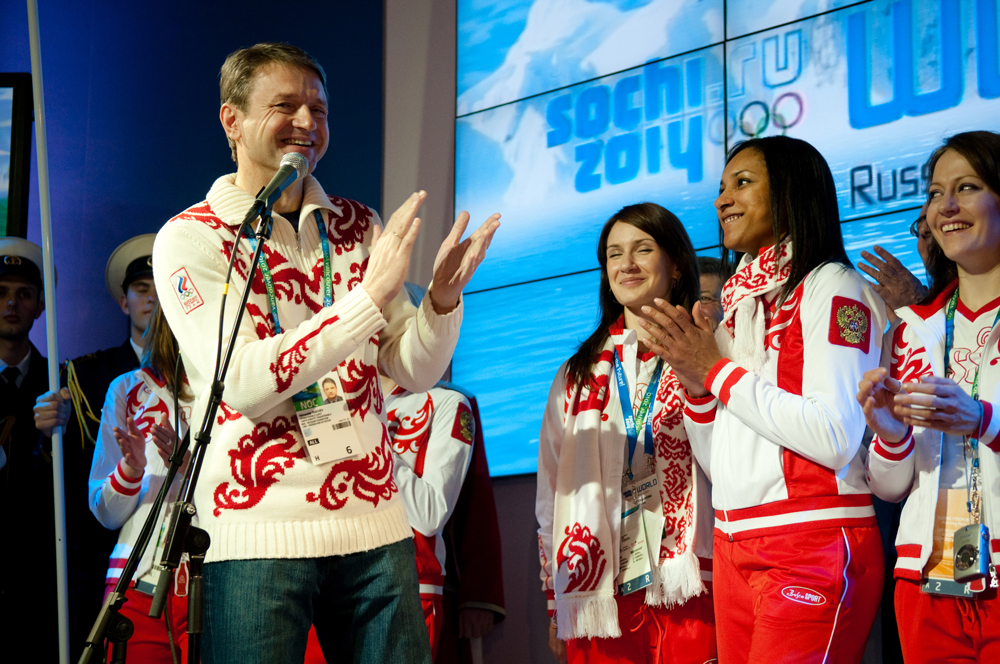
Krasnodar governor Alexander Tkachev, whose powers expire only in 2017, may have to be re -elected much earlier
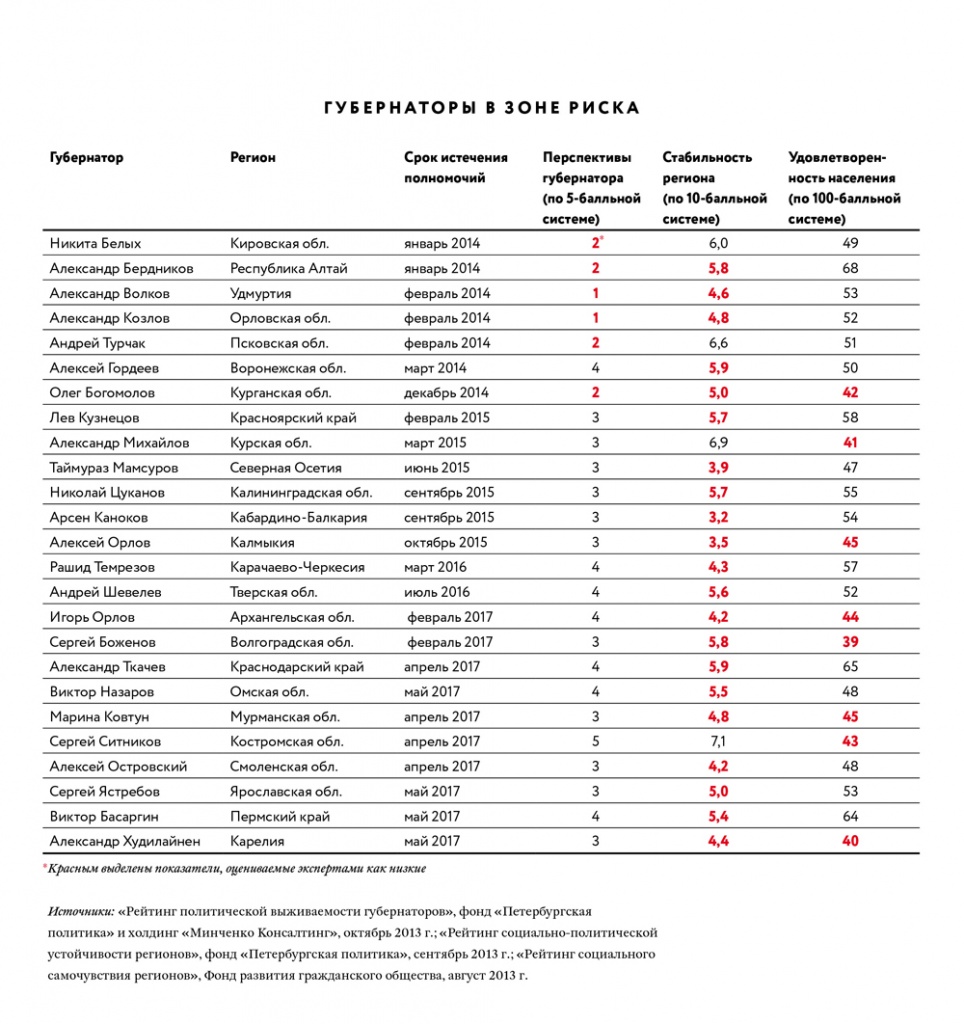
As for those who really have to leave, the results of recent regional studies of leading analytical services give a clear idea of the main “flight candidates”. As can be seen from the table (see p. 36), there are 25 governors in the risk zone, which received estimates “below the average” for at least one of three parameters. And the main applicants for resignation can be considered those who have two or three such assessments - this is primarily Oleg Bogomolov (Kurgan region), Alexander Volkov (Udmurtia), Alexander Kozlov (Oryol region) and Alexander Berdnikov (Altai Republic). All these heads of regions expire in 2014, therefore, the replacements selected by them at the top, it is likely to be appointed before the end of 2013 - so that the Kremlin managed to calmly check the new appointments in the case and either fully “promote” them to the elections, or to make a second replacement if necessary before the start of the election campaign.
Well, at worst, the federal center will have a backup option: some regional leaders, even from the category of “most dangerous”, can not yet be touched and returned to this issue only in the fall of 2017, after they are already overlapping for the next five-year term. It was then that the Kremlin will make them an offer of early resignation, from which they will not be able to abandon. True, it will be much more difficult to explain the motives for the replacement of the newly elected governor than to justify the need for early elections of the head of the region, which has worked for two or three years. But this circumstance can be attributed to the number of inevitable costs in the upcoming struggle for the desired result in the 2018 presidential election.
Photos: Alexander Karpov/ITAR-TASS, Yuri Martyanov/Kommersant, Mikhail Klementyev/RIA Novosti