
Translated material
Sochi deposit
How the capital of the Olympiad survived the election campaign
“Sochi is a full -fledged political battle,” the president said in a recent interview with Novaya Gazeta. What distinguished this “fight” and how the future capital of the 2014 Olympics chose the mayor-observed The New Times 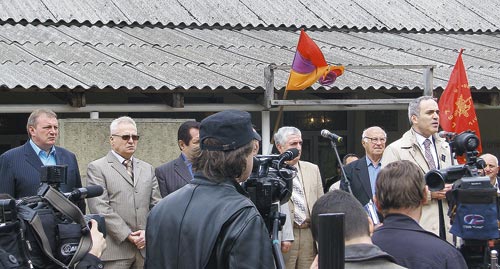
An unequal battle is a full -fledged political battle involves equal conditions for the struggle of candidates, their programs, and ideas. But there was no competition in Sochi. Candidate from "United Russia" acting Mayor Anatoly Pakhomov was successful with local television channels (about five of them), which refused to place Nemtsov’s campaign clips. Pakhomov flashed in each news issue, together with the governor of the Krasnodar Territory Alexander Tkachev, then with the specially arrived Moscow mayor Yuri Luzhkov, then with President Medvedev, who accepted the acting Sochi mayor at the end of March. Nemtsov was also shown on television, but exclusively in connection with the "Korean history." As a result, Nemtsov had to bet on meetings with voters who took place right on the street, because his headquarters also did not manage to rent the premises - so Sochi did not need money, and that’s it! Most of the agitmaterials were arrested in the printing house. At the meetings of residents, it was most interested in how Nemtsov was going to solve the problem of Olympic construction projects in Sochi and what he sees exits from the socio-economic crisis that covered the city. Nemtsov spoke about the need to return the city with a separate line of financing to the federal budget and freeze the construction of a number of sports facilities. During one of the meetings in the market, the pensioner began to blame Nemtsov of Orange. “I hate you all,” the grandfather shouted. “You, and Chubais, and this of your ... Gaidar! ..” “This is probably a living political discussion,” Nemtsov laughed.
Without failures - in favor of Anatoly Pakhomov - worked out an administrative resource. The early turnout made 3%as a result. “Most vote for Pakhomov,” the new Times told The New Times, two days before the election, an employee of the election commission in the village of Veselia. The city election man unexpectedly announced that not only Sochi, but also citizens of Abkhazia received the right to vote in the elections. It turns out that after the recognition of the independence of Abkhazia, many residents of the republic issued Sochi registration so that they could receive Russian pensions. “We could not even suggest that they would show interest in our elections and want to participate in them,” the chairman of the city election commission Yuri Rykov justified. He specified that several thousand Abkhazians expressed a desire to vote. The headquarters of the opposition suspect that the Abkhazi unexpectedly concerned about the fate of Sochi will support the candidate from the party of power.
Pakhomov himself all the last days of the campaign opened kindergartens and repaired schools, met with state employees and distributed an interview with “his” media. To the requests of journalists about an interview with the candidate, the press service of the acting The mayor replied: "Sorry, it will not work, he spends all the time in the village."
The last day of agitation coincided with the anniversary of the Armenian genocide. In the village of Nor Louis, next to Dagomis, about 250 representatives of the Armenian diaspora gathered for a rally at the monument to the victims of the genocide. The authorities could not ignore the event, and as a result, at one event, the acting Mayor Anatoly Pakhomov and the ex-champion of the world of chess Harry Kasparov, who came to Sochi in Sochi for Nemtsov. Pakhomov performed at the very beginning of the rally and called the genocide “animal miracle”, assuring the Armenians that the Sochi authorities “will support the holding of all the useful events that you carry out”. The mayor was carried out with lethargic applause. Kasparov was also allowed to speak, however, they very quickly tried to interrupt him, referring to the regulations. The crowd supported the famous chess player and interrupted his speech with applause several times. The Pakhoma, standing away from the microphone, frowned and immediately after the end of the rally fled. Making his way to the car, he stumbled upon the headquarters Gazelle Boris Nemtsov and, it seems, was completely upset, seeing his portrait. “It could have been worse if this one came,” one of the local officials tried to reassure the candidate. Kasparov could not get out of the crowd for a very long time, distributing autographs and taking pictures with everyone as a keepsake.
At 5 pm, completing the campaign, Boris Nemtsov held a final rally in front of the city administration building, which gathered about 400 Sochi. The “Young Guard” tried to disrupt the event, which arranged a sports day and sent a group of young people in Korea-2014 T-shirts for a rally. The provocateurs were dispersed.
Other candidates for the mayor’s post in the last days of the campaign did not show themselves. Only the leader of the local branch of the Communist Party of the Communist Party, Yuri Dzagania, who gained more than 12% of the vote in the past elections, held a rally and agreed with Nemtsov’s headquarters that the opposition would coordinate the work of its observers in polling stations.
Pulling the electorate from Abkhazia, the local authorities did, at the same time, it seemed that everything possible so that the Sochi themselves would not come to the polling stations. The correspondent of The New Times in Sochi failed to find visual agitation of candidates and even just election advertising. Only one poster on the building of the city administration reported about the approaching voting day of the voting. All shields in the city were scored by advertising of the 2014 Olympics.
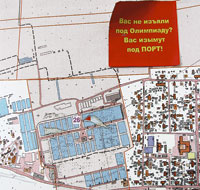
It was necessary to advertise the future to the detriment of the present for two reasons. Firstly, Nemtsov’s candidate built all his campaign around the idea that the Olympics should be held not only in Sochi, but also in other cities of Russia, since Sochi are subtropics, and the 2014 Olympics are winter. Secondly, in two years the townspeople did not notice modernization. So far, only destruction. In the Imeret Lowland, for example, a couple of weeks ago were demolished the greenhouses of the Russian state farm. At the site of the greenhouses, it was decided to build a port, which initially had to appear several kilometers closer to the Abkhaz border. Buildings were taken out of the huge field, leaving a lot of broken glass. “There will be no more fruits, and if the port is built, then tourists too,” Galina lives on Tsimlyanskaya Street in Imeretka and leads a tour of the places of recent destruction. The construction of the port has not yet begun. The construction of any of the Olympic facilities has not yet begun. At the moment, the symbol of the future Olympiad is a fence. The imported Turkish builders here and there begin to install fences, but they, having called the police, are driven away by local residents. Many Imeretins are forced to leave their homes, explaining this by Olympic needs. At the same time, authorities do not offer appropriate compensations to residents.
With the beginning of the campaign, people have a hope that even now they will pay attention to their problems. But even despite the fear of losing voices in favor of Nemtsov, the acting authorities did not go to negotiations with residents.
It was among the inhabitants of the Imereta Valley that the support of Boris Nemtsov was the highest. The opponent of the Party of power and the support of most representatives of the numerous Armenian diaspora was enlisted. Harry Kasparov, who came to support his colleague Harry Kasparov, who came to his colleague Harry Kasparov, helped him to support this. He traveled with Nemtsov by meetings with voters and often enjoyed even a great success than a candidate.
Before the “Day of Silence” a day before the election, a telephone sociological survey (sample - 2000 people) showed: about 50% of the Sochi residents are ready to give their votes for Pakhomov’s candidate, about 30% for Nemtsov. Having arranged a bullying campaign, the Kuban authorities only added popularity to the opposition. Relying on his failure, Nemtsov was not removed from the elections, but until the very finish of the campaign, he was confident at least the second, losing only to the administrative resource. “They (power) want to ensure that we believe that nothing depends on us, as if we are not deciding as if nothing can be done,” Kasparov told the Sochi people gathered around him. - When I lost in the match for the championship Karpov 0: 5, it also seemed that nothing could be done, but in the end I managed to win. Then I was alone, but now there are a lot of us. ” The men nodded in agreement, but, diverging, they still said: "Pakhomov, of course, will become the mayor, but we will vote for Nemtsov, let them know that not everyone agrees."
Anapa - Sochi.
The resource of Anatoly Pakhomov, candidate from the party in the fall of 2005, having arrived from Krasnodar and entering the post of acting Mayor, Pakhomov was surprised that the resort of Anapa is most popular among residents of the southern regions of Russia. Whereas in the city were specially provided for preferential therapeutic programs for children and adolescents from the northern regions. But these quotas were chosen so tiny that the very expediency of their existence was called into question. Anatoly Pakhomov began to understand and quickly found out that efficiency suffers due to which he could hardly allow: at the then price of the Magadan-Anapa-Magadan, about 60 thousand rubles, any “benefits” at the resting place look almost meaningless. Pakhomov attracted the Siberian students by the sea and the sun for the improvement of local beaches. “You would try to make local youth work like that,” said Pakhomov. “These hereditary loosers, whose ancestors rented apartments and rooms to visitors for decades and did not bother with the minimum restoration of order even in their own areas: they were lazy to dig in human growth, explained that the plant was giving a shadow.”
Even the new mayor was amazed at the abundance of wine and beer stalls permitted on the beaches-this is in a children's resort! All alcoholic trade has significantly moved away from the coastal zone, and this zone itself has strongly ennobled. In his first bossal season, Pakhomov laid the embankment quite a Euro at a couple of years and brought it to mind, simultaneously chasing a service car for drivers throwing a bottle and other garbage from the window - before that they were fined for a ride in permanently into a permanently intoxicated form. Yes, and the state of police, lazily-resort, for the most part replaced with a servant from Krasnodar.
Those who saw Anapa before and during the appearance of Pakhomov in it said that the city is clearly changing for the better. The mayor also had a program for the further development of the children's resort, but in January of this year, Governor Tkachev, who at one time “urged” Pakhomov to move to Anapa, invited the Anapa mayor to resign “in connection with the transition to another job”. He quickly crossed.
Sergey Mikulik
Sochi