
Translated material
Paris bag
Eternal bag. The exhibition of the most expensive leather galanter in the world from Louis Vuitton has become the main attraction of this summer in Paris. The New Times has plunged into the atmosphere of French luxury 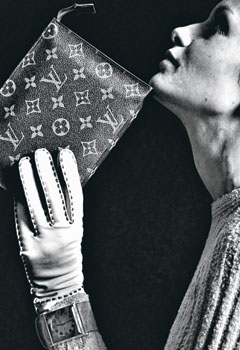
On foot to Paris
Louis Witton was only 14 years old, when in 1835 he arrived in Paris. A boy was born in a little -known town of Yura in the family of a carpenter. From early childhood, he possessed the carpentry tools. This was enough for bread, but it was not enough to live a person with ambitions. Louis made his path to Paris with a length of 400 km on foot, working on his craft on the road. After two years of life in Paris, he managed to get a apprentice in the workshop of Monsieur Mareshal, specializing in the manufacture of road chests and hat boxes. There were no suitcases in the usual meaning of this word, they were just invented by Louis Witton, thereby committing a revolution in this important matter. The end of the 19th century coincided with the development of railway transport and cruise liners: people began to move more actively, it was difficult to carry chests with them. The flat suitcases proposed by the master (they were called Trianon, by the name of the fabric that were covered) made a splash: they could be placed one on the other and easily opened on the side. In addition, unlike heavy wooden chests, they were made of leather and special waterproof fabrics.
The subject of luxury
But before achieving a tangible success, the young man worked for 17 years in this workshop and only then earned enough money to open his own business. In Paris, his fate brought him with Charles Frederick Wings, an Englishman who went to France. He studied the story of the costume and created outfits himself. The first success of the Worth was a dress of tulle, margaritas, pink hearts, beams of grass and silver sparkles, which was put on by the wife of the Austrian ambassador on the solemn ball in Tuileries, the residence of the French emperor. There, this dress was admired by the wife of Napoleon III Empress Evgeny, who attracted the Wings to the composition of her toilets. Vort specifically at her request was invented by Crinoline (a light frame put on under a dress), thereby riding women from heavy lower skirts, and soon became a court tailor. 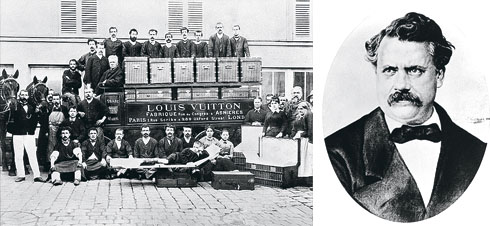
Around then, Louis Witton’s friendship with Charles Wrnet was entrenched. After all, Witton did not just invent a suitcase, he began to make suitcases and bags as objects of luxury, which only the most wealthy people could afford. For example, a suitcase with a hanger. Or with special departments for fans, gloves and other accessories. There was even a suitcase. One of Witton’s main clients, as in the case of Wort, was the same Empress Eugene. A beautiful Spaniard introduced in Europe a fashion for travel, comfort, perfumes, large hotels and a vacation on the coast of the Atlantic. Witton was appointed the empress’s personal packer.
Creating an empire
Louis Witton was at the right time in the right place. In 1854, he opens his first store in the Champs Elysees-not yet the big one that every shopaholic knows. Among his clients are Indian Maharaja, French and American nobility and even the Russian royal family, and among friends such stars as Sarah Bernard. Already at this time, Witton products begin to fake competitors, and in order to avoid fakes, he comes up with a special bright fabric with a waterproof impregnation, which makes his suitcases immediately recognizable - the very striped tissue of Trianon, which gave the name to suitcases. The other proprietary fabric of Witton - “in the checker” and in the brown gamut - is called “Damier”. To avoid fakes, he is one of the first to begin to put his own monogram on the products. 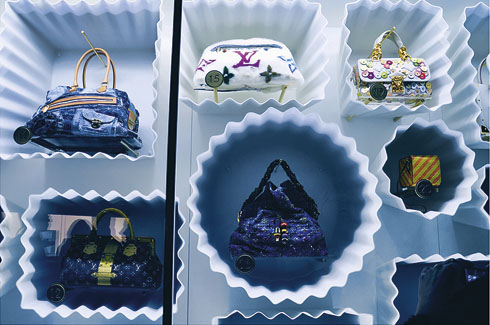
The company became the world brand thanks to the heirs of Louis Witton - the son of Georges and the grandson of Gaston, who retained the motto of the brand: "Each suitcase should combine high mobility and lightness." Georges drove with advertising tour throughout America, began to open shops in other countries. In 1895, under his leadership, the famous Monogram branded canvas was developed-an ornament consisting of a beige circle containing a four-leaf flower, curved beige rhombus containing a four-beam star with a point in the center, as well as the initials of LV in memory of his father (he died in 1892, then the company began to produce women's bags for the first time). 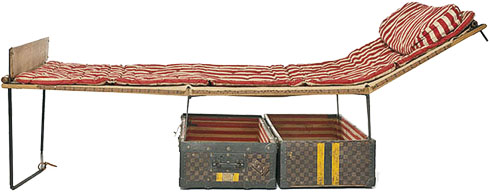
In 1901, the company creates a light and soft Steamer bag, which becomes a prototype of the future collection of hand luggage from Vuitton - these bags are covered from a whole piece of skin and a lifelong warranty is distributed to the purchase. In 1934, a trapezoidal bag was specially issued by Coco Chanel. At first it was the personal Ridical Coco Chanel - after years, the model was called Alma. In total, under Georges Witton (he died in 1936), 700 new models of bags were released. Then there was a hushed -up period of cooperation with the Nazi regime during the Second World War - in this Witton, unfortunately, was not alone ... In the history of the brand, 1978 was especially noted, when shops in Japan were opened and there was an inexplicable boom for these bags. Rich Japanese women were even ready to fly after them on the other edge of the Earth. Due to the wild queues that they began to arrange in Paris in a store in the Champs Elysees, they were even forced to introduce a temporary quota there: tourists with Hokkaido give out in some hands no more than two bags. 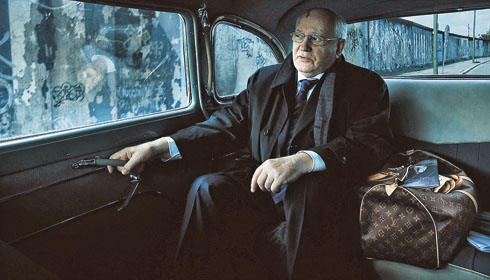
Once Coco Chanel said that her famous jackets should be inherited-from mother to daughter (which is now happening). The same applies to bags. Therefore, in the Louis Vuitton advertising campaign, stars such as Catherine Denev, Sean Connery and Angelina Jolie are removed. Mikhail Gorbachev also starred. In an advertising picture, the former president of the USSR peers from the window of the limousine into the remains of the Berlin Wall, and from the Louis Vuitton bag lying next to him is peeping the New Times magazine with the announcement of the murder of Alexander Litvinenko.
King of shocking
In 1997, the company made another turn in its development - again became a manufacturer of luxury goods. That is why American designer Mark Jacobs was invited to the position of art director Louis Vuitton. Inviting a provocative and scandalous American to a bourgeois French house with old traditions was risky. Mark Jacobs was faced with the task of creating for Louis Vuitton the first collection of finished clothes and accessories. The artist abandoned the conservative gamut and presented a completely different concept: bright colors, crazy glamor, avant -garde solutions. “Louis Witton is not a fashion house, but a“ fashion house ”. We do everything in a fashionable, thinking about fashion, trying to catch the spirit of time, making the best examples of popular culture into fashion, ”says Mark Jacobs. Now the products of this brand are worn not only by elderly ladies, but also by young women and pop stars. 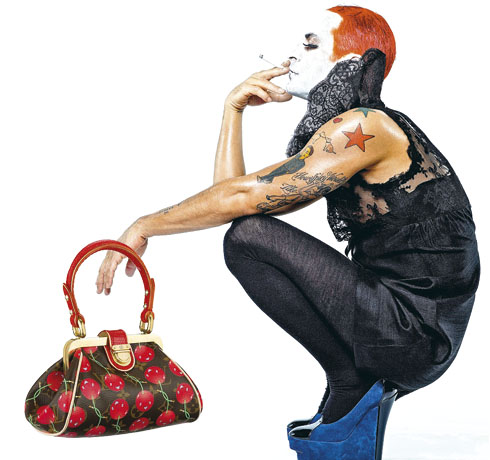
The provocative behavior of the designer himself gives his collections additional charm. Mark Jacobs is included under the eighth number in the list of fifty most influential gays and lesbians of the United States, compiled by OUT magazine. He does not hide his orientation, but defiantly flaunts it, appearing at the most important tricks in specially tailored dresses. So, his last dress, which he put on in New York on a kind of Oscar for designers-Met Gala-was made of transparent black lace, and on the feet of the brand were varnished shoes with large buckles. 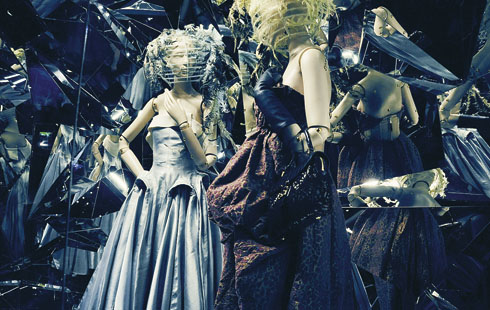
The humor with which Mark Jacobs refers to his image also applies to his collections - in them he successfully combines the irony and his own understanding of the glamor.
Louis Vuitton bags are expensive
The price of a classic road bag is $ 2.5 thousand, ladies' design bags of past years can be bought for $ 1-1.5 thousand, new models - from $ 3.5 thousand and above. Medium sizes of the suitcase will cost $ 4 thousand Louis Vuitton the most faked brand in the world. Every year, the company spends up to € 20 million on the fight against counterfeit goods and has the right to even confiscate the suspicious product from the buyer who acquired it. There are several recommendations on how to distinguish a fake from the original. Louis Vuitton sells its products exclusively in branded boutiques - today there are more than 350 around the world. There is definitely the inscription “Louis Vuitton - Maison Fondée En 1854” on the corporate bag, and only in this order. The accessories of the brand are packed into the signature pleasant to the touch boxes with a special “tongue”, which helps to open them. Louis vuitton boxes are dark brown on the outside with a beige sliding part. As a rule, boxes are tied with a rope made of rubber material resembling the skin. The secret detail of the product is the date code that should coincide on each part of the bag, for example, on the inserted wallet and the bag itself. If the bag was produced after 1995, the code consists of two letters and four digits. The pens are packed in cellophane, but only when they go to the stores, when they are put up for sale, cellophanes are sure to be removed. The LV logo is very important for the company, on branded products you will never see it cut, skewed, placed asymmetric or inverted.
The most interesting order entered the company from China
The customer asked him to make a suitcase 190 cm high, which would place equipment for the preparation of coffee and two plasma screens for viewing TV and DVD, and all this was supposed to eat exclusively from solar panels. Every year, about 4 million animals are used to produce bags.