
Translated material
Live to a referendum
In Karakas, mass protests are held at the call of the Venezuelan opposition. 2 million signatures have already been collected in favor of departure from the post of President Nicholas Maduro. Why the people are dissatisfied with the authorities and whether it will be able to change it peacefully - the New Times found out
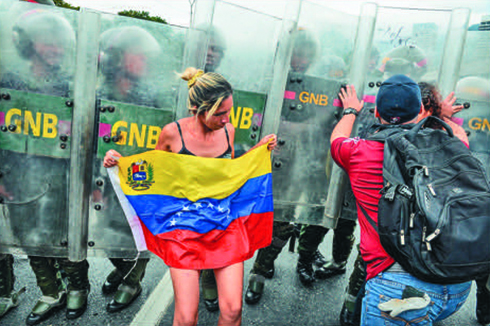
Peaceful manifestations moved into clashes with the police, Karakas, May 11, 2016
We have hunger, we have nothing to have, it’s scary when people have nothing to eat in such a country! ” - She did not say, but shouted to Guadalup. An elderly woman from the working family, she, along with her two daughters and grandchildren, lives in the small village of Guakar, which is 154 kilometers from Karakas. Once this village was part of a fairly developed industrial zone of Carabobo. Today everything is different. “To buy at least some food, you need to stand in the queue of five hours,” says Guadalup. - quarrels often flare up in line and fights begin. And at the exit from the store, bandits are already waiting for people with bags and take food from them. We are just afraid to go there, we can easily kill us there. ”
The daily diet of the Guadalup family - bananas, corn, yukka (food root -fruited tropical plant. - NT ). "Eggs? For several months I have not seen them on sale. And I don’t remember the last time I ate meat. ”
Life due to handouts
Each Venezuela has his own day in a week when he can go to the store. This day is determined by the last number of the number of the identity certificate. On other days for people, retail outlets are closed. But even having come to the store on the “right day”, you can be left without food.
“On Friday, I took the turn at 4 in the morning, and at 4 o’clock in the afternoon I returned home empty -handed,” says Judit, who works as a concierge in the house where your correspondent lives. “There were no products at an affordable price at all, but I did not have enough money for those that were.”
The eldest daughter Judit graduated from the university and got a job abroad. “Thank God, she sometimes sends me a little dollars to at least acquire something in the black market,” says Judit. “I began to live like Cubans who receive money from relatives from the United States.”
Felipe, the tenant of the same house, says that he cannot stand in lines on the appointed day, because in this case he will have to miss the work: “So, one fine day I will be expelled, and then I will be left without everything.”
“I saw with my eyes how some officer tried to pull the chicken from the window, and when he was stopped, he pulled a gun from his holster, took the chicken and left, without paying.”
There are a great many such stories in Venezuela, which is now experiencing the worst from a socio-economic point of view for many decades.
Moreover, not only people from unsecured families suffer. It is difficult for everyone, including representatives of the middle class. Elisabeth, a professional doctor, also complains that on the day when it was her turn to go to the supermarket, the shelves were empty. “Eggs in the store are 300 bolivars (a little more than $ 30. - NT ) for a dozen, but there they are very rare, and they are already sold on the street for 2800 Bolivars. I can’t buy at such a price. ”
Elisabeth complains of a “terrible sense of humiliation”: in order to take out the products from the supermarket, you have to take your fingerprints so that the same buyer could not come twice for food.
Another acquaintance of the author of these lines, engineer Jose Lugo, says that he repeatedly saw how several of his colleagues tried to find the remains of food in garbage tanks.
The authorities do not just turn a blind eye to the Venezuelan drama - they carefully refute all this. The Minister of Foreign Affairs of Venezuela Delesi Rodriguez, recently speaking in Washington at the OAG Extraordinary session (organization of American states. - NT ) accused certain external forces of unleashing the "Campaign of Disinformation against Venezuela." According to her, the country purchases food in an amount sufficient "for three Venezuela."
This is not true. The country does not buy food, but weapons. In 2015, the Karakas government, according to the Institute for Research of Peace Problems in Stockholm, spent $ 162 million on military purchases from Russia alone. And in 2016, as our Minister of Finance announced in the National Assembly, even before the opposition won the parliamentary elections, the government intended to spend 2.4 billion Bolivars ($ 240 million).
Many people ask: how is the military living today, which are considered one of the pillars of Chavist power? Someone believes that they have everything they need. Others assure that they also have a hard time. “I saw with my own eyes how some officer tried to steal a chicken from the window, and when he was stopped, pulled a gun from his holster, took a chicken and left without paying,” says Jorge, a street fruit merchant.
Hospitals that have become morgues
When the conversation comes to local hospitals, the face of the lord of Guadalup from the village of Guakara is even more dark. According to her, in local hospitals absolutely everything - from the simplest solutions to syringes and enemas - patients are required to buy themselves. At the same time, surgical operations in Venezuela have almost never been done. “The surgical department has been closed in our guaakar,” says Guadalup. - In the hospital in Valencia, the capital of the state of Carabobo, they say that the operating room is infected not clear what. And also - in many places. "
Maternity houses are filled with pregnant women from one place to another, and often women give birth right on the street. “Recently, I went to the hospital and saw there a huge number of children with diarrhea, amoebiasis and fever Denge,” says Guadalup. “When there is no soap or toilet paper on sale, there is no need to be surprised at the rampant unsanitary conditions.”
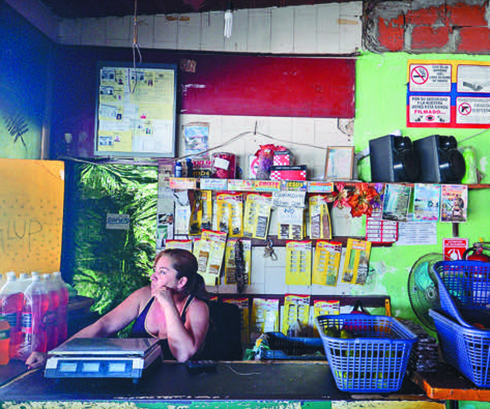
Not only is there nothing to buy, and electricity is constantly disconnected. *Shop in Santa General, Venezuela, April 2016*One of the ambulance doctors, he asks to call him Jorge, does not want to indicate his real name out of fear of losing his job, for which he receives real pennies,-says that in their hospital people die because of the lack of drugs. “Doctors have no gloves, very rarely have syringes, an X -ray has been absent from the time of Hugo Chavez * . The maternity ward is generally closed for a long time, ”the interlocutor NT , a professional doctor with twenty years of experience, continues the story. - There are no drugs to reduce the temperature, there are no antibiotics, there is nothing that would prevent a heart attack, there are neither laxative nor sedatives, there are not even ordinary bandages and cotton wool. The windows in pharmacy points at hospitals are closed with sheets, because there is nothing in pharmacies. The picture was depressing during the time of Chavez. Now all hospitals have turned into morgues. ”
In addition to all, the country is catastrophically lacking doctors-they leave the profession due to extremely low earnings: a graduate doctor in Venezuela receives an average of about $ 34 a month, while Cuban doctors working in Venezuela pay $ 400. However, they also flee the country, trying to get asylum in the United States.
“In our country, professional doctors were replaced by arrears who only master the basics of the profession and often elementarily kill patients because of their ignorance,” says Jorge.
Nevertheless, because of the fear of losing his job, he refused to put his signature under the petition in favor of the referendum on the impeachment of Maduro.
Maduro will leave, the same will come
“What is happening now in the country has nothing to do with Venezuela to Chavez,” is convinced by Heronimo, a writer living in Karakas. “Yes, Chavez sowed toxic seeds, but now it has become even worse under Maduro.”
Heronimo is convinced that a universal uprising may be a way out, which will sweep away everyone who represents the current regime. An alternative to this is a nationwide referendum on the recall of Maduro, which the opposition intends to achieve. By law, the president may be withdrawn after he spent half of his term at the post. Maduro passed his “equator” in April. His opponents have already collected almost 2 million signatures in support of the recall, which several times higher than the necessary norm. They have to collect another 4 million - for the “final resolution of the issue”. Among those who support the referendum are many Chavists, former supporters of the current government.
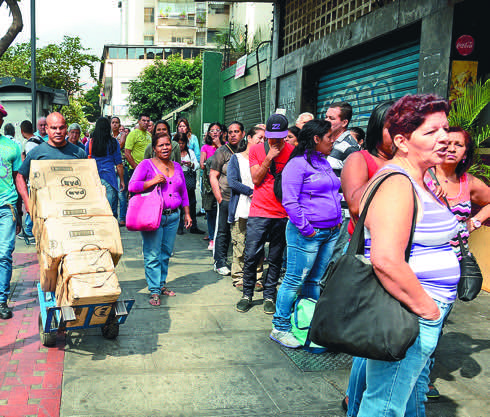
** The usual picture: the queue of the supermarket, ***Karakas, February 2016*However, the terms for the referendum are very compressed. The National Electoral Council, which is under the full control of the government, must approve all the signatures, but, as the former chairman of the council warned, now the mayor of one of the municipality of Karakas Horge Rodriguez, "the opposition will not receive a referendum this year, and the signatures will not be confirmed."
In the fight against the opposition, the authorities use the energy crisis that erupted in the country due to drought. In order to save electricity, the government reduced the working week to two days to two days, Karakas and other major cities for the same reason over the past two months are open four days a week and are required to provide themselves with electricity at the expense of their own generators. Venezuelan schools also work according to the same four -day schedule. The emergency plan, which provides for constant fan shutdown of electricity, was adopted in February for two months, last week it was extended for another two months - until the beginning of June. The authorities use the energy crisis not only to limit public events, but also to “squeeze” the electoral schedule.
** “There are no drugs to reduce the temperature, there are neither laxative nor sedatives, there are not even ordinary bandages and cotton wool. Shoes in pharmacy points at hospitals are closed with sheets, because there is nothing ”**Indeed, in order to remove Maduro from power and declare universal elections, you need to hold a referendum in November. But even if the plebiscite passes successfully, this is not a guarantee of Maduro's resignation - the opposition needs to have time to launch the electoral process until January. Otherwise, Maduro’s place-until 2019-will come to the Vice President Aristobulo Heduuris, and this will mean the preservation of the current regime. That is why many Venezuelans doubt that the country will be able to get out of the deepest crisis peacefully.
Engineer Jose Lugo, who was still Hugo Chavezi, expropriated the company, but who “still has the means to leave the country”, recalls: when Chavez in 1998 first won the elections, oil cost $ 6.50 per barrel, but the supermarkets were full, the country was inherent medical care, no one knew about any “groups” and “social missions”, there were no secrets Agreements between the government and the semi -war gangs of criminals, holding in fear and terrorizing people. Soon after Chavez came to power, “he took off the mask, and everyone saw that it was a communist”, “Then we first heard the word“ comrade ”from him,” says Lugo, the father of four young children, who, according to him, have no future in his homeland. And he concludes: “What began in Venezuela 17 years ago will simply not end. The regime will not allow any referendum to hold, he will never give up power peacefully. We will inevitably have to go through violence. ”
*Evgeny Bai took part in the preparation of the material** President of Venezuela Hugo Chavez died of cancer in March 2013.
Photo: Federico Parra/AFP