
Translated material
One against Chavez
Chances of oppositionist Enrique Capriles
One against Chavez. Venezuela approved a single opposition candidate in the upcoming presidential election in October. The challenge of Hugo Chavez, who has just had an operation to remove the new cancer tumor, was thrown by the 39-year-old Governor Enrique Capricles Radonski. His chances of defeating the current president appreciated The New Times
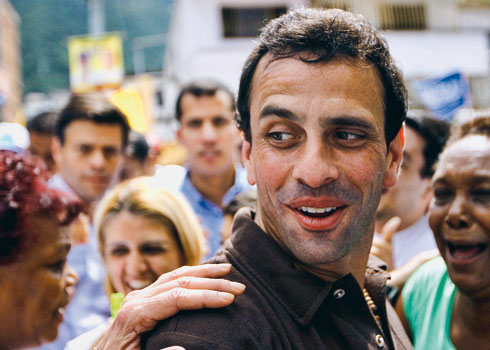
It will be a hotter
The Venezuelan election campaign is somewhat reminiscent of the Russian one. 57-year-old Chavez in power since 1999, that is, almost as much as Vladimir Putin. Both are seen in the opposition to the "settlers of the United States", whose services are "paid for the American State Department." The main slogan of both leaders: while they are in power, in the country - stability. The propaganda of Chavez, however, is a little more radical than that of Putin: in the case of the opponent’s victory, the main builder of Bolivarian socialism “guarantees” the nation of the civil war, while the Russian nationalizer is still limited to the call to “die near Moscow”.
But there are still more differences between the elections in Russia and Venezuela. Enrique Kapriles, a lawyer by profession, is the current governor of the state, one of the richest in the country. He became the main competitor of Chavez in the elections according to the results of the February primaries in the opposition camp - the first over the past 13 years. Capriles won a difficult struggle between five candidates, almost all of them are either governors or mayors. 62% of the vote was cast for it, and 3 million voters took part in the vote. This means that now 16% of 18 million Venezuelans who have the right to vote are ready to support the opposition candidate. 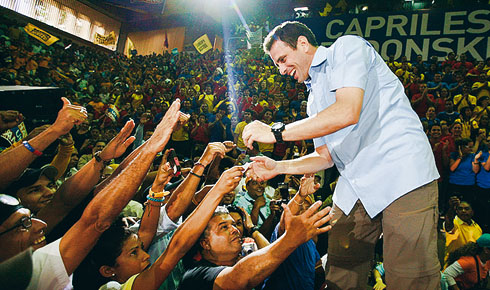
Both the ownership of the primaries, and the election of a single opposition candidate became a major success of the opponents of Hugo Chavez. Since 1999, when the lieutenant colonel came to power, the opposition in Venezuela was fragmented, disorganized and could not agree on any joint actions. And although, according to the latest sociological surveys, Chavez is leading in the race, bypassing his opponent by almost 20 points (60 versus 40), Capricles’s positions can intensify - if only because four opposition candidates lost their electorate for him to vote for him.
"Zionist and fascist"
Enrique Kapriel Radonsky is the grandson of Polish Jews, who in the 40s of the last century fled from the Nazis to Venezuela. Enrique's great -grandfathers were shot at the Treblink concentration camp, and his grandmother Lily Bolshochechenk de Radonsky hid from the Gestapo in the basement of her house in Warsaw for 20 months. Venezuela Lily and her husband Andres Radonsky reached the banks of Venezuela after long wandering in 1947. Looking around, opened cinema in the east of the country. Now their grandson Enrique is the heir to one of the widest cinema networks in the country.
As soon as the Caprilesis of Chavez did not call the Capricles: the “American agent”, and the “fascist”, and - apparently, creatively “processing” the biography of the relatives of Capriles - “Zionist”. The Capricles himself, like the vast majority of Venezuelans, Catholic. Thinnated insults against him are a clear evidence that the President Chavez team perceives him as a strong and dangerous rival.
By the way, the most sensational “exposure” of the opposition emanated from the frantic pro -government television team Mario Silva. He read a certain police protocol on the air, which indicated that in 2000 Enrique Kaprles was allegedly seen in his car "during sexual actions with another man." Kapriles in response stated that this "supposedly police report is pure insinuation." However, for some reason, the police authorities did not comment on the commentator’s statement, although it was not difficult to test their reliability.
However, in Venezuela people like Mario Silva do not make the weather the weather. An essential part of the Fourth power, including large daily newspapers and a national Globovision television channel, supports the opposition today: strong means of protection remain at Enrique Capriles.
Imitating Lule
In the ideological platforms of Chavez and Capricles, paradoxically, there are no dramatic differences. Chavez is a classic left populist who decided to revive traditional socialist ideas. Capricles speaks of himself as a levocentrist, and he considers the former Brazilian President Inasiu Lula da Silwa *** President of Brazil in 2003-2011, the co -founder of the Socialist Party, in which the Brazilian government paid great attention to large -scale social programs, not forgetting to observe democracy and respect the values of the free economy.
“Capriles loves to repeat that“ he was elected (the same candidate from the opposition.-The New Times) is not to fight someone, but to solve specific problems of ordinary people, ”notes the Venezuelan historian Margarita Lopez Maya in a conversation with The New Times. “In the state of Miranda, he is often seen in a T -shirt and jeans on the streets of poor quarters than in the office.” At the same time, Capricles always opposed the confrontation, militaristic style of Chavez, accustomed to conducting mass rallies under the slogans "Who is not with us, that enemy and footman of the Yankees." By the way, during the election campaign, Capricles avoids direct personal attacks to the seriously ill patient chavez. “I want to fight only with crime, unemployment, corruption,” says the opposition candidate. His peaceful style is one of the main factors that brought him success on opposition primaries. “The nation is tired of the aggressive pressure of Chavez, from his speeches, only sharing our already polarized society,” thinks Margarita Lopez Maya.
According to sociological surveys, 80% of the Venezuelans consider uncertainty in the future their main problem and most of all fear for personal safety. Even according to the official figures of the Ministry of the Interior and Justice, in Karakas for 100 thousand people account for 48 murders. And in total, 19 thousand people are killed annually in the country, which puts it on a par with regions of military operations in Africa and in the Middle East. 43% of the active population, according to the Spanish newspaper El Pais, is busy in the “informal sector” of the economy, that is, he is engaged in illegal trade and smuggling anything, from gasoline to drugs. And the level of inflation in Venezuela is one of the highest in the world - 27.6%.
Great communicator *
The Chavez government for 13 years spent multimillion -dollar amounts for the construction of dwellings and hospitals for the poor, laying roads and aqueducts. “The secret of Chavez’s popularity lies in the fact that he is a“ great communicator ”who communicates with the nation daily, promising her golden mountains,” says Margarita Lopez Maya. In Venezuela, for example, there is a social program for the construction of dwellings for low -income citizens Mision Vivienda (“Housing Mission”). The author saw with his own eyes how people are recorded in it. “Do you want to participate? - asks the official of the person coming from the street. - Fine. We will build a house for you. But it will be in seven years. Well, maybe in five. ” 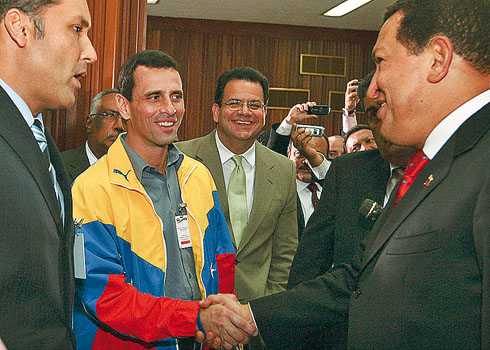
This new participant will almost certainly vote in October for Chavez. He thinks simply: here is the president who will give me the house. And the other is almost certain. Chavez in each of his speech claims that if he is not re -elected, "chaos for the poor will come in the country." Capriles disavow it as he can. He says: look, in the state of Miranda I did not turn either a “housing mission” or a single other social program of the federal government. And I'm not going to do it in the future. " But in order to convince the population to vote for him, Capricles for the remaining eight months to carry out a titanic campaign work, visit the most distant and poor corners of the country. "
Chavez in every speech claims: if he is not re -elected, chaos will come in the country. Caprice disavoizes it as it can
“Another factor playing in favor of Chavez is the fear of Venezuelan state employees to lose their places or benefits, if they do not vote for the re-election of the current president (something familiar is heard again, true?). This happened in 2004, when hundreds of administrative workers lost their posts and privileges after the referendum on the cessation of the presidential mandate of the Oblastoyan.
Without forecasts
However, this time, many public servants, overcoming fear, gave their vote for one of the opposition candidates. They did this, despite the instructions of the Supreme Court, to all the opposition candidate who participated in the elections until October, "in no case do not burn and not throw away their registration coupons of voters."
“Chavez still looks like a probable election winner-as social appropriations increase, its support is growing”-analysts of the international consulting group Eurasia Group came to this conclusion, calculating political risks in Venezuela. A cancer discovered in Chavez last year has not yet had a negative impact on its rating: today it is about 50%. Although the president’s assurances that he was completely cured of cancer after four chemotherapy courses in Cuba was convinced to few. In addition, in February it turned out that Chavez was discovered by a new cancer tumor, and at the end of the month he had to go to Cuba and lay down under the knife of Cuban surgeons * * The first operation in connection with the intra -zone abscess was carried out on Cuba on June 10. He later underwent another operation - to remove cancer tumors from the intestines.
** According to the latest “secret materials” of WikiLeaks, Russian doctors invited to consult Karakas, also practically did not give Chavez the chances of recovery .. Poleniev was also thrown into the fire and the words of the former doctor Chavez Salvador Navariette - he said that the president remained to live “a maximum of two years” ** . So the providence itself can also intervene in the election.
Perhaps, for this reason, Venezuelan experts do not risk giving forecasts for October. “The country is divided approximately in equal proportions into those who love Chavez, and those who hates it,” says the New Times, sociologist Luis Vicente Leon. - Every fourth Venezuela does not belong to any of these camps. A lot of undefined young people who grew up during Chavez’s presidency can play a decisive role in these elections. A high turnout will almost certainly be in the hand of Caprichee. ”
Experts so far agree in one thing: the 2012 presidential election will become one of the most intense and unpredictable Venezuela in modern history.
Enrique Kapriel Radonsky
Born in 1972, Holost. He has no children. In 1998, at the age of 26, he was elected chairman of the lower house of the Venezuelan parliament. Starting since 2000, Alcald Barut, one of the richest in the country, was twice twice.
In 2008, he received 52.5% of the vote in the elections of the Governor of the state of Miranda, bypassing a strong competitor, the former army captain Diosdad Cabel, the closest friend of President Chavez.
In 2002, Enrique Capricles was charged with preparing an attack on a foreign diplomatic mission-he sat in prison for four months. Subsequently, all charges against him were removed, but the excuse process lasted seven years.
Miranda's state
One of the 23 states of Venezuela, the most important center of the political, trade, economic and cultural life of the country. According to the number of residents (as of July 2010 - 2 million 987 thousand people) he ranks second in the country. The state ranks first in the Venezuela on the human potential development index (Human Development Index) - an integral indicator that is calculated annually for comparison and measure literacy, level of education and longevity as the main characteristics of people's living standards both between countries and within each state. Since 1990, this index has been published annually at the UN.