The global financial crisis touched the pro -Kremlin youth and communists. November holidays began to reach rallies for all political forces. The New Times summed up the last wave of 2008 street performances
The Communists, quite in accordance with the Kremlin line, are sure that liberals and the West are to blame for the financial crisis. For the traditional demonstration on the occasion of the 91st anniversary of the October Revolution, activists of the Communist Party came out with the slogans “Liberal in the government-crisis in the economy”, “We should not pay for their crisis!” And “Capitalism is bankrupt. Give socialism! " True, in addition to the usual idea to return to socialism, the leadership of the Communist Party of the Communist Party of the Communist Party did not offer any other measures to combat the crisis.
An attempt to burn the dollar
Actively the topic of the crisis began to work out Kremlin youth at its rallies. On the Day of National Unity, the movement “Russia young”, led by deputy “United Russia”, Maxim Mishchenko, staged a rally “in support of the Russian language”. Inviting journalists, Rumola activists sent a press release, which had enough spelling and punctuation errors, and almost no one remembered the Russian language at the rally itself.
“Well, Elena Yuryevna, please go! Cold!" - Schoolchildren asked their class teacher. “No, you have to stand up. Nothing, will not freeze. More recently they came, ”she answered. The frozen teenagers continued to wave the flags of the “Young” Russia movement. Elena Yuryevna, Elena Yuryevna, began to explain the New Times on what kind of ordering for rallies of pro -Kremlin youth.
“When I was very young and lived in the small city of Taganrog, I got my first scholarship,” MP Mishchenko shared with the audience. “I went to the city market and bought one thing that I will show you now and I will do something with it.” The thing that Maxim Mishchenko bought in the market for the first scholarship was one American dollar. “This is not money! Does anyone have a lighter? " - shouted the deputy to the audience, but the currency did not desperately wanted to burn, and in the crowd they were tired of waiting and advised to just crumpled and throw it out. The arsonist promised to sprinkle with ashes of this dollar of the “shamans with Wall Street”, accusing them at the beginning of the global financial crisis, but the banknote remained just a little soldered. “Do not forget our native Russian language! Remember that a killer is a killer, and a broker is just a speculator! Honor! Earth! Russian language! Honor! Earth! Russian language!" - the deputy chanted. The crowd was silent. “Something didn't go. The people did not understand, ”the young man in a green jacket said tiredly, continuing to wave the flag.
In their own way, the guys from the “Young Guard” “United Russia” decided to fight the crisis. The main culprits of all the financial troubles of the country, they declared migrants with the slogan "Our money - our people!" The young "United Russia" first picked the FMS, and then arranged a rally on the Revolution Square. The movement “ours”, which not only of a crisis, but also accused the United States, also accused the movement to master the nationalist theme after the “Young Guard”. Several thousand commissions blocked the city center, picket the American embassy. The boys and girls, wet in the rain, were brought from different regions on a free tour of the Russian capital, they held pumpkin in their hands with the names of “victims of American aggression”. For some reason, the commissars were listed in the list of “victims”, the ex-deputy of the State Duma Ruslan Yamadayev recently killed in the center of Moscow. A photograph with pumpkin, on which the name of the deceased Hero of Russia was written, caused a scandal that only intensified after the newly-naked leader of the commissars Nikita Borovikov hastened to suggest that some other Yamadaev was in mind. Confused in pumpkins, “ours” hastened to fix their mistake and after a couple of days they demonstrated the “blanket of the world” on the Vasilievsky descent. From different rags, the Kremlin activists sewed one large and all together hid under him, thus symbolizing the unity and their rejection of nationalist ideas.
Nazi Crisis
The nationalists who published in Moscow and St. Petersburg were more concerned about their problems than the troubles of the world financial system. About 600 people were published on the permitted “Russian march” on the embankment named after Taras Shevchenko under the flags of the “People’s Union” and “Russian image”. Although the organizers were waiting for at least two thousand. Under the close supervision of the police and riot police, young patriots marched along the embankment, chanting "on x ... th politics, we will return the streets to ourselves." When the procession ended, the majority scattered into the yards, and only the most faithful fans remained to listen to the ex-deputies of the State Duma Sergey Baburin and Nikolai Kuryanovich. “With all my respect for President Medvedev and Putin, until we get rid of the liberal lobby in the Kremlin, nothing will change,” Baburin explained in an interview with The New Times at the end of the event. - The liberal lobby runs our economy. First of all, I mean Mr. Finance Minister Alexei Kudrin and Mr. Chairman of the Central Bank Sergey Ignatiev. They have to get rid of them. They are now saving banks: not banks need to be saved, but people. ” “We are opposed to America to be saved at our expense,” the leader of the “People’s Union” ended his speech.
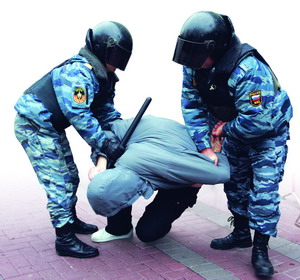
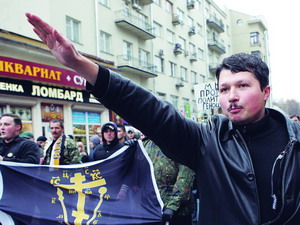
On another, unauthorized “Russian march”, organized by the movement against illegal immigration, maybe someone wanted to say about the crisis, but the desires did not coincide with the possibilities. Several hundred National Patriots were detained by the police preventively at the exit of the Arbat metro station. Planning to go through the column to Red Square to the Minin monument and Pozharsky, the nationalists eventually changed their plans - all approaches to the Kremlin from Arbat Square were reliably blocked by riot police. However, the law enforcement agencies did not manage to do anything when the national activists, having grouped at the beginning of the new Arbat, ended up about two thousand people on the old Arbat and went freely to Smolenskaya Square, chanting the usual slogans “Russia for Russians!” And throwing his hands in a Nazi greeting.
Petersburg "Russian March" gathered several hundred people. The self -proclaimed magi for all the Slavs of Bogumil II (in the world - Vladimir Golyakov) led his adherents. Having passed under the supervision of the police from the Oktyabrsky BKZ to the Chernyshevsky garden (approximately 300 meters), Bogumil climbed into the children's slide and already began his “sermon” with this pedestal. Speech of the Magi was built in the form of a dialogue:
- Our power?
- No!
- Our markets?
- And the markets are not ours? - “Sincerely surprised” Bogumil.
- And then what is ours? Maybe factories? Press?
The priest Golyakov never touched on the theme of the crisis, like the nationalists gathered on the day of popular unity on the Hay Square of St. Petersburg. Smolny did not agree on this action, unlike the “Russian march”, but no one began to disperse the Orthodox patriots. Having stood about an hour, the protesters moved along Sadovaya Street towards Nevsky Prospekt. The police detained 45 people who had not been endured by an unauthorized procession. The rest dispersed, without saying a word about the painful.
Wood and leader
Liberals in response to “Russian marches” reacted to rallies “For Internationalism!” In Moscow and the “march against hatred” in St. Petersburg. “How lucky these police officers were! This is not nationalists to protect! " - said Oleg Mitvol at a rally “Yabloko” “For Internationalism!” The law enforcement officers (about 500 people) smiled in response: there was no one to be afraid. No more than 30 party activists gathered in Bolotnaya Square.
"Choose a nationality!" - shouted some of the young "Yablons." The “Yablchiki” came to the arrived posters: “I am Russian”, “I am a Jew”, “I am a Georgian”, “I am a war” (Wood-a small Finno-Ugric people.-The New Times). Among the audience were also found “Aleut”, “Karachai”, “Ingush” and even “Chukch”. For some unknown reasons, the leader of Yabloko, Sergei Mitrokhin, preferred to be left without nationality. Standing between the “Jew” and the “Eskimo”, he recalled the bright times of Soviet internationalism, frightened the Serbian Milosevich, Georgian Saakashvili and apologized for the small number of shares.
A little more, about 300 people, went to the St. Petersburg "march against hatred." Its participants gathered at the Sportivnaya metro station and passed the column along the Voblyubov Avenue, through the exchange bridge to Sakharov Square, where the rally was held.
“There are concrete reasons for the anxiety that people gather - this is the activity of neo -Nazis,” said Alexander Vinnikov, the head of the movement for Russia without Russia.
The theme of the crisis of St. Petersburg fighters did not touch with hatred. Unless Maria Gaidar, who came from Moscow, unexpectedly began to talk about the army of unemployed and street children, indifference to which gives rise to irreconcilable hatred in their hearts. But it seems that no one in this context did not understand her.
Waiting for a miracle
Until the end of 2008, large street performances in both capitals are no longer expected. Unless the leaders of the dying “other Russia” promise to hold the next “marsh of disagreements” in early December, and some experts talk about the possible protest speeches of the victims of the financial crisis. However, the last wave of rallies this year showed that if the victims of the crisis decide to rebel, not one of the political forces will be ready to support and head this protest. Either the crisis did not reach the stands, or the stands have not yet reached an understanding that the country was crisis.