
Translated material
And thunder struck
In the spring of this year, the 25th anniversary of the All -Union referendum on the preservation of the USSR - the first and only in the history of the country, was fulfilled, when the population was suddenly considered citizens who have the right to speak out to be an empire or not. Of the 15 republics of the USSR in a referendum held on March 17, 1991, 9*took part, the absolute majority of the voting (76.43%) spoke out for the preservation of "USSR as an updated federation of equal sovereign republics." However, the empire was doomed, its provinces declared their intention to withdraw from the Union one after another and cease to obey the metropolis. The New Times opens a cycle of publications dedicated to the events of that fateful year. The first of them was timed to the anniversary on April 9, 1991, when the Supreme Council of Georgia adopted an act on the restoration of state independence of the republic
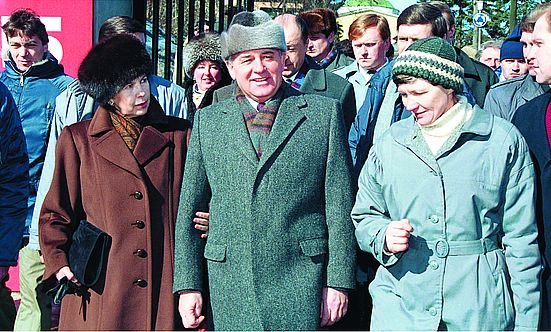
The First President of the USSR Mikhail Gorbachev goes to the polling station on the day of the All -Union referendum on the preservation of the Union of the SSR, March 17, 1991
The date on April 9 is not accidental - on this day two years earlier, the paratroopers of the Transcaucasian military district is cruelly, with the use of sapper blades, they dispersed the demonstration for the independence of Georgia, which took place on Tbilisi Prospekt Rustaveli: then 19 people died, and this became a tragedy for the republic that accelerated the process of separation from the USSR. Georgia moved along the way, begun back in 1990 by the Republics of the Baltic states. In the spring of 1991, the union could no longer be kept from decay, but the Kremlin was not yet aware of this.
Principle for the principle
The unity of the Union, as soon as it became obvious, could only be maintained in the conditions of a totalitarian regime. When the USSR was forced to go to some democratic reforms in the face of an economic collapse, it became clear that it was doomed. Even with a limited Gorbachev publicity, it was impossible to restrain the desire of the peoples, including national elites, to independence and resolve interethnic contradictions. Mikhail Gorbachev did not have some intelligible program for reforming the Union of the Union, and not the fact that he could be reformed at all in conditions even of limited democratization.
The first thunder of interethnic contradictions struck in the Armenian enclave of Azerbaijan - in Nagorno -Karabakh. Two fundamental principles of international law collided here-the right of nations to self-determination and the principle of indestructibility of the territorial integrity of states. The freedom of assembly, introduced de facto, and the appearance of semi-legal public organizations revived the ideas of national independence, which, after decades of suppression, could not but lead to interethnic conflicts. Already in early October 1987, at ecological rallies in Yerevan, the requirements were made to transfer to Armenia the Nagorno-Karabakh Autonomous Region of Azerbaijan. The administrative borders in the USSR (however, like around the world) did not coincide with ethnic ones, this gave rise to a lot of conflicts in the Caucasus and Central Asia.
Gorbachev understood that it was possible to suppress national movements only with great blood, which meant the collapse of his entire policy
Probably, at the very early stage, the Karabakh conflict could be resolved peacefully. For example, it was proposed to exchange Nagorno -Karabakh with an adjacent corridor in Armenia for an equivalent territory in the Zangezur region, which would also give Azerbaijan a territorial relationship with the navigation of Nakhichevan, populated mainly. However, in the Kremlin they stood on the principle of indestructibility of borders and did not want to change anything. Meanwhile, national movements developed: in the spring of 1988, the Karabakh committee was formed, which soon became the core of the Armenian national movement, and the Popular Front arose in Azerbaijan in August 1988. This happened after the anti -Armenian pogroms in Sumgait in February. Then the anti -Armenian pogroms followed in Baku, after which allied troops were introduced into the capital of Azerbaijan. The confrontation between the two republics and between them and the center by 1991 was heated to extreme.
Popular fronts
In Georgia, the growth of the national movement took place as conflicts developed in Abkhazia and South Ossetia. The April rally of 1989 in Tbilisi was precisely a reaction to the many thousands of Abkhazov’s many thousands in the village of Lykhny on March 18, demanding the withdrawal of Abkhazia from Georgia and granting it the status of the Union Republic. The Georgian national movement, led by former dissident Zviad Gamsakhurdia, already in October 1990 won the Georgian Supreme Council elections. As in Azerbaijan, it was in a sharp confrontation with the communist authorities of Georgia.
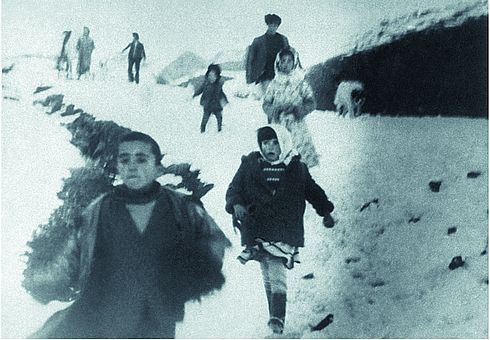
Azerbaijani refugees from the Armenian village in Nagorno -Karabakh, 1989
But in the Baltic states and Moldova it was different. Here, popular fronts that arose in 1988-1989, for the most part, found a common language with the leadership of local Communist Parties updated during perestroika. They were inspired to the struggle for independence by the victorious “velvet revolutions” in Eastern Europe. In Ukraine, in 1989, a “folk ruch” arose, which headed the movement for independence.
The first few months of their existence, the popular fronts spoke mainly about the economic independence of their republics. But already in 1990, the slogans of independence were opened openly. On December 24, 1989, under the pressure of representatives of the People’s Fronts of the Baltic states and the leaders of local committee leaders, the Congress of People's Deputies of the USSR recognized the authenticity of the secret protocol to the Molotov -Ribbentrop Pact and other secret protocols signed between the USSR and Germany in 1939-1941. The deputies announced these protocols "legally insolvent and invalid from the moment they are signed." This gave reason to believe that Lithuania, Latvia, Estonia and Moldova were annexed to the USSR illegally and have every right to leave the union at the request of their peoples - without looking at the law on the USSR on April 3, 1990, which impeded this procedure as much as possible.
Before the avalanche
At first, Moscow tried to cropped national movements with the help of limited, but nevertheless force methods. This led to bloodshed in Tbilisi, and in early 1991 - in Riga and Vilnius, where riot police and Alpha were thrown. But this only twisted the desire of the peoples themselves for independence, and in Moscow the most powerful rallies and demonstrations of the democratic public caused. Gorbachev was not easy: he maneuvered between the conservative elite of the Communist Party, which demanded to stop the “independence bacchanalia”, and the public that supported him to the extent that he was faithful to the restructuring he had begun. Gorbachev understood that it was possible to suppress national movements only with great blood, which meant the collapse of all his policy. Then propaganda was used - on March 17, 1991, a referendum was appointed to preserve the USSR.
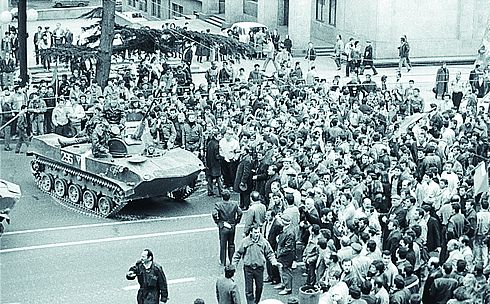
Participants in the unauthorized rally at the Government House in Tbilisi on the night of April 8 to 9, 1989
Democrats met this initiative with great skepticism. Gorbachev was criticized for the slyly compiled question, which, figuratively speaking, suggested, pour new wine into old bugs. Nevertheless, the referendum took place: 76.43% of voters spoke out for the preservation of the USSR. However, six out of fifteen republics - Armenia, Georgia, Lithuania, Latvia, Estonia and Moldova - a referendum was boycotted. Subsequently, all the opponents of Yeltsin gave the results of the Gorbachev referendum as the last argument against the “collapse of the USSR”. But nothing could stop decay. One after another, the republics adopted laws on the priority of republican laws over the Union, which led to disorganization of the economy.
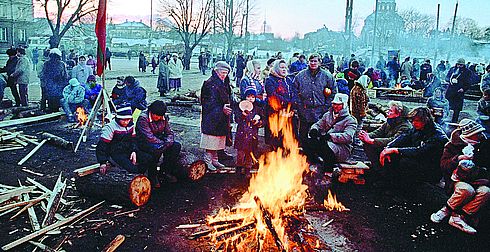
Alarming days in Vilnius. Citizens near the Lithuanian Parliament building January 16, 1991
Trying to save the alliance and his power, Gorbachev initiated the signing of a new union agreement, which actually turned the USSR into a confederation. The Novoogarevsky process, as it was named by the name of the Gorbachev residence near Moscow, was an attempt to implement the result of a referendum. On April 23, when the first meeting was held in Novo-Ogarev, the participants made an application for the need to conclude a new agreement of the “sovereign states”, which radically increased the role of the Union republics. Its text was parafated by the heads of nine republics and on August 15 was published by the newspaper Pravda as the “Treaty on the Union of Sovereign States (SSG)”. Art. 6 attributed issues of defense, security and foreign policy to the field of joint jurisdiction of the Union and republics, as well as the foundations of social and economic policy. In practice, to make decisions in all these areas, a consensus of nine leaders and their parliaments was required, which was unrealistic, at least in the operational control mode, taking into account a significant difference in the interests of the republics among themselves. For nine states, such a scheme was obviously not viable. It is no coincidence that only Belorussia, Kazakhstan, the RSFSR, Tajikistan and Uzbekistan should have signed the contract, while Azerbaijan, Kyrgyzstan, Ukraine and Turkmenistan should have joined it only in the fall of 1991. Obviously, the leaders of the last four republics were quite skeptical about the prospects of the new union.
Pocket strategy
The new agreement was opened for signing and those republics that did not conduct a referendum on March 17. In order to force them to join the contract, the KGB of the USSR developed a strategy for “pockets”: autonomies, not controlled by the republican authorities, were created on the territory of the republics that declared independence. Torg was supposed: in exchange for restoring control over autonomies, the rebels had to join in one form or another to a new union agreement. Otherwise, autonomy would have done this by leaving their republics. In addition to the already created "sovereign" formations in Abkhazia, South Ossetia, Transnistria and Crimea, Russian autonomy was supposed to appear in the northeast of Estonia. However, its creation was postponed. A bet on the “Interfronts” was made, created as opposed to the Popular Fronts in order to hold the Baltic states in the Union. In its own way, the “pocket” strategy worked. Autonomy turned into the territory of frozen conflicts, creating big problems for the former republics, while Russia had funds for pressure on new independent states.
Autonomy turned into the territory of frozen conflicts, creating big problems for the former republics. Russia, however, had funds for pressure on new independent states
But the ephemeral SSG, which the metropolis wanted to replace the USSR, could no longer save. Even if there were no August coup, it would inevitably fall apart in a matter of months-due to the contradictions between the republics on foreign policy, the construction of the army, and socio-economic development that have already been designated then. Democratization, albeit not quite consistent, made the collapse of the Soviet Union inevitable.
* Armenia, Georgia, Latvia, Lithuania, Moldova and Estonia did not take part in the referendum. In Kazakhstan, the formulation of the issue was changed: instead of the “sovereign republics” the phrase “sovereign states” was indicated.
Photo: Yuri Lizunov, Alexander Chumichev/Photokhronika TASS, ITAR -TASS, RIA Novosti, Vladimir Zavyalov/Photo Chronicle TASS