
Translated material
Games of classics
Borges and Cortasar: equal and different
"Everything is sneaked by the outskirts of sleep." The two great Argentines, who had a tremendous influence on world literature in the 20th century, were born in late August: the 24th marks the 110th anniversary of the birth of Jorge Luis Borges, and the 95th anniversary of Hulio Cortasara. Why have the writers who have a common homeland at one time are so different from each other - The New Times thought 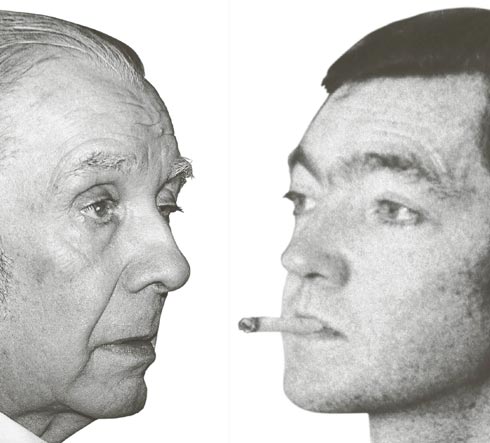
Bores was born in Buenos Aires, Cortasar-in Brussel occupied by the Germans. Among the ancestors of Borges were the British, Spaniards, Jews, Normans, among the ancestors of Cortasar - Basque. Cortasar was rather left -handed, Borges was rather right: he went to Chile after the events of 1973, shook his hand in Pinochet and thanked for the victory over the Communists. But both were ardent opponents of the semi-fascist populist, the Argentine dictator of Juan Puron, which is why Borges were fired from a small library (appointed director of the National Library after Peron’s departure, but Borges was almost blind), and Cortasar, living in Europe and being one of the first Latin-American immigrants, for his homeland during his homeland during his homeland during his homeland during his homeland He did not risk the peronist dictatorship. Nevertheless, both were "Argentines from the Argentines."
Mentor and student
One can only guess what helped Kortasaru say that he will do something else and will go beyond his mentor Borges at least in one. Namely: in building marginal psychological and domestic reliability - in order to turn the ordinary in such a way as to show the elusive, alluring and frightening essence. Cortasar always considered Borges to those who indicated his path to literature (the first story was printed in the magazine published by Borges in 1946), although by and large both the origins of their work were seen in the tragedy of Calderon “Life is a dream”. It is noteworthy that the plan of the novel “Idiot” was born with Dostoevsky after reading the same tragedy, and both Borges and Cortasar considered the famous Russian novel one of the greatest novels of all time. Despite the fact that Cortasar always called Borges his literary teacher, since he took his extraordinary brevity for the sample, bordering lapidarity bordering on dryness.
... However, the difference is fifteen.
Borges began as an adherent of a poetic school of ultraism, in which the main metaphor was. He moved to prose relatively late and never wrote Romanov. The novel form seemed to him too stretched, in it, in his opinion, there was no opportunity to clearly and consistently draw one topic, one idea. Cortasar became known as a representative of the school of magical realism, and later, in the 60s of the last century, he became famous for writing the first “New Latin American novel”-“winnings”. It is Latin American, not Argentinean, Colombian or Kubinsky. The former novels investigated national reality and were built according to the canons of classic novels of the 19th century. Kortasara, by his own admission, "captured the idea of being among the characters himself, not to have any advantages over them, not to be a demiurge who decides fate at his discretion." Tearing the traditional forms of the novel, Cortasar set the way for authors such as Cuban Aleho Karpentier, Guatemens Miguel Asturias, and especially Colombian Gabriel Garcia Marquez.
Based on the story of Borhees, “The Top of the Traitor and Hero” Bernardo Bertolucci shot the film “Spider Strategy”, based on the story of Cortasar “Seluni Devil” Michelangelo Antonioni - Blow Up.
Life is fiction
In the story “The Analytical Language of John Wilkins”, Borges created a paradoxical classification that seemed to be contained in a certain ancient Chinese encyclopedia and looked like this: “Animals are divided into: a) belonging to the emperor; b) embalmed; c) tamed; d) dairy piglets; e) sirens; e) fabulous; g) stray dogs; h) included in this classification; i) raging, as in madness; j) innumerable; k) painted with the finest brush of camel wool; m) others; m) broken the jug; O) from afar, seeming flies. " Undoubtedly, Borges came up with both the encyclopedia and this classification, as he came up with a significant part of those writers, philosophers, historians, theologians, to whose works he refers in his stories and essays. However, the fundamental work of the philosopher Michel Foucault “Words and things”, by his own admission, was caused by laughter to the life of this classification, enthusiasm that we have an example of absolute impossibility to think in a similar way. An example shows how easily you can crush "Our thousand -year experience of identical and other."
Borges turned out to be much wider than his own creativity - it is as if literature in a state of protoplasm, a certain, paraphrasing the statement of Edmund Gross about Walte Whitman, a sensitive intellectual organ, just reacting to any object set before him. He built several clear “projects” for others - and they were embodied by writers completely dissimilar to each other. So, Stanislav Lem owes Borkhes to his magnificent book of preface to nonexistent books, Milorad Pavich - experiments about dreams and fantasies, Slobodan Schneider - “The phenomenology of the small”. Even Vladimir Nabokov, according to the researchers, did not escape the influence of the “great blind”, in Borhezovo abundantly including false quotes and links in his stories and novels. Outwardly, literary game, Borges's work affects one of the most important, serious, frightening Borges of the problems of culture: the relativity of ethical principles developed by mankind. One of the most famous stories “Servo, Ukbar, Orbis Tertius” shows how fragile, unprotected concepts and principles of people, their ethical and aesthetic values are easily replaced by the intellectual groups that are directly opposite as a result of the efforts of the group.
Another reality
If the imaginary in Borges breaks into reality, then in Cortasar one reality easily replaces the other. The reality of Kortasara is written out so that it is not possible to determine which one is “more real”. Not the transition of sleep to everyday life, but the transition from one everyday life to another, previously hidden, frightening - this is what is the author’s method of Cortasar. At the same time, Cortasar is more likely to write about those who created “The Sludge, Ukbar ...”, who does not accept the conventional conventions and standards. These people are not a fruit of fantasy for him, they are made of flesh and blood. They form a new world, so that later, sitting in a quiet cafe, to listen to the melody of Milongi, to drink the Argentine vodka of Kanya with strong coffee and be proud of their ability to force others to obey their will.
Once in the world of Cortasar (for this it is just to re -read stories such as “Summer”, “The neck of a black kitten”, especially “hot winds”), you begin to feel that behind a well -recognized everyday life is the background, where the everyday life is constrained by the ice of horror, where, according to the exact characteristic of his mentor, “there is no place for joy”. Kortasar, unlike Borges, does not give any freedom to their followers. To recreate the Borges style (another question - is it possible to recreate the depth?) Many imitators were able to, but with Cortasar this number rarely passes. It's like imitating Daniil Harms: it is impossible, a look at things different. After all, it is not rational, not logically to see chronopes, Fams and Nadeak - the world of “near -human creatures created by Cortasar, but to feel, feel the skin of their being in the space parallel with us. In the world with which some people, such as Hulio Cortasar, had the opportunity to communicate ...