
Translated material
Council without risk
An exhibition of nominees in the All-Russian contest "Innovation-2015" is held in the absence of the main contender for the prize-detained by the artist Peter Pavlensky
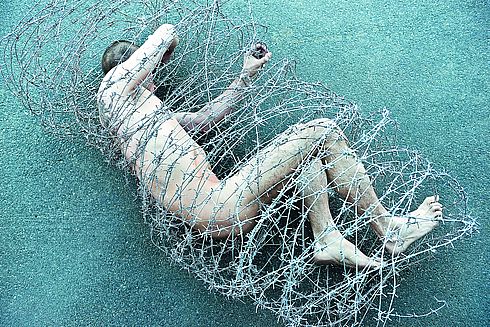
Peter Pavlensky, who is now in prison, do not get used to the barbed wire, during the “Carcass” campaign in St. Petersburg in May 2013. Photo: Sergey Ermokhin/ITAR-TASS
The current exhibition, which was opened on April 1 at the metropolitan state center of contemporary art (GCSI), from the very beginning accompanied the scandal. The organizing committee of the competition, which is supported by the Ministry of Culture of Russia, demanded to exclude the “threat” campaign from the short leaf (arson of the FSB building on November 9 last year), for which Pavlensky is still under arrest. As a result, the Expert Council simply canceled the award of the prize in the nomination “Work of Visual Art”.
The revolution did not happen
When Pavlensky was deleted from the list of applicants for actually the State Prize "Innovation", most of the participants in the competition breathed a sigh of relief. And this, unfortunately, is quite natural.
Five years ago, the “war” art group received “innovation” for graffiti in the form of a giant phallus opposite the FSB building in St. Petersburg. Everyone then was amazed at the amazing complacency of the Russian state. Most members of the Expert Council and the jury of the competition said that the next competition all participants would try to create something similar in material and topics. But no: it turned out that in 2011 the state apparatus simply did not notice the swearing of a small group of desperate desperate artists.

Installation of Maria Poluektova “I want to live where I can be free” - much less radical statement on the topic that Pavlensky touches, 2015
Revolution in domestic art did not occur. There was neither a surge of protest art, nor a wave of polyactivism, nor daring flash mobs, nor bold speeches like the campaign of the “We” group of Roman Dobrokhotov, when students tried to picket the White House on the Krasnopresnenskaya Embankment with empty A4 sheets in their hands, but quickly ended up in the gabs. The followed reaction was very natural for Russia: the authors hid behind an “individual myth”, which justifies the artist’s asocial behavior.
At one time, when European performances were torn by Europe, and in the US there was a bloody struggle for the abolition of slavery, Claude Monet to the question of the historicism of his paintings answered the famous phrase: “And this is how I see our time.” The last two words were forgotten, and the remaining part of the phrase after a dozen years became a slogan of postmodernism.
Clear relevance
When you look at the work of art, you are invariably waiting for some kind of inner revelation. When you look at the creation of contemporary artists, you logically hope to see something that reflects modernity. The vast majority of the townsfolk are poorly imagined by the language of current art, but are very demanding on the semantic load of the work: they say, if we are contemporaries of this phenomenon, then it should be clear to everyone. Judging very strictly, this evaluation criterion is really the most true. There is even a professional term - "relevance". Actually, this is the main measure of the qualities of the Council, as contemporary artistic experiments are abbreviated.
The Russian layman expects from art not the form of expression, but of the world that is not visible in his ordinary, humble and gray life
Incarnation of the original plan, the artist finds a metaphor that transfers the breath of time, and then searches for adequate material. These are quality categories that are little distinguishable in the art of the XXI century. But there are other characteristics that affect the assessment of a work of art. For example, the courage with which the artist Vinogradov entered the gas chamber with the children - he taught them drawing in a concentration camp; Or the uncompromising of the German expressionists, whose work was burned by the Nazis in Nuremberg and Munich. Or fearlessness of Soviet-dissidents of the 1960-1980s, who did not know fear of power. Similar circumstances - more social than artistic - create a historical context that is more understandable to people than a “characteristic smear” or “stylistic correspondence of the era”, as critics of hoodies like to express themselves.
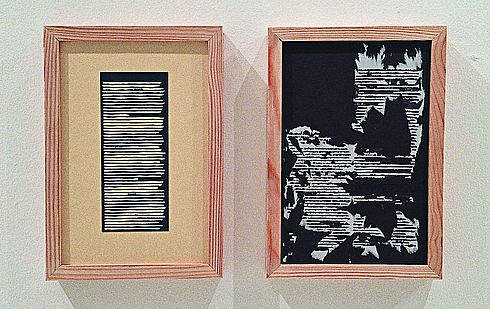
Collage of the photo artist Evgeny Gradiyshchikov "War", 2015
The Russian layman expects from art not the form of expression, but of the world that is not visible in his ordinary, humble and gray life. Therefore, after a hundred years, the “Black Square” remains “contemporary art”, although by year this, of course, is already a completely museum exhibit-the interest of society is still the revolutionary idea of this object. It was according to these condition that the artist Pavlensky forced the attention of himself. “Game in experiences” we expect from actors; He, without playing at all, showed the naked flour of a man suffering from non -freedom. There is no allegorical language in Pavlensky’s shares: the symbols of his art are clear. He sews his mouth in a courteous and is already completely naits the scrotum to the saint for each patriot paving stones Red Square. In the country where millions of people visited prisons, such a metaphor is quite clear to many.
Grace and conformism
The “Innovation” competition is like a fragment of an elegant text in the middle of hundreds of chapters of a mediocre novel, which writes the “team of authors” of the Ministry of Culture of the Russian Federation. Maybe, by inertia, and most likely, due to the arrogant indifference of officials, this island of real art on Zoological Street in Moscow has been managing to clean the obscurantist image of Russian official culture for 12 years with all its monuments to Prince Vladimir and the destructive policy of the “recreation” of the capital's architecture. Against this background, the nominees “Innovations” are very progressive and make a lot more for the reproaches of the state than all Gazproms and Severstal, combined.
This year, the exposition of the work of nominees is ironic and spectacular to a greater extent than last time. The architecture of the exhibition is intricate and successfully resembles collapsible screens. The viewer enters the space, separated by many identical deesses that form square rooms - they are located in them. Each author has a small nook, where visitors' views are opened and the artist’s “own vision” is opened.
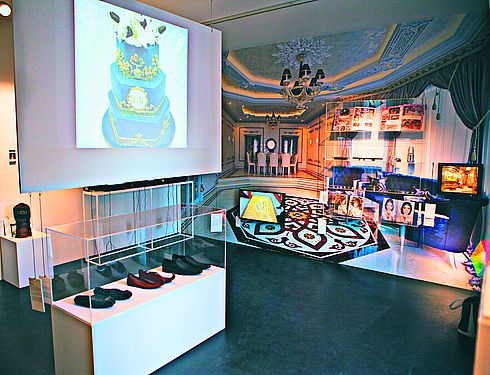
Fragment of the Exposition "Pavilion" Caucasus ", community" Restless ", 2015
The collages of Evgeny Gradiyshchikov are magnificent: he makes the viewer see not what is shown, but to read the author’s unspoken thoughts behind empty lines cut out of the text. The Caucasus pavilion - the unconditional hit of the Lightly Moscow Biennale at VDNH - is represented by fragments of that exposition, subcultural marginalia, like rhinestones strewn with security belts. This remarkable allegory of the group "Unrestrained" is prophetically iconographic for the whole of Russia. The deconstruction of meanings and concepts in the project of Anna Zhurba with a red thread of Ariadne pierces collage sets of images. This is the only project in which there is ambiguity, and political surrealism, and the visual grace of the image, and most importantly - an analytical form.
There is no allegorical language in Pavlensky’s shares: the symbols of his art are clear. He sews his mouth in a courteous and is already completely naits the scrotum to the saint for each patriot Panceta Red Square
These and many other authors presented at the exhibition, of course, are worthy of attention. Only now, the very contest, which, in converting, denied the participation of one of the main applicants for the prize, will have to return with great difficulty the respect of artists and critics. Indeed, after the expulsion of Pavlensky, only one author and only one member of the jury left the “innovation” in protest. So the next exhibition would be logical not in the immediate vicinity of the zoo, where the GTCS is located, but closer to the FSB building on Lubyanka or SIZO Sailor Silence. And of course, not in the room, but on the street.
Dossier
The All -Russian competition in the field of modern visual art "Innovation" was established in 2005. The works are evaluated in five nominations: “A work of visual art”; "Curatorial project"; “Theory, criticism, art of history”; "Regional project of contemporary art"; "New Generation." Also annually awards are awards in two out -of -competition nominations: “For a creative contribution to the development of contemporary art” and “For the support of the contemporary art of Russia”. The prize fund of the competition is 3 million rubles.
An exhibition of nominees for the “Innovation-2015” contest is held from April 1 to May 29. 19 projects are exhibited in the exhibition hall of the HCSI. The awarding ceremony of the winners will be held on May 18 at the State Museum of Fine Arts. A.S. Pushkin.
Photo: ncca.ru