
Translated material
Thimblerig
The return of the column "against all": how the authorities use the requirements of the opposition
The State Duma adopted in the first reading a bill, which will return the “against all” to the election ballots in the elections of all levels except the presidential. How the Kremlin uses the requirements of the opposition to manipulate the elections, the New Times understood
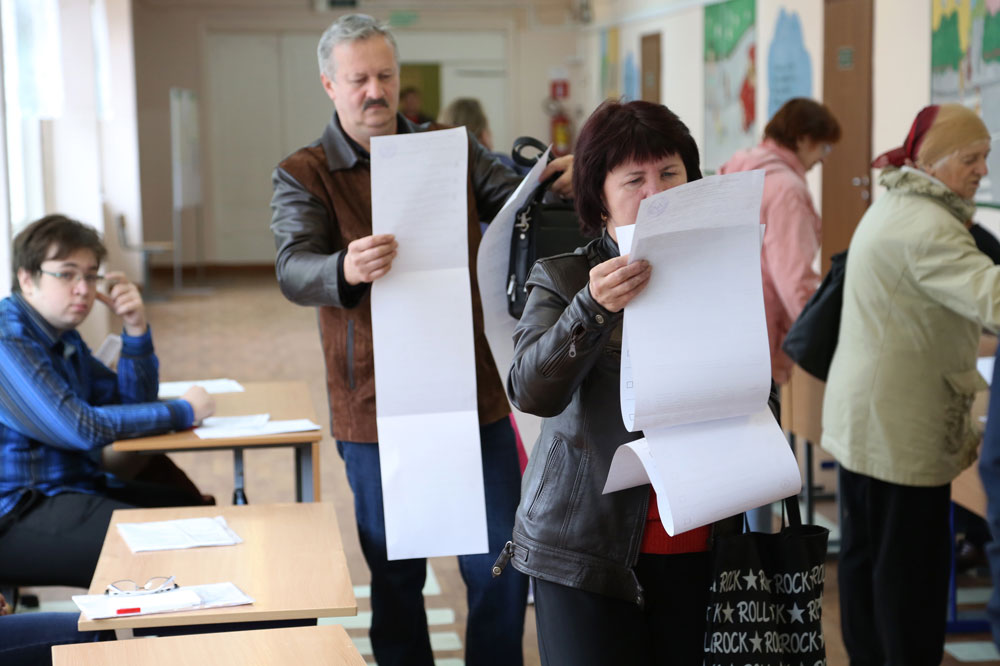
Simple voters learned about party reform on strongly lengthened ballots. Elections to the Yaroslavl Regional Duma 09/08/2013
“The past elections showed that we live in new political conditions, with growing political competition. Let's talk the appropriateness of the return of this graph ” - with such words the speaker of the Federation Council Valentina Matvienko opened a meeting of the upper house on September 25. Thus, she launched a discussion about the return of the column “Against all”, withdrawn from there in 2006. Later, in an interview with Russia 24, the Speaker SPIA explained: the presence of such a column “will more clearly understand-citizens vote for a particular party or are it just protest moods that result in someone, but not for power”.
Suddenly, Matvienko had the desire to understand the motivation of oppositionly -minded voters is actually understandable. After all, this is at least the fourth case over the past couple of years, when the authorities are adopted by the slogans of the opposition, then to turn them into something opposite with a slight movement of the hand.
Governor's elections
On the one hand, the return of direct elections of the heads of regions was one of the main slogans of the opposition since the transition to their appointment by the president in early 2005. This idea was also supported by ordinary citizens: in September 2011, 66% of respondents spoke in the Levada Center survey for the election of governors. So the return of the elections could prove that the authorities really listen to its people.
On the other hand, the Kremlin could not just take and return the previous system: why do independent leaders grow with your own hands in the regions, risking to get the Governor's Front a la “dashing 90s”? Therefore, the substitution of concepts took place at the very first stage, even before the bill in the State Duma.
"
"United Russia" inspiredly played an unusual role for the role of defender of freedom
"
The minimum set of restrictions was personally formulated by Vladimir Putin during the “direct line” on December 15, 2011: the mandatory “presidential filter” (“to cut off the entry into the power of semi-criminal or separatist forces”) and the right of the head of state to “remove from the position of the governor in case of any actions related to the exercise of power”. And the Duma United Russia gave an additional “curvature” to the “direct” elections, adding two more filters to the Putin list - municipal (collection candidates from 5 to 10% of municipal deputies) and criminal (ban on the ranks for heavy and especially grave articles of the Criminal Code).
The amendments were made, of course, "at the numerous requests of workers." Thus, the municipal filter appeared according to the results of the meeting of the then President Dmitry Medvedev with a group of governors, mayors and speakers of regional parliaments, which said that this would be cut off from the elections of “scammers, populists and crime”. As well as "Croses, city crazy and rustic fools," Medvedev added from himself.
As a result, the action entitled “revived governor elections”, as shown by the first autumn campaign of 2012, had a very distant resemblance to the campaigns of the 1990s or even the first half of the 2000s. According to the former Minister of Finance, Alexei Kudrin, whose committee of civilian initiatives (KGI) monitored regional campaigns, through the municipal filter, “the authorities actually appoint competitors itself, which largely depreciates the idea of direct governor’s elections”.
Party liberalization
In the case of party reform, the Kremlin thimbles applied another approach: the idea of liberalizing the party system was brought to the point of absurdity. Ah, do you think that at least 40 thousand party members are too many? Well, we will reduce it by 80 times, so that it doesn’t seem enough (or rather, a lot) to anyone. Want to remove obstacles for registration of candidates? Yes, for God's sake: let party candidates are registered in the elections automatically, without collecting signatures and other restrictions. What, what? Are the ballots get a meter length? Well, you yourself wanted real democracy! ..
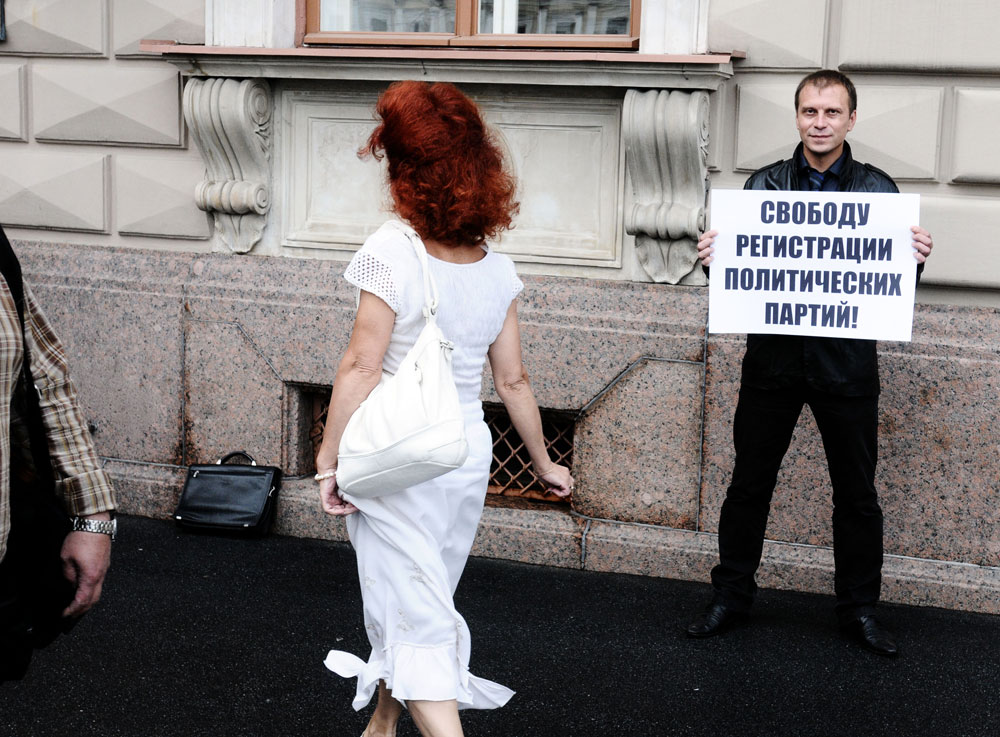
The Ministry of Justice borrowed the slogans of the free registration of parties from the opposition. (Single picket in St. Petersburg 06/29/2011)
The Duma opposition tried to limit the revelry of a multi -party system, offering to increase the party minimum at least to 5 thousand members or introduce an “electoral filter” for beginners (that is, to allow, say, only parties with deputies in municipalities). But United Russia inspiredly played the role of freedom defender not very familiar to itself and drove the party members into a bright future with an iron hand, not allowing a single restrictive amendment to the bill.
And then actors from the Ministry of Justice entered the scene of the theater of the absurd. From 2005 to 2011, this agency registered only one new batch (the Kremlin project “Right Business”), but after the in the spring of 2012 adopted the Law on Parties, the Ministry of Justice turned from an impregnable fortress into the passage courtyard, distributing registration to the right and left (only regular enemies of the regime, Limonovites and supporters of Alexei Navalny remained in the stop list). As a result, by the end of 2012, 49 parties were listed in the register of the Ministry of Justice, and by the beginning of October 2013-already 73.
At the same time, the officials were not embarrassed by either very exotic names like the party “against all”, nor obvious “doubles”, although in Art. 6 of the updated law, a direct ban on creating parties with names, “similar to the extent of mixing” with the names of existing organizations appeared. Therefore, the Communist Party of the Communist Party of the Communist Party is now compiled by the CPSU (the Communist Party of Social Justice) and the “Communists of Russia”, along with the “Alliance of the Green - People’s Party”, there is simply the “People’s Party”, and the “Party of Russian Pensioners” has a “close relative” represented by the “Russian Party of Pensioners for Justice”.
Another consequence of “liberalization” was the mass emergence in different regions of party science, consisting of the same candidates. According to experts of KGI, Arkady Lyubarev, eight parties used such technology during the recent campaign: there were 73 out of 281 (26%) in the elections to the regional parliaments of the twin lists, and 60 out of 200 out of 200 (30%) elections to the City Duma of regional capitals (30%).
These “twins” received a little percent, but they spoiled the blood “real” parties. For example, in Yakutia, the “civilian platform” of Mikhail Prokhorov before overcoming the five percent barrier did not have enough 0.07% of the vote, while her spoiler “Civic position” received 0.4%. And in seven regions, 4-5% were gained in the amount of the CPSU and the “Communists of Russia”, taking these votes from the Communist Party. So, it seems, the leader of Yabloko, Sergei Mitrokhin, was right in February 2012, when party amendments were discussed in the first reading, suggested that "the true plan of this whole event was to maintain the monopoly of the Party of power by fragmentation of the rest of the political space."
Return of single -mandate
It turned out even easier with the restoration of single -mandate districts. It’s not that the Kremlin here shrugged something-it was simply the political situation in the country in such a way that the single-mandate, who in the mid-2000s were a symbol of democracy, turned into the only hope of the party in power to salvation from failure in the elections by 2013.
President Putin proposed to return the system from 1993 to 2003 by half of the Duma at party. True, for this, United Russia had to refute their own arguments of nine years ago. If in 2004, when a purely proportional system was introduced, they together rested on the need to “stimulate the development of political parties”, then in 2013 they suddenly realized the acute need for “expanding direct democracy” and “personification of the parliamentarian responsibility to the population of the electoral district where it is elected.”
The opposition saw the reason for the reform in another. The communist Vadim Soloviev even remembered on occasion a quote from Lenin - that "bourgeois politicians always have a double explanation of the steps taken: the first, true - for himself and the second - for voters, that which looks good and noble." The truth, in his opinion, is that “United Russia” “is no longer able to win in party cards, therefore, to ensure its victory in the next elections to the State Duma, they must go through a mixed system.”
“The Count“ Against All ”may in some cases play in a completely unexpected way for power”
"
United Russia was angrily rejected this conclusion, but it is confirmed by the results of the latest elections. According to the Central Election Commission of the Russian Federation, on September 8, compared with previous elections of the same level, the party of power worshiped its results in voting at the Parties of 15 of the 16 constituent entities of the Russian Federation, where parliaments were elected. At the same time, in the single-mandate districts, United Russia, at the expense of the administrative resource, still wins “in one gate”-from 71% of mandates in Bashkiria to 100% in the Vladimir region.
In other words, majority voting turns to the authorities into the only way to compensate for losses in party registration and save the majority. Moreover, the Kremlin now has the All -Russian Popular Front, which is not burdened by the sins of the "party of crooks and thieves" and is able to become a kind of "single -member party in power" - while maintaining the "United Russia" monopoly on the nomination of party schedules. But the proportion of the list of listers will decrease - especially in regions where, according to the bill adopted in the first reading, the share of single -mandate will increase from the current 50% to 75%.
“The authorities will be easier to carry out to the parliaments of their, as it were, independent candidates who took off their T-shirt with the inscription“ United Russia ”, but still have influences, ties and an administrative resource,” explains political scientist Dmitry Oreshkin. “This is very reasonable from the point of view of the authorities, so the single -mandate districts make sense to return right now.”
“These proposals are aimed at a general decrease in the influence of parties in the elections and leve up the Institute of Political Parties as a whole,” says Alexander Kynev, an expert on regional elections. - But any norm must be perceived taking into account a specific reality. And in the current conditions, the strengthening of the majority component will only lead to an increase in arbitrariness and pressure on the opposition in the field. ”
Again "against all"
A similar picture - with the return of the column "Against all." Oppositionists and ordinary citizens also advocated for such a measure: in the September survey of the Levada Center, 78% of respondents supported it. But they were unexpectedly joined by the harmonious choir of representatives of United Russia - from the heads of regional branches to the leader of the party Dmitry Medvedev. The latter in an interview with “Russia 24” on September 28 explained: this count allows “not to vote for some candidate who simply opposed to the current government (to vote in spite: let anyone, if only not this disgusting power), but directly write that I am against all.”
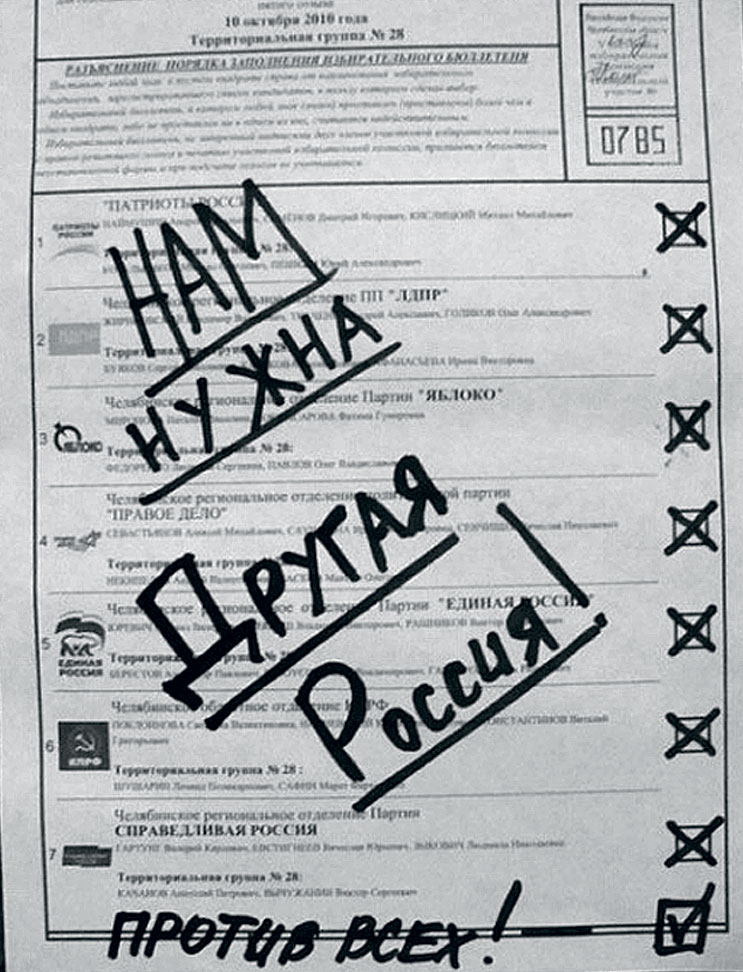

The absence of the column “against all” never interfered with a protest vote. (Bulletin in the State Duma elections 04.12.2011)
In this description, specific examples of the protest voting on September 8 are easily guessed, the results of which were victories in the mayor of Evgeny Roizman (Yekaterinburg) and Galina Shirshina (Petrozavodsk), as well as the high result of Alexei Navalny in the elections of the Moscow Mayor. After all, these candidates managed to mobilize the majority of the protest electorate in their support. And if the column “against all” were also in the ballots, then perhaps one of the opponents of the current government would prefer her, and the result of the opposition would be worse.
“The proposal to return to the Count“ Against everyone ”is a direct consequence of the elections,” Alexander Kynev agrees. “This is an attempt as far as possible to disperse the protest electorate.”
“They (the authorities) proceed from the fact that“ there will be few against all ” - say, up to 10% of voters. And then this column will work mainly against candidates who occupy the second or third place after the candidate from the authorities, ”explains Dmitry Oreshkin.
However, these expectations, according to experts, may not be justified.
“The authorities make all these decisions rationally, deliberately and in its interests, but at the same time comes from the situation about two or three years ago,” says Oreshkin. - And the situation is changing rapidly, and protest moods are growing. For example, the column “against all” may in some cases play in a completely unexpected way for the authorities, as well as elections in single -mandate districts. ” Alexander Kynev also does not give his forecast in favor of the authorities: “In this way, an attempt to solve their problems will lead to the fact that the opposition will have incentives for more radical behavior in the elections. As a result, the power will receive the radicalization of the opposition as a boomerang. ”
So Valentina Matvienko, perhaps, should have thought better before voicing initiatives from the evil one.
Photo: Anna Solovyova/RIA Novosti, Alexander Koryakov/Kommersant
The text is published in No. 32 (300) of October 7, 2013