
Translated material
Venue
Theater as a place free from censorship
Today the theater has become a kind of kitchen of the Soviet era: a place for public statement, space, free from censorship and state supervision. The New Times offers two views of theatrical observers on the modern stage - read the material of Arthur Solomonov also
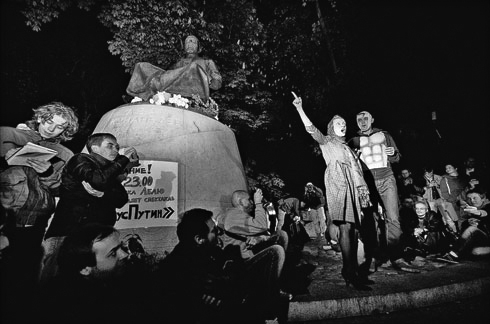
"Occupy-Abai." Theater.doc played performances on purebred boulevard
Life is completely different
Some are eager for the audience, others are afraid of their audience
It would seem that there is nothing more pleasant for the creative ear of aged rebels and truth -seekers than the persistent call “Speak!”, For the first time sounding in the performance of Valery Fokin, staged by him at the dawn of perestroika in the theater named after Ermolova.
"Speak, artist!" -Now they are required by network hamsters, hipsters from Jean-Jacques, young listeners of public lectures, experts in the work of Lars von Trier and Alexei Balabanov. Office clerks and bank employees, restaurateurs and tour operators, glossy magazines and viewers of fashion shows are required. The artists, writers, theaters, walking around with white ribbons in Moscow Boulevards are demanding. The surviving pensioners, teachers and doctors, officers and researchers, librarians and guides attach their vote to them.
Theater-dialogue
The heroes of the cultural revolution of the two thousandth were theater.doc and Mikhail Ugarov with Elena Gremina. Theater.doc is not just an artistic chronicle of current events from Beslan and Nord-Ost to Magnitsky and Pussy Riot. This is an ongoing direct dialogue with the viewer, an attempt with him to formulate the main ones not even claims, but accusations against the authorities, to call their names not only the crimes themselves, but also the performers and customers. Among the others, the evenings, the campaign of the so-called witness theater became a unique experiment: when the actors are not reading texts on the stage in front of the audience, but the participants in the events themselves communicate directly with the hall. Before the eyes of the audience, the lines of the news are formed in the voluminous picture of what is happening, and the viewer himself gradually becomes not only an accomplice, but also by the co -author of the further development of the plot and takes on the same responsibility. The satirical pamphlet “Berlusputin”, in which the actors Evdokia Germanov and Sergey Epishev literally go on the verge between mockery and insult, is also not a finished work, but largely depends on the morning news. Berlysputin played at the Occupy-Abai-right on the purebred boulevard, and in this, the meaning of the street theater, exciting the crowd and turning it into the people, was stunning in their emotional impact of the show.
"
"Speak, artist!" - Now require network hamsters, young listeners of public lectures, bank employees and restaurateurs, viewers of fashion shows and artists themselves
"
Pain points
Mark Zakharov for the last time picked up an automatic machine (literally) in 2003, when the protagonist of the “Crying Executioner” Alexander Abdulov shot the audience with long bursts. “Contemporary”, as in the old Soviet times, hides the topicality in plays about foreign life: then about the rebellious consumption of American rockers (“anarchy”), then about
fanatical American military reporters (“hidden prospect”). The magnificent, incredibly relevant drama of Stoppard “Rock-N Roll” in the production of Adolf Shapiro in Ramt lost all his acuity, turning into a boring historical reconstruction and imitation of protest. The best performances that encourage relations with modernity, addressed to the pain points of entire generations, to the incredibly important and nervous topic of the confrontation of man and the state, personality and system, periodically arise either in small scenes or in small theaters. Such work breaks into large scenes by a miracle and usually with huge losses. We must pay tribute to Oleg Tabakov’s instinct: not very understandable to him, and sometimes the performances of Konstantin Bogomolov’s performances that were not only in the basement on Chaplygin Street, but also on the Great Moscow stage. Tabakov himself participates in some and is surprised to watch the growing interest and even admiration for the public. Aleksey Devotchenko, who joined the Moscow Art Theater Carbonarium, played his monospace “Diary of a Provincial in St. Petersburg” on Saltykov-Shchedrin on a small stage. The evil, mockingly satirical story on behalf of the heroic and patriotic absurdity of the hero of the century that was lying on the basis of the political and patriotic absurd is killing his merciless relevance, as if a hundred years have not passed. Devotchenko-the very-acting theater itself, and the authors chose only such-slaughterhouses: Limonova and Kibirova (“epitaph”), Brodsky (“Waltz for Farewell”), Sasha Black ... Such nomadic artists are unique and, unfortunately, a rare phenomenon of Russian nature. There is no longer Mikhail Kozakov, but there is Alexander Filippenko, who discovered the prose of Solzhenitsyn and Shalamov for the whole generation. There is no Igor Kvasha, but there is Valentin Gaft with his strange, desperate poetic anti -Stalinist tragifars "Dream Gaft, retold Viktyuk." There is Sergey Yursky with his absurd experiments at the Mossovet Theater (“The Fatherland”, “Polonaise”). Kirill Serebrennikov stubbornly pushes himself from the Political, journalistic theater, but each of his work is an attempt to search for a modern language, and such a search is impossible without a painful, direct hit to date.
Theatrical patriarchs are afraid of their public in the same way as the authorities are afraid of the people, and in the same way prefer not to notice its changed face
"
Yesterday's joys
But for most repertoire state theaters, the current attempts to revive society, its timid civil flashes are “the life of others”. Theatrical patriarchs are afraid of their audience in the same way as the authorities are afraid of the people, and in the same way prefer not to notice its changed face. And therefore, many out of habit feed the hall with an expired shelf life, without realizing that the deception is opened before the end of the first act.
A society, sedimented from lies and hypocrisy, from imposed false religiosity, from a patriotic cod, from legalized theft and legal lawlessness, as if it hit a blank wall, staying in this theater of an absurdity. And the theater as such, instead of putting the inverted picture of the world in place, often helpfully participates in this Orwell delusary. The essential conversation about the meaning and mission of theatrical art, unique to its momentary, and therefore absolute freedom of statement - the theater elite is terribly afraid of such a conversation. It is much more comfortable to spit in Konstantin Bogomolov and Kirill Serebrennikov, to loudly declare the end of the Russian psychological theater and sink with the contempt of theatrical critics.
Photos: RIA Novosti