
Translated material
The choice of snobs
Who will wake up famous after the "National bestseller-2009"
The motto of one of the most prestigious Russian literary awards “National bestseller” - “Wake up famous”. The prize marks Laureatai indicates the market: this author deserves to be book a bestseller. So we have structured a literary process: bonuses and market are fatally diverge. On their impressions of modern Russian prose and the procedures for the “appointment” of bestsellers - on the pages of The New Times tells the small jury - 2009
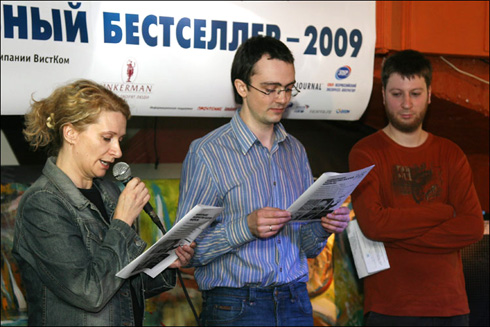
Announcement of a short-list of the prize. Photo Yustas Founder of the St. Petersburg Critician Viktor Toporov even at the first meeting of the small jury-2009 admitted: of course, we are talking about the best of bestsellers in general, but about intellectual bestsellers. True, it was more ax that he had in mind simply high -quality lititer, because none of the six -sophisticated books of the jury is intellectual in the sense that is what the term in the West is in this term. Nona our book market - loose, unstructured, unwritten - any therapy can be safely enclosed in quotation marks, including the concepts of “intellectual” and “bestseller”. Nobody knows even the circulation borders of these phenomena. In principle, the starting circulation of the “steppe gods” Andrei Gelasimov - 15 100 copies - huge. Eksmo's publishing house was very risky: Gelasimov’s prose is not calculated on an enlightened mass reader, many consider it simply boring. But, however, more on that later.
Optional mainstream
Almost all the finalists are famous figures in the literary field. More than that, they are laureates of prestigious awards, including the same “National Best” - for example, Ilya Blesshov. Even young Alexander Snegirev, and he is not for 30 laureate of three literary awards. Among the well -deserved persons are Andreighelasimov. Herman Sadulaev visited all possible longs and short lists.
Viktor Toporov openly called the composition of the finalists a sluggish and sad word "mainstream". If this is so, then the mainstream in modern Russian literature is a high -quality. The question is, what is this quality and with what can be compared with?
Finalist books are the level of permitted “literature for the intelligentsia”, which in Soviet times had an appropriate existence and went out more or less significant circulations. However, that prose-well, for example, “insomnia” by Alexander Krona or “imitator” Sergeyesin-was a mandatory reading: any-hundredth intellectual and a representative of the Soviet middle class should read these works and discuss the course of a friendly feast, guess who is hiding behind the character, etc. Now, the role of the mandatory books is played by the romance of Pelevin, Vladimir Sorokin, Lyudmila Streetskaya and several other authors. But this is the first echelon, which is not in content, but in the function - in the Soviet years, Yuri Trifonovili of the times of their fisheries. The “heavy sand”, which exploded the representations of the Council intelligentsia about the permitted-distinguished one. And here is the second echelon presented on National Besting, is not obligatory. In the sense that the lines of Sadulaev, Gelasimov, Blessishov, who have unveiled for their life, will still be able to be considered quite intelligent and well-read people. It is not necessary to understand the nuances of the current liter -member of the Intelligent Little Man.
The mirror of criticism
The choice of finalists talks a lot about modern Russian literary and book criticism. The screetings of the main education put forward applicants for the prize. Prime and the market are contrary to different directions precisely because it is not customary to study Russian criticism and monitor its trends. The poet is the reason and are nominated for different premiums, in essence, the same people. The priest of the laureate titles, which is on their fragile shoulders, as a rule, does not provide them with fame outside the professional community. That is, of course, “wake up famous”, but in very narrow circles.
Literary and book criticism in Russia is a non -biistic. Therefore, its choice is for snobs, and not for any mass reader. Under this concept, the author means by no means absorption of serial, detective, ladies' novels, and a mass reader who prefers high-quality prose. But writers from Meinstim and critics do not work with this reader, for many of them even the Ulytskaya is not the Comme il Faut, because, theine, she has too large circulations. And the if the circulation of Daniel Stein, the translator is 150 thousand, the critic refuses to understand how to work with this text.
The “market” of critics is also unstructured by us. Therefore, the reader does not pay attention to him. It is much easier in some kind of pupil. For completely egg -headed (but non -nobs!) - Le Magazine Litteraire magazine, a Libre monthly reader.
Kill the protagonist
Gelasimov and Blesshov are writers, who someday, perhaps, will be redistributed by the second echelon in the first. The “tanker” of Bracks, telling about the distraught and lost memory after the wound of the leader-driver, a sort of thriller nameriala of the Great Patriotic War is an exciting thing. It is characteristic that the time of the “steppe gods” Gelasimov is also the war seen by the eyes of the child. Modern Russian literature its representatives from generation older than 40 live and experience this material that turns out to be the most interesting and fertile. But this is what there is no this prose is a feeling of reliability. The effect of presence can be even - the presence is not necessarily that described.
The Steppe Gods somewhat reminiscent of the novel by the deceased Alexander Chudakov “The Old Steps Lies”-the same impressive heating of survival details in the steppe military and post-war years. But the eccentricity is reliable, but Gelasimov is not. It would be not so important, we are talking about artistic prose, and not about non-fiction, but all the same-there is not enough reliability.
Reliably and talentedly describes the life manager of the middle link German Sadulaev, but he gives his prose, if not with a gypsy, then pelevenshchina, and too clearly. And his lyrical deviations about the Khazar is a political satire, while again referring to another prose, this is Pavich’s emergency. But the other kind of reliability is a modern city novel describing the life of the modern Tsets - this is the prose of the young Alexandraznegirev. His book "Oil Venus" talks about how a 31-year-old father is raising a 15-year-old dowan son. And in this compassionately short thing, our today's life is recognizable. It is a rarity in Russian literature. Especially when the ending is tragic. In our current market circumstances, to kill the main character, and even Down, this is a personal courage of the author.
Therefore, the author of these lines, as a member of the National Bestu-2009, chose Snegirev. However, the result of the final vote, which passed on June 7, is unknown to the author. The reader is already known to the reader.
Small jury of 2009
- Dmitry Borisov, Moscow. Restator
- Mikhail Kalatosishvili, Moscow. Director-winner, screenwriter, producer
- Andrey Kolesnikov, Moscow. Journalist
- Zakhar Prilepin, Nizhny Novgorod. Writer, laureate of the award for 2008
- Konstantin Golshevnikov, Petersburg. Astronomer, doctor of physical and mathematical sciences
- Olga Shelest, Moscow. Television and radio host
Honorary Chairman of the Chairman - Andrey Galiev, Moscow. General DirectoroOOO Kommersantholding.