
Translated material
Bitcoin: “loot” from numbers
Virtual currencies conquer the world
The world is experiencing explosive growth in the popularity of virtual currencies. Financial regulators of different countries felt a threat, but the process, it seems, can no longer be stopped: states will have to learn to coexist with private money
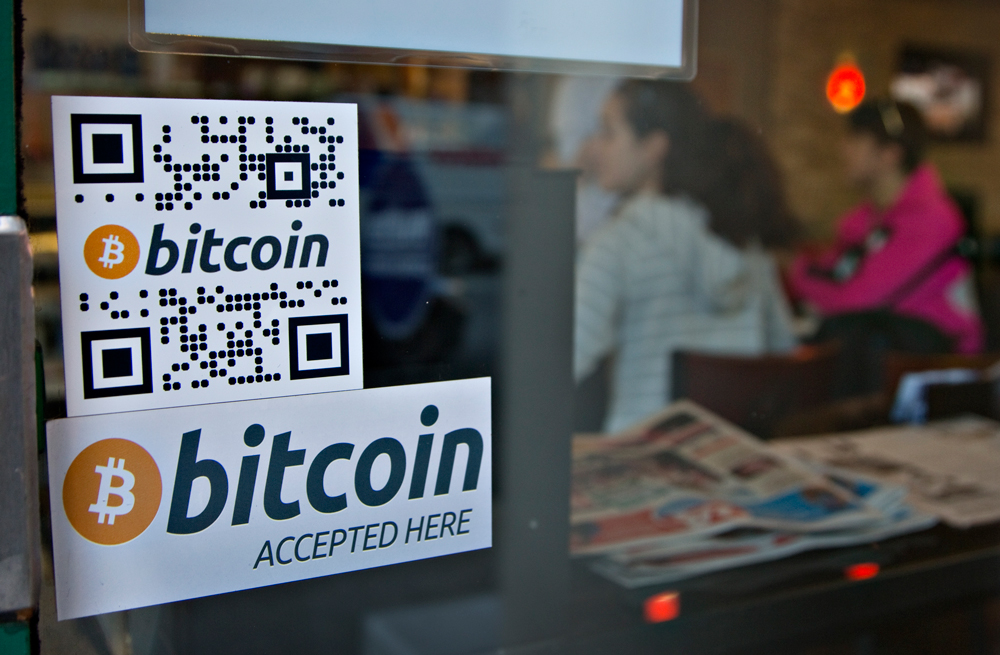
Advertising stickers on the world's first bitcoin automatic in Vancouver (Canada). It was installed in October 2013
On January 13, 2014, in London, as Interfax, the first in the world, the safe storage of the Bitcoin currency in the world, opened. The project is carried out with the support of Lloyds of London insurers, the Storage Commission is about 2% per year, depending on the Bitcoins course. The servers are stored in the most protected place and "physically disconnected from the Internet."
Stop! What are we talking about? What kind of currency is this - Bitcoin? What is it provided with? How and what can it be spent on? Finally, why did she appear at all?
Why did this appear?
Providing society with money for the exchange of goods and services is one of the main functions of power. For more than 2000 years, the development of metal ores, coinage of coins - gold, silver or copper - and the subsequent collection of customs duties was a tempting source of young lady, an important tool of power, and later a symbol of power, with which the ruler approved his sovereignty, recalls economist Frederick A. Hayek in the book Private Money. Through monetary circulation, subjects learned about who rules them at the moment: coins carried the image of the ruler. Over time, in all countries, the cost of money was gradually devalued - inflation caused a gradual decrease in the amount of metal in coins.
The distribution of paper money made adjustments to the historical tradition. And 40 years ago, with the refusal of their binding to the cost of gold, the situation changed completely. The value of paper money is not related to the cost of the materials from which it is made is conditional and is determined primarily by their number. Its increase is inevitable in the conditions of the growth of trade and the speed of monetary circulation. Hence - inflation. Which, however, has another important reason: for the treasury, the coating of a budget deficit due to monetary emissions is the easiest way to make ends meet.
"
Bitcoin almost fully meets the ideas of liberal economists about the perfect currency
"
| *Local currencies operate in the British Bristol and another 100 cities and areas of Europe - for more details see The New Times No. 26 of 08/27/2012 and dated 04.04.2012 |
The states, as practice shows, are bad guardians of monetary circulation. Nevertheless, for a long time competing projects had neither a chance or sufficient ambitions for serious success. The maximum that they could count on is the maintenance of the interests of local entrepreneurs*. The main function of such money is to intensify trade within municipal communities, to increase the demand for local goods. Therefore, for example, in Greece, in the midst of a crisis, the release of local currencies became very popular - he helped to support the falling demand and direct it to the goods and services of local manufacturers.
But then a new era came. The gradual displacement of paper (state) money by non -cash circulation - in fact, their final virtualization - created the conditions for new projects of private money. Paradoxically, the states themselves attached the hand to this, trying everywhere to limit the turnover of cash. So, in 2009, Bitcoin appeared.
What is this?
Bitcoin almost fully meets the ideas of liberal economists about ideal currency. In fact, this is a very reasonably planned electronic payment system (“cryptocurrency”): the cash turnover of bitcoins is impossible, their turnover and emission are completely decentralized, the exchange rate is not attached to anything and is determined only by the ratio of demand and supply.
Each transaction in bitcoins should receive at least 120 evidence for its confirmation (to exclude the likelihood of double use), this requires significant distributed computing power. In general, the next analogy of such a system is torrents, or rather, peering nets in which there is no center, and each participant plays the role of the user and server at the same time. This technology is used to exchange files between users and the organization of “distributed calculations”. In other words: the task, the solution of which would require hundreds of years of work of supercomputers, is divided into small blocks and is solved jointly by a large number of users.
The dynamics of an increase in the total number of bitcoins is known by 25 years in advance - this should prevent inflation. Records about all transactions with bitcoins are stored in the public domain, but without information about the identity of the owners.
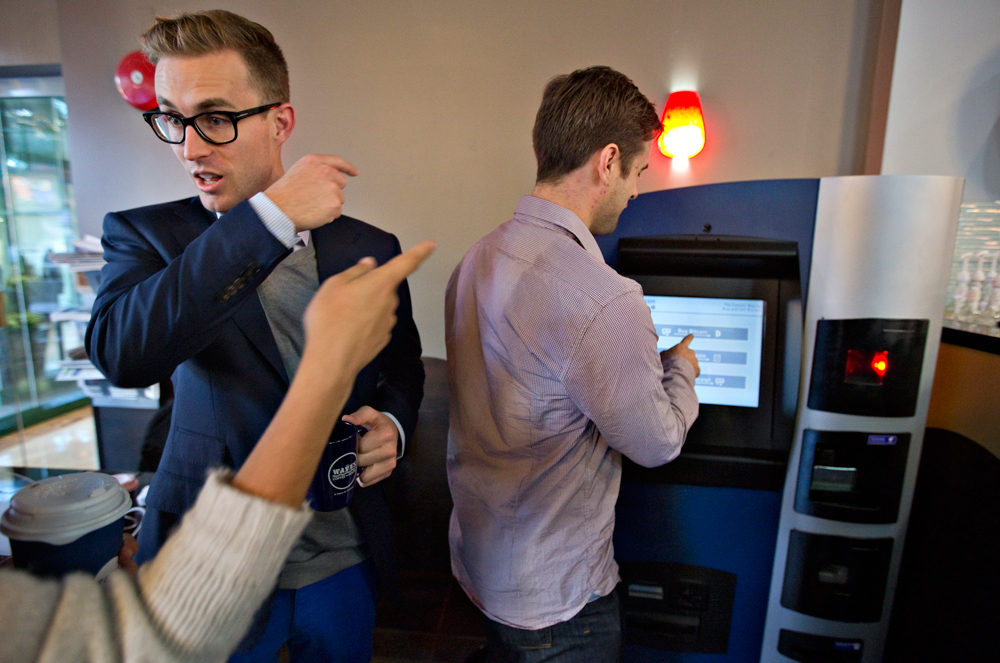
How to use it?
The initial owners of the bitcoins were computer scientists: coins were received as a reward to the one who allocated the computing power of his “unit” to maintain the operation of the system. (Moreover, the owners of low -power computers on the award could initially not count.) By analogy with the production of metal for minting coins, the excretion of power for “minting” bitcoins is called “mining” (English mining - mining). The problem is that if in the future bitcoins become even more popular and the number of transactions will grow seriously, it will become impossible to use ordinary home computers to work in the system.
To hack the system to abduct virtual coins from other participants or to emit their own, so far no one has been able to. But viruses appeared, the purpose of which is hidden mining on other people's computers. There were cases of hacking the exchanges of bitcoins - transactions services. True, they did not lead to big losses.
Gradually, the remuneration for the provision of computing power for the operation of the system has been reduced, and from 2031 the Bitcoins emission will be stopped. But the system will charge a commission from the participants for transactions - this will allow maintaining its functioning.
Now the commission fee is voluntary, whether it is necessary to pay it to the real user - it depends on which program he uses to operate with bitcoins. The initial advantage in the system is those who took up the Bitcoins mining earlier - in 2010, the remuneration for mining was twice as much as the current one. But the main reward for the enthusiasts of the new currency was the growth of its value.
How much does it cost?
In April 2010, at different sites at a rate of $ 0.003, the first thousand bitcoins were sold apiece. After 9 months, the Bitcoins exchange rate for the dollar reached parity, and in June 2011-$ 29.6. The initial cost of bitcoins increased 9857 times!
But the year 2013 was the year of explosive growth in the popularity of Bitcoin. The request that it is in the English -language Internet in the category of requests “What is”, somewhat lagging behind the questions about what gluten and sequestration are. The expansion of the number of sites on which you can pay with virtual currency also contributed to this. The growth of Bitcoin also followed the growth of popularity: in November-early December 2013, $ 1230–1240 was given at different sites for Bitcoin. This is equivalent to the increase in the cost of Bitcoin from the beginning of the quotes 413 333 times.
However, by mid -December, Bitcoin was more than doubled to the dollar (below $ 500), then it rose again, and on December 17, Bitcoin could be bought for $ 890–925 (Bitcoin does not have a centralized, unified exchange rate, and real transactions are concluded on different exchanges for various exchange rates). Thus, Bitcoin turned out to be an extremely volatile currency - possibly suitable for speculation, but hardly suitable for unprofessional investors.
One way or another, it was the fantastic increase in the value of Bitcoin that attracted general attention to him. In the second half of 2013, it seemed that each new day brings at least a dozen articles about bitcoins in business and socio-political publications.
In November and early December 2013, $ 1230–1240 was given at different sites for Bitcoin. This is equivalent to an increase in the cost of Bitcoin from the beginning of the quotes 413 333 times
"
It is hardly possible to predict the further cost of bitcoins. Of course, if the popularity of virtual currency continues its growth and after 5-7 years each housewife will consider himself obligated to keep a hundred or two bitcoins “for a rainy day”, their cost can increase several orders of magnitude more orders of magnitude. Nothing interferes with this: the number of bitcoins is limited, known in advance and will not grow in parallel to the growth of demand. Therefore, with an explosive growth of needs in bitcoins, their course can be arbitrarily high. In the same way, it can fall to zero, if a vulnerability is found in the system or the bitcoins will have a popular alternative.
Who now remembers the first search engines or, for example, about sites that have been at the dawn of Runet's development, the most popular? Almost no one. Bitcoin can also turn out to be only a forerunner of a new era. Already now he has several alternatives - Litecoin, Peercoin, Primecoin, Novacoin, Dogecoin, Feathercoin, Namecoin, Yacoin, their number will multiply. Moreover, they differ from bitcoins, which differ in unexpected technical details for ordinary users.
One thing is undoubted: the number of transactions using virtual currencies will only grow. Although how many such currencies will be and which of them will be popular in 10–20 years - now it is impossible to guess. Perhaps these will be new virtual currencies created by large financial players from the real world - JPMorgan, Sberbank of Russia (possibly in cooperation with Yandex.Money), several investment funds have already shown interest in this topic. The increase in the cost of bitcoins is hundreds of thousands of times - a bait, which business simply cannot swallow.
What will happen to this?
Obviously, the private world perceives bitcoins with enthusiasm. The number of goods and services that can be purchased for bitcoins is constantly growing. A week ago, Zynga, which creates Internet games, supported cryptocurrency. Cryptocurrencies are generally very convenient for quick transactions on the Internet - in particular, for gaming, buying various applications for smartphones, etc. It takes bitcoins many charitable organizations. In December 2013, Bitcoina agreed to accept the large online store Overtock (sells real goods).
But the states do not like much in cryptocurrencies - first of all, their anonymity. It is not visible who paid for anything, who was laundering criminally acquired income. Silk Road, known for the electronic trading in drugs and weapons, was closed. Then, the European Banking Administration and other National Banks negatively spoke out about Bitcoins. And the National Bank of China simply forbade the country's banks to serve transactions with online Bitcoins trading turbines. True, they did not prohibit private individuals with bitcoins in China.
Virtual currencies are too volatile, it is better for unqualified investors to bypass such tools
"
The ex-head of the Fed, Alan Greenpensen did not recognize the new currency, but his replacement on this most important post for the global economy, Junet Yellen spoke very approvingly about Bitcoins. In general, the US approach is that any providers of operations with bitcoins, as well as with another currency, must be registered as suppliers of financial services (exchanges, exchange points, etc.). They are subject to rules governing operations with ordinary currency - for example, the obligation to report suspicious transactions. Whether the authorities of other countries will go along the same path is unknown. Perhaps, along with “anonymous” currencies, virtual currencies that do not allow anonymous operations will be created. Then all the claims of states to virtual currencies will disappear.
One way or another, ideally suitable for transactions on the Internet, virtual currencies - at least now - are categorically not suitable for the role of means for savings and investment. They are too volatile. And although in the future, when people decide on what kind of currencies and what they use for, virtual currencies will become a little more volatile than the courses of ordinary currencies, unqualified investors should still bypass such tools.
Photos: Andy Clark/Reuters