
Translated material
Day of misfortune
What are the Jews about 9 AVA
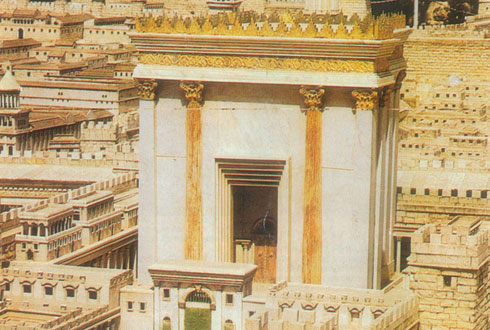
Jerusalem Temple. Modern reconstruction
There are three weeks in the Jewish calendar when the Jews read the “Crying of Jeremiah” and remember the destruction of the Jerusalem Temple, the bitterness of scattering, centuries of wandering, marked by pogroms and humiliations that ended with the Holocaust. This period, Bane Ha-Metsarim, literally “between the tepon”, begins on the 17th of the month Tammuz and ends on the 9th of the month AB, or August. This day, marked with the same strict post as on Judgment Day, became for the Jews a symbol of all persecution and misfortunes that fell to their share.
The Lord made his anger, poured out the rage of his wrath
And he lit a fire on Zion, which devoured his foundation.
The kings of the earth and all those living in the universe did not believe,
So that the enemy and the enemy enter the gates of Jerusalem.
All this is for the sins of his false prophets, for the lawlessness of his priests,
who shed the blood of the righteous among him; They wandered like blind in the streets, defiled by blood, so it was impossible to touch their clothes.
"Crying of Jeremiah", *4: 11-14 *
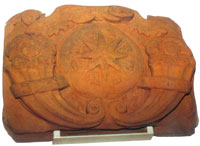
Wedding stone. 1700
The Israeli Museum in Jerusalem stored at first glance a strange exhibit from Germany - a large rude stone of red sandstone with a eight -pointed star carved in the central medallion and Jewish letters around. Motallion is surrounded by motives symbolizing abundance, prosperity and wealth. This stone was specifically walled into the outer wall of the synagogue of the German city of Bingen, so that during the wedding ceremony the grooms would defeat a glass glass in memory of the destruction of the Jerusalem Temple. Nowadays, such special stones are no longer there, and the modern groom simply steps on a glass with his foot. This paradoxical custom is designed to arouse in a person the memory of the national tragedy even in the most joyful moments of life.
Sanctuary
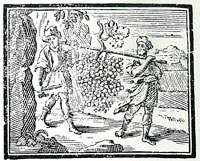
Scouts return with fruits
Holy Land. 1806 Basel
It is believed that it was on the night of Ava 2449 from the creation of the world (that is, in 1312 BC) those 12 people who Moses, who brought the Jews from Egyptian captivity, sent to explore the land of the Hanaan from intelligence. As stated in the Old Testament book “Numbers”, they distorted the image of the Holy Land and convinced the people that all attempts to populate it were doomed to failure. The Jews heeded the story of the scouts: “And the whole community sobbed, and the people cried that night”, lamenting that he had left Egypt. Seeing tears, the Almighty, as described in Midras*, turned to his people: “Now you cry for no reason, not wanting to fulfill my will. For this, I will make you have a reason for crying on this day. He will become a day of misfortune. "
So, in punishment for weakness and disbelief, the Almighty decided to force the generation of the outcome to end their days in the desert and let their people into the Holy Land only after forty -year -old wandering. But the main misfortune that happened on this day, Jews still consider the destruction of the Jerusalem Temple. Moreover, twice - the king of Nebuchadneosor in 586 BC. and Titus legions in 70 A.D.
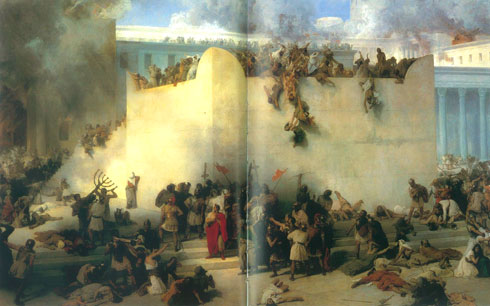
Francesco Hayes. The destruction of the Jerusalem Temple. 1867
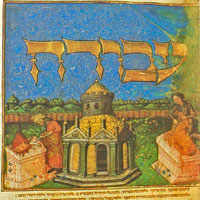
Jerusalem Temple. End. XV century., Italy
The role of the temple in the life of the Jewish people is huge. Initially, he was collapsible, mobile and called the Levia in Greek, or Mishkan in Hebrew. For forty years, he moved along with the people along the desert and was built in parking lots. Subsequently, the architecture of the tabernacle formed the basis of a stationary temple, conceived by King David and built by his son Tsar Solomon in 957–950 BC. In Jerusalem on Mount Moriah.
The temple was a symbol of monotheism and a religious center, around which twelve knees of Israel gradually rallied. Victims were made on the temple mountain. Most of the commandments mentioned in the Pentateuch refer precisely to the ritual laws of sacrifices, the architecture of the temple, the vestment and service of priests and Levites. On its territory, the court also met, the Sanhedrin, who made national decisions.
But most importantly, the temple was a sign of the divine presence among the people of Israel. As stated in the Pentateuch: "And they will build a sanctuary to me, and I will stay among them." The ark of the covenant with the tablets was stored in his holy saints, on which ten commandments were drawn. According to legend, anticipating the disaster, the Jews hid him in a special cache, the location of which is still not known.
Destroyed twice
The Nebuchadnezzar took revenge on the Jewish king Sedekia for an attempt to declare the Judea department from Babylon - there was no stone on the stone from the temple. The Babylonians killed the majority of the inhabitants of Jerusalem, and the remaining people were captured and stolen into slavery. The temple was restored only 70 years later, in 516 BC, when, after the conquest of Babylonia, the Persian king Cyrus the Great allowed the exiles to return to Judea.
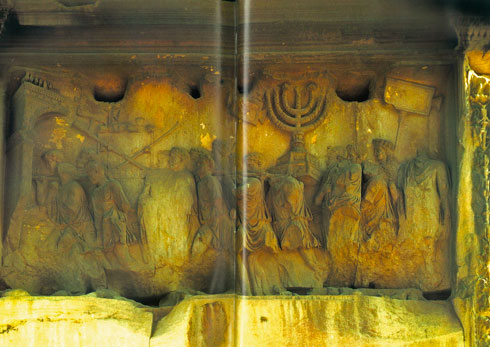
The part of the relief of the Titus arch with the image of trophies from the Jerusalem Temple. I century. N.E.
It is interesting that it was with the uprising that the second destruction of the temple began. In 66 A.D. The Jews rebelled against the Roman Empire. During the so -called great uprising of the Jews in Jerusalem, the Roman garrison was destroyed. Emperor Nero threw large military forces led by the military leader Vespasian to suppress the uprising. For the Romans, this was fundamentally important, since Judea then occupied the strategic position between Syria and Egypt.
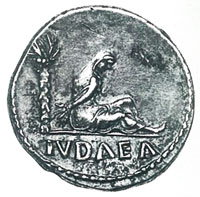
Silver coin
Emperor Vespasian, 69–70. N.E.
Judea here is allegorically depicted
In the form of a captive with her back hand.
Having defeated the rebels in Galilee, the legions of Vespasian besieged Jerusalem. The city was well fortified, had abundant food supplies, as well as experienced and bold defenders. Therefore, the siege was far from simple. In addition, she dragged on due to political events in Rome: after the death of Nero in 68, three emperors were replaced during the year. And only at the beginning of next year, the eastern legions proclaimed the emperor Vespasian. In the spring of 70, the son of Vespasian Titus went on the offensive. The siege lasted about five months. Despite the huge numerical superiority of the enemy, the Jews fought bravely and desperately. However, the city fell, was plundered, residents were killed or sold into slavery. On the orders of Titus, the temple was burned. He, like the whole city, was equal to the ground, leaving several towers and the western wall, that is, the outer wall of the temple surrounding the western part of the temple mountain. This is the famous Crying Wall. In honor of the victory over Jerusalem in Rome, a special triumphal arch was erected - the so -called Titus arch.
Crying of the prophet
The destruction of the temple, like the outcome from Egypt, became the most important elements of Jewish collective memory. Daily prayer begins with a request for the restoration of the temple. A number of customs are designed to maintain a memory of him. When decorating the interior of the house, a neoterled square is left with a side of fifty centimeters - it should remind with its rough texture that the temple has not yet been rebuilt. In memory of the destruction of the temple, the usual feast is not accompanied by a game of musical instruments, the exception is only solemn cases. A woman should not put on at the same time all her jewelry, she needs to refuse some kind of memory of the loss of Jews.
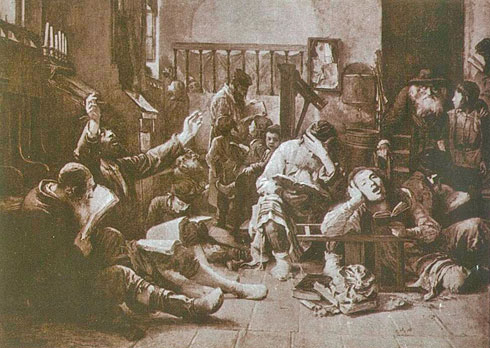
Kinot (mourning elegy). Postcard from the picture of L. Gurvich.
The Talmud says: "As soon as the month of AB begins, they reduce the fun." The post of the ninth Ava (in Hebrew-ATSHA BE-AB) lasts a day. During this time, there are special restrictions that set in a mourning. The day before, they arrange the so -called dividing meal: each of its participants sits separately from others on the floor or on a low bench, as the mourning do. Among the treats is one boiled screwed egg and bread that is dipped in ashes. With the sunset - additional prohibitions: you can’t eat, drink, wash, wear leather shoes, enter into marital intimacy. In the synagogues on this day, a muffled light burns, special mourning elegy, as well as the book “Crying of Jeremiah” are quietly read. In Hebrew, it is called Aich and tells of the destruction of the first temple by the Babylonians, the horrors of the siege and the plunders of Jerusalem and the collapse of the once great capital. “Aikha” is an emotional woeful exclamation that looks like Russian “Oh, how ...” usually books of tragic content begin with this exclamation. The Prophet Jeremiah foresaw the destruction of the first temple and was a witness to these terrible events. “I am a husband who saw the torment from his anger. He led me and stole me into darkness, and not in the light. (3: 1-2) ”The text amazing in beauty and inner strength is built on metaphors associated with dramatic female images-a suffering, abandoned, deceived, widowed woman, mother, bride. The key to these images is not least in the grammar of Hebrew. The fact is that the words “city”, “Jerusalem”, “Judea”, “Zion” in Hebrew are feminine. Therefore, such traditional biblical comparisons of the dramatic relations of the people of Israel with God as lovers, the bride and groom, wife and husband become natural. “What certificate will I give you and what will you like you, daughter Jerushalaim? What will I compare you to console you, Virgo, daughter of the bun? For, like the sea, your destruction is great. Who will heal you? " (2:13) The second main motive of “crying” is the contrast between the former greatness and the fall that occurred, between honor and shame, wealth and ruin, dignity and humiliation of Judea. A work of enormous moral power, the “crying of Jeremiah” entered the treasury of world literature.
Payment for weakness
Many tragic events occurred 9 AVA according to the Jewish calendar. On this day, the tragic final of the expulsion of Jews from Spain in 1492, which largely changed the course of Jewish history, fell. Then King Ferdinand and Queen Isabella, being influenced by the Inquisition, issued a decree that requires Jews to either leave Spain in three months or accept baptism. The diaspora was divided into two groups: those who remained faithful to Judaism, and those who, under pressure, accepted another faith - the so -called “new Christians”, or “converser”. The Spaniards contemptuously called them "maranes", that is, pigs. But many and under pain of death continued to follow the commandments of Judaism. The exiles were forbidden to take any property with them, except for food. Most countries refused to accept the fugitives, and they died of hunger, diseases and hands of robbers.
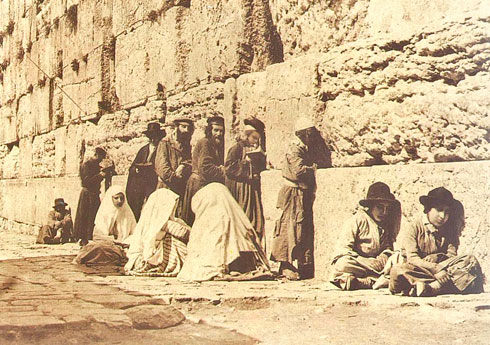
Crying wall. Photo around 1900
It so happened that in the history of the Jewish people, 9 Ava was celebrated many times as a tragic day - a day of great misfortunes and deep grief. Remembering on this day the destruction of the temple, scattering, wanderings, persecution for faith, pogroms and the greatest tragedy of the twentieth century - the Holocaust, the Jews never lost hope. And this hope for the future transformation at all times accompanied 9 Ava and was a source of spiritual power for the people.
Famous historian Joseph Flavius (c. 37 - c. 100)
In his essay, the Jewish War claims that the Roman legionnaires burned the temple of their own free will, and not by order of Titus. And it seems that he does it by chance. The defense of Galilee was entrusted to him, a Jew by origin, during the great uprising of the Jews. Having gained 10 thousand people, Josef Ben Matitahu organized the defense of several fortresses, which nevertheless fell in 67 AD Under the onslaught of the Romans. In the latter - Iotopata - Joseph lasted 47 days, and then hid with 40 comrades in a cave dug under a tank. Not wanting to give up, they killed each other in lot. As a result, Joseph and his comrade, whom he nevertheless convinced himself, remained alive. In captivity, he successfully predicted Vespasian imperial power, for which he made a perspicacious Jew by the close of Titus's son.
The Jewish calendar is lunar-solar. Each of the 12 months (or 13, if a leap year) begins on the new moon, like the Jewish New Year, which is celebrated for two days in a row with the beginning of the autumn month of Tishrey, which comes in September-October.
What happened 9 Ava:
135 -the defeat of the anti-Roman uprising of the Jews, named after his leader Shimon Bar-Kokhba. Only during the battles the Romans destroyed 50 fortresses, destroyed 985 villages and killed 580 thousand people. Many died from hunger, diseases and fires. This three -year Jewish war ended in the fall of the Betar fortress in the Jewish mountains and mass repressions against the Jews.
1095 - Pope Urban II announced the beginning of the first crusade, as a result of which tens of thousands of Jews were killed and many Jewish communities were destroyed.
1146 - during the second crusade, pogroms in the Jewish communities of Germany and France were organized.
1290 - the beginning of the expulsion of Jews from England.
1306 - the next day a decree was issued on the expulsion of Jews from France, and they had to leave all their property.
1348 - European Jews were accused of organizing one of the largest plague epidemics in the history of black death). This accusation led to a brutal wave of pogroms and murders.
1492 - the expulsion of Jews from Spain.
1555 - Jews of Rome are relocated to the first in the history of the ghetto.
1648 - the massacre of Jews in Poland, in Ukraine and Bessarabia, arranged by Bogdan Khmelnitsky and its associates.
1882 - the pogroms of Jewish communities within the limits of the settled man began in Russia.
1914 - the beginning of the First World War.
1942 - the deportation of Jews from the Warsaw ghetto and the opening of the death camp in Treblink began.
* The section of the oral Torah, which is included in the Jewish tradition along with the Torah of the written.