
Translated material
The tram is tram
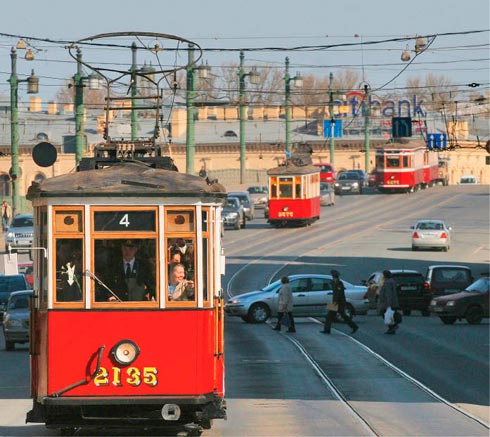
The tram is tram. Public transport goes unnoticed. Only old films today remind of funny humpbacked buses, elegant-ugly trams, round-headed blue trolleybuses running along the streets of our cities. But there are places where these signs of the bygone eras are carefully stored
In the tram, I always go in a trailer car. The people there are more good -natured. In the front carriage, it is boring and frowning, and no one to step on the leg. And in the trading, not to mention the legs, more comfortable for me and more fun. Sometimes there passengers talk among themselves on abstract philosophical topics - about honesty, for example, or about wages. Sometimes adventures also happen.
Mikhail Zoshchenko. "On live bait"
Ancient cars now will not surprise anyone. In Moscow alone, there are six museums of retro cars, of which two state museums. Another thing is a public transport. Throughout the country, old buses, trolleybuses and trams are collected only in five museums: in Moscow, St. Petersburg, Nizhny Novgorod, Kursk and Yekaterinburg. Moreover, the Moscow Museum has been closed to the public since 2001, and from the day the same fate is waiting for St. Petersburg from day to day.
The fundamental difference from automobile museums is that the vintage cars are allowed to admire only outside, at the most - they will be allowed to run through the curved wings and sparkling chrome. And public transport can and should be studied from the inside. Entering the car of an old tram, sitting in a wooden seat, as if you were making a short time in time. Or you feel like a hero of Soviet cinema.
Do not lose heart
Contact the tram,
So empty
So eighth.
Osip Mandelstam
At least in Moscow with the cinema it all began. Since the tram of the 1930s, a series of km with an on-board number 2170, shot in a damn lot of films-from "The meeting place cannot be changed" to the "Pokrovsky Gate". The car restored for the film was one of the first exhibits of the Moscow Museum of City Passenger Transport.
Thanks to the stormy artistic career of this tram, you might think that the wagons of the Kolomensky factory walked around the Soviet capital. Another cinematic illusion is Moscow two -story trolleybuses. There were only 11 of them in the capital: one foreign and 10 homegrown copies. But the unusual transport was loved by the newsreels. Look at any chronicle of the 1930-1940s and will remain in full confidence that Moscow is the city of two-story trolleybuses.
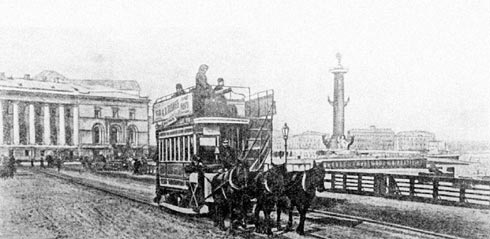
Double -tier public transport in Moscow was only in the era of Konka. “The wagons were two -story, lower and upper on the roof of the first. It was called the "imperial", and its passengers - "three -skin imperialists," - we read by Gilyarovsky. - Below, passengers paid a nickle for the station. A narrow spiral staircase led to the imperial. Women were not allowed there. The question of the assumption of women to the imperial was excited in the Duma commission. One of the liberals even proved that this is a deprivation of women's rights. Solve to be decided by voting. One of the members of the commission, who defended the prohibitions, is the Ukrainian, at the time when it was proposed to vote, said:
- They are without rods!
And the question with general laughter did not run. ”
In Moscow, the real Konka, probably remembering Uncle Gilyai, is still alive. The last time it was shown to the public in June 2009 during the anniversary parade of Moscow trams. The procession was headed by a car specially written out for the Moscow Horse Railway from Belgium.
Then the trolleybus appeared,
Rushing at full speed.
He froze in front of the tram
Young, fresh and flowing around,
And he said: “Well, brother,
Turn back. "
Sergey Baruzdin. "Tale of the tram"
In public transport, the history of the city can be traced no worse than in architecture. For example, freight trolleybuses are found on the streets less and less, for the past thirty years they have not been made. These "trucks" - a product of war, when gasoline was needed before the last drop. Later, trolleybuses became the true love of Nikita Sergeyevich, almost like corn. It was with him that Moscow earned the title of the most trolleybus city of the world. Then the cargo counterpart of the trolleybus with a small autonomous gasoline engine was bred.
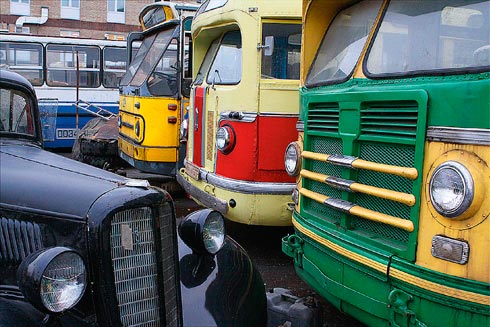
Rinseed machines have to be stored in the open air.
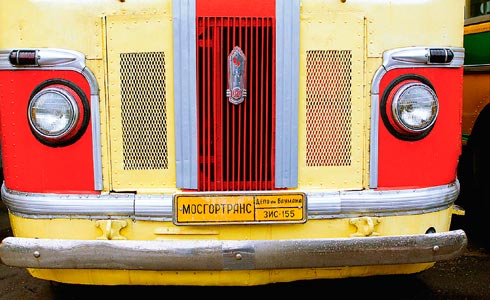
In the photo there are two modifications of the ZIS-155 bus (right), and followed by Danish Den Oudsten
The Khrushchev era also gave rise to an exemplary trolley, designed to glorify Soviet engineering in 1954 after a long break of the All-Union Agricultural Exhibition. On its territory, a guide trolleybus line was specially arranged on its territory. At first, ordinary cars walked along it, but a year later a special excursion trolleybus appeared. A very light salon with almost entire glass ceilings, instead of window glasses - plastic curtains pushing under a transparent rain of roof - all to improve the viewing on excursionists. And on the "muzzle" of the trolleybus, a socialist bas -relief with a tractor driver and a collective farmer flaunted. A total of 20 such cars were made. They liked them so much that soon in Moscow they launched another excursion route on Gorky Street. One such trolley is still alive. Simultaneously with the trolleybus, demonstrating the achievements of Soviet industry, a tram appeared, showing the jail of the Soviet leadership. Especially for the USSR, the Czechs released the modification of the Tatra T2 tram with two doors instead of three. The savings turned out to be double: both on the door mechanism and on freezers, which were easier to catch. But in everything else, the tram was excellent: warm, convenient in management and, by then standards, ultramodern. It was with him that the dominance of Czech cars on Moscow streets began.
From the windows brings the crust of the fried.
Behind the curtains - flickering hands.
There is no stop here, but me - please:
The driver on the bus is my best friend.
Bulat Okudzhava
But the bus trailers have not become a sign of time, now many Muscovites will not remember them. Meanwhile, in the Khrushchev years there was such an experiment - for the capital they were made 50 pieces. The very idea itself is good: at an hour of the peak to carry people on a bus with a trailer, and the rest of the time to unhook it. But the manageability of buses from the innovation was badly damaged, and miraculously managed to avoid serious accidents. They decided to abandon the trailers, and now it is also a museum rarity.
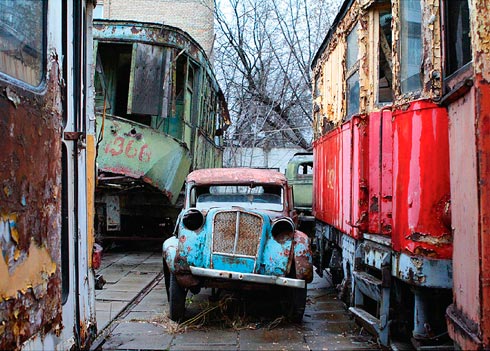
In this form, the technique enters the museum. On the left of the trailed car "C" is a former change house.
On the right - a railman written off from the depot
From the 1990s, their monuments of the era remained. For example, the old Danish buses Den Oudsten driven to Moscow. Soviet production chains no longer worked, the new ones have not yet improved, and people had to be carried on something. So these cars appeared in the bus parks of the capital, used and completely inappropriate to domestic conditions (two doors, without storage sites, four rows of seats). They often broke, the details from Soviet buses and “Ikaruses” did not approach them, and by 1997 all Danish cars were taken from routes.
Museum workers are stern people, select and completely unstable, but already decommissioned models. Prosiness is a compelled measure. When you see sparkling, clean and quite self -propelled Soviet buses at the parade, it is hard to believe that all this beauty fell into the hands of museum workers in the form of rusty and crumpled households. For example, the widespread Soviet practice: the employees of the enterprise went to the potatoes and took the written -off bus with them. We drove on it, lived during harvesting, and then threw it. The fact that they did not pass into scrap metal now searches for a few collectors and sometimes find very valuable exhibits.
The last trolleybus, along the streets of MCHI,
The tops of the boulevard circle,
To pick up everyone, victims in the night
Drushing, spinning.
Bulat Okudzhava
For a long time it was believed that the wooden pre-war trolley of the Yatb-1 of the Yaroslavl factory was lost irrevocably. The last famous copy was restored on Lenfilm, removed in several ribbons, and then for some reason they burned on the set of “Letters of a Dead Man”. But at the very end of the 1990s, another YATB-1 was discovered in some kind of gardening of the Leningrad region, where he served Sarai for many years. A rare trolleybus of the Kyiv electric vehicle (there are no more such in Ukraine), the employees of the Moscow Museum unexpectedly found near Tarusa. “We accidentally drove past and saw an incomprehensible barn,” says Vladislav Karganov, director of the Moscow Museum. “I am to my own eyes: according to the official version, Kyiv trolleybuses never left for the limits of the Ukrainian SSR.” Everything cleared up when a huge inscription “Kio” was found on board the car: it seems that she served a trailer for the transportation of equipment of the famous magician for a long time. And, judging by several metal sheets with the emblem of the Krasnoyarsk port, in this capacity, the Kiev trolley has traveled the whole union.
Trams are easier to look for, far from the rails they will not go. There are, however, exceptions: the trafficed carriage of the “C” series of the museum found the skeleton in the form of a change house in a parking lot in Kolomna. Once it was the most massive Moscow trailer carriage, which went around the city as much as 600 pieces. Now there is only one left. Usually stagnant rarities are given by depot workers. True, what the frustrated tram people do not reduce the decommissioned veterans. At first, passenger cars are turned into freights or tugboats - such “trucks”, converted from pre -revolutionary trams, are still working. For example, in the Moscow Museum collection there is a wagon of 1902 of the Prague Plant of the Ringhoffer concern, the very one on which the Czech Tatra later manufactured. True, he has not yet become an exhibit, as he needs restoration. And for this you must first decide what exactly to restore. The fact is that the passenger Ringhoffer was redone in the Civil War into a cargo car. And the handicraft alteration of that time in itself is a rarity.
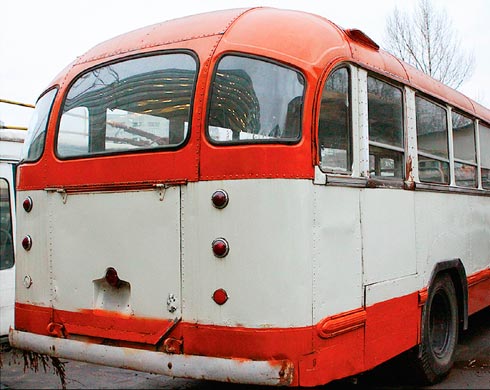
It's hard to believe that these buses were once sheds in summer cottages
Ten years ago, anyone could look at all these wonders for free, and even with the guide. But in 2001, the museum was deprived of the land - it went under the depot for the Moscow Monorail. Since then, the restored exhibits have been scattered through the tram depot and bus parks, and the rarities that are still waiting for restorations are rusting in the open air on the territory of the tram-repairing plant. There can be no question of the tour, but twice a year on the City Day and May 9, some museum exhibits are rolled out to the main entrance of the VVC. The new building for the museum was to be built in Strogino until the end of 2009, but the work on the site did not even begin.
The St. Petersburg Museum of electric vehicles on the Vasilyevsky Island is threatened with the same fate. In its place they want to build a business complex, and in the Committee on Transport of the Northern Capital, although they promise to save the collection, no words say where to show all this wealth to people ...