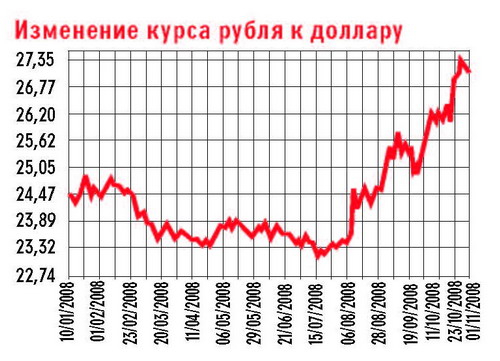
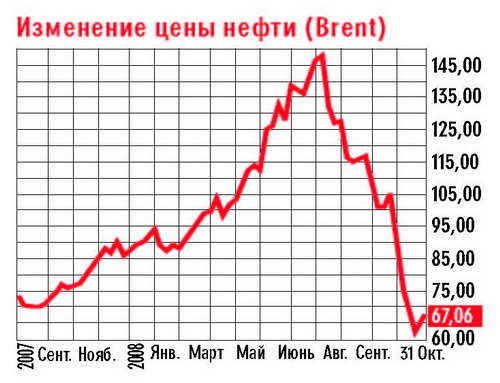
Recently, the dollar has grown markedly in relation to the ruble, while oil prices fall from sky -high heights. How these two trends are interconnected and how they can affect the savings of citizens - the New Times sorted out
Compared to the beginning of August 2008, the dollar strengthened relative to the ruble by 16%, and today it costs as much as in April 2006 - about 27 rubles, according to the official rate of the Central Bank of the Russian Federation. The price of Brent oil for the same period has almost doubled and amounts to about $ 60. “The trends in the change in the dollar and oil prices in the medium term are unequivocally connected,” says Yevgeny Gavrilenkov, chief economist of Troika Dialog. “The cost of a barrel is measured in dollars, therefore, the price of oil changes in binding to its rate.” In recent years, a clear feedback has been established between these two factors - the price of a barrel and the exchange rate of the American currency. Until mid -2008, oil valued with a record pace, and the dollar lost weight just as rapidly. Now the trend has changed to the opposite, but the interdependence of the “sweet couple” remained unchanged. This is understandable: after all, the funds allocated in the global economy for the purchase of oil are considered “long” money, which guarantees a stable binding of a barrel to the currency for which it is traded.
Why is the dollar growing
Today, oil costs as much as in July 2007. The drop in prices for “black gold”, which began in June 2008 (the peak value of $ 142 per barrel was passed during the first weeks of summer), led to the weakening of the ruble relative to the dollar. Everything enters the country Less currency, and it is becoming more valuable for Russian companies that need to pay with huge external debts (as The New Times already wrote, by the end of 2008, domestic enterprises need to find $ 50 billion). That is why the ruble is falling, and the dollar is growing, said Oleg Zamulin, professor of the Russian economic school. “In the world market, including Russian, there is a dollar hunger. It was the demand for the American currency, which over the past three to four years has not been very strong, and today has increased markedly, the dollar is pushing up-many countries need to pay with creditors US currency, ”explained Renat Malin, senior assets of the Capital Criminal Code . In addition, the dollar, despite talking about the imminent “collapse” of the American economy and the already slowing down its growth rate, remains the only world reserve currency. In crisis moments, investors prefer to transfer their funds to the US currency, and such a “flight to quality” also explains the strengthening of the dollar regarding not only the national currency of Russia, but also the other currencies of the world, the expert noted.
Why does oil fall
The drop in oil prices is a consequence of speculators's expectations regarding the slowdown in the growth of the global economy. In favor of this forecast, a decrease in economic activity in the USA and Europe is indicated: people began to ride less, spend less and save more. “Of course, this affects the price of oil,” says Gavrilenkov, “but in many ways the speculative mood of the market participants also affect. In previous years, the price of oil was swollen, now it is adjusted and looking for an equilibrium point. ”
Experts interviewed by The New Times were extremely reluctant to share their forecasts regarding how much a barrel will cost in the near future: as the practice of recent years shows, the risk of mistakes In this forecast and thereby throwing a shadow on your expert reputation is too large. Nevertheless, daredevils were found. Renat Malin believes that by the end of 2008, the barrel will be in the price range of $ 55–75. Analysts by Goldman Sachs, which managed to give an accurate forecast several times, are called a more specific figure - $ 70. Independent expert at the stock market, Alexander Prishchepov, gives an estimate of $ 70–80. However, Evgeny Gavrilenkov warns, any consensus of experts on the issue of future oil price has always been wrong.
What to save
However, if we talk about forecasts, then people are more interested in how the ruble exchange rate in relation to the dollar will change: after all, the tactics of their personal savings depend on this. “I do not see fundamental reasons that caused an increase in the dollar observed over the past months. In the future, I also do not see such reasons, so I do not think that the dollar will be strengthened further, ”says Zamulin. “We expect 27–28 rubles per dollar by the end of this year,” says Malin from the Capital Criminal Code.
A proven recipe for how to insure your savings from course ups and falls: to divide the amount into three parts - a ruble, dollar and euro - and depending on the size of the “free” amount to store it on a deposit or “under the mattress”. If the amount of savings does not exceed 500 thousand rubles, then it is better to store it in rubles at a deposit in a state bank, and preferably in several, it advises Prishchepov, because the deposit rate in rubles is higher than in euros or dollars.
If you approach the purchase of currency as a long -term investment investment, then today you need to buy a dollar at all, but the euro, which since August 2008 has fallen into two rubles, experts recommend. The logic here is the same as when buying shares at the moment when the market lies “at the bottom”: time will pass - and the asset will rise in price. In any case, when buying the currency of a particular country, you should remember: you take the risks of the functioning of the relevant economies. Accounting for the last circumstances is by no means superfluous in the conditions of the current global crisis, when a number of countries have already directly encountered the threat of default. So, if free funds allow, the risks should be balanced: to collect a foreign exchange basket in which, if desired, you can put pounds of sterling, Japanese yen or Swiss francs.