
Translated material
Rectangular hole
Matra reports to the audience
An academic exhibition has opened in the Moscow Museum of Contemporary Art. Matra reports to the audience
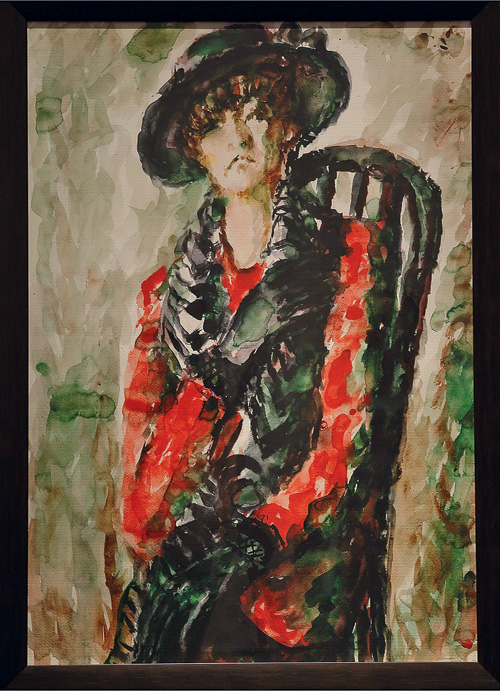
Boris Messerer. Portrait of Bella Akhmadulina. 1980s
The project of the confluence of the three academies was excited by the public and even more of the academicians themselves. Apparently, as a preventive measure of academicians from fine art, just in case, they decided to report to the audience. The exhibition on Gogolevsky Boulevard is represented by 35 members of the Presidium of Rah. Those who could not set picturesque or sculptural work presented scientific articles or monographs. The creative family of Tsereteli managed to participate in the exposition at once in several forms. Zurab Konstantinovich himself, the president, put up paintings, his daughter Elena Zurabovna, author of “Books and Articles about the Russian Academy of Arts, the Research Museum of Contemporary Art and the work of Z.K. Tsereteli ”, reported by scientific works, and grandson Vasily Zurabovich, Executive Director of the Mom, is a new generation of artists at the exhibition. As well as Aidan Salakhov. We always had art dynasties, all the more curious to compare how the strict lines of her father-the classic of Soviet painting Tair Salakhov, and close to neoexpressionism of Baskia, Vasily Tsereteli, enters into a polemic with his grandfather’s, the classic of Soviet painting.
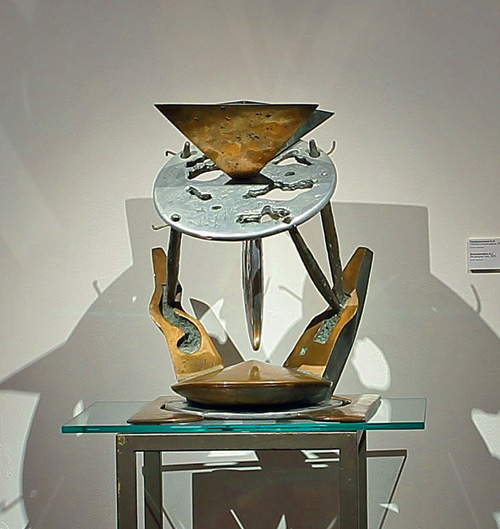 |
| Alexander Rukavishnikov. "Rectangular hole." 2011 |
"
There is no need to compare the current authors with Polenov, Vasnetsov, Vrubel or Kuindzhi. Rather with the master of socialist realism
“Satisfying the audience curiosity, the Academy presented the whole color of its composition at the exhibition. Sometimes it still embarrasses: the architecture of Mikhail Posokhin, once the chief architect of Moscow, has long been perceived by the odious, as well as the experiments of the sculptor Alexander Burganov, who decorated the old arbat area with temporary portable sculptures. And yet, despite the abundance of the exhibition of the samples that were designed in the exhibition. Supervocably Soviet aesthetics, there are aesthetic tuning forces. (1991). The author conveys the energy of someone else's life and the story of the thorough fixation of the details - inscriptions, roughness and scuffs, a dull splendor of the old portal. The sculptures of Alexander Rukavishnikov (“Rectangular hole”, 2010) are also fascinated by their meaningful form, completely devoid of any content.
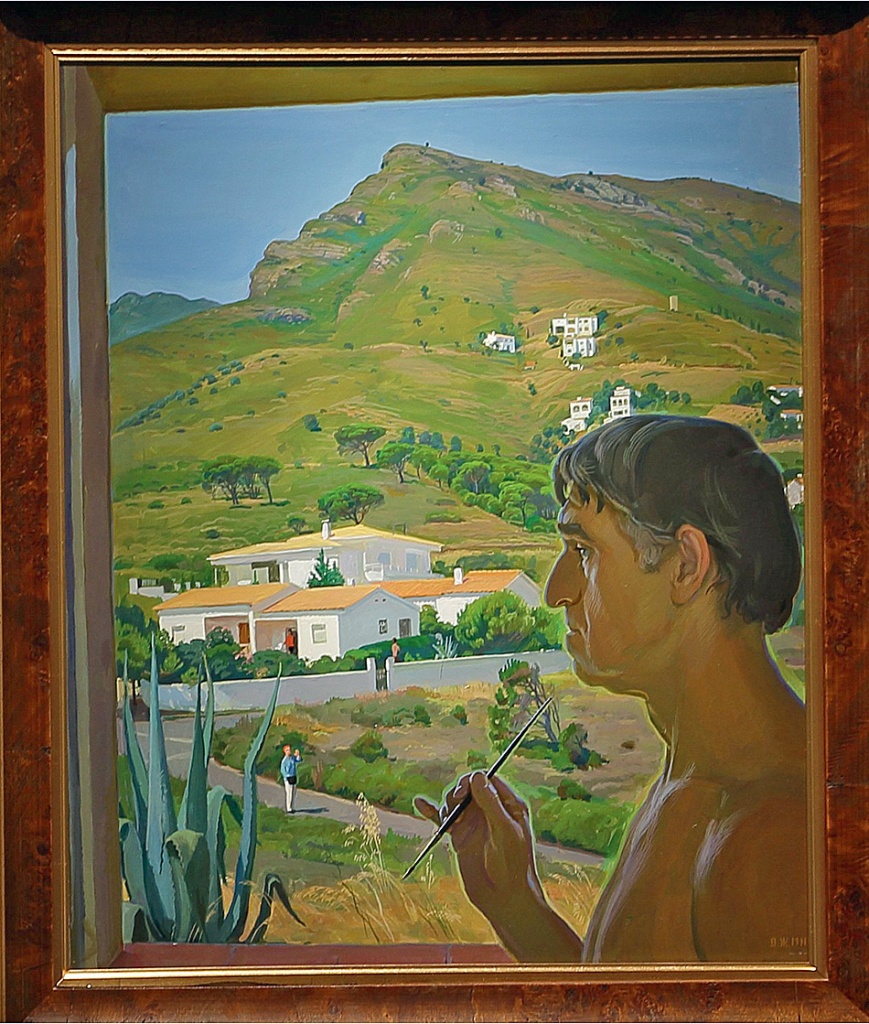 |
| Dmitry Zhilinsky. "Self -portrait in Spain." 1991 |
Nevertheless, some oddity of the exhibition remains. Considering himself the successor of the Academy of Arts and Sciences, formed by a decree of Peter I in 1724, this exhibition is called to confirm continuity. But there are very few new, fresh works of academics on it - only a few. The scatter is from 1972 (the sculpture of A. Tsigal “Portrait of the Geologist”) until 2013 (Zurab Tsereteli, Konstantin Khudyakov, Victor Glukhov). That is, we have a retrospective before us, showing achievements over 40 (!) Years. However, to consider himself the successor to the Imperial Academy of Arts, the current Academy has no reason. She was abolished in 1918 by a decree of the Council of People's Commissars, and the current one appeared in 1947 by resolution of the Council of Ministers of the USSR. This facilitates the task. There is no need to compare the current authors with Polenov, Vasnetsov, Vrubel or Kuindzhi. Rather with the master of socialist realism. A certain rudimentary remnant of the Soviet Union, decorating our life with air winter landscapes or lush -pisty naked beauties, calling for a correctly oriented sexual feeling. Longing for it may well be satisfied for many years to come after visiting this curious exhibition.
Photos: Rah press service