
Translated material
Sepia effect
"Cherry Orchard" in the production of Vladimir Mirzoev is similar to the old cinema
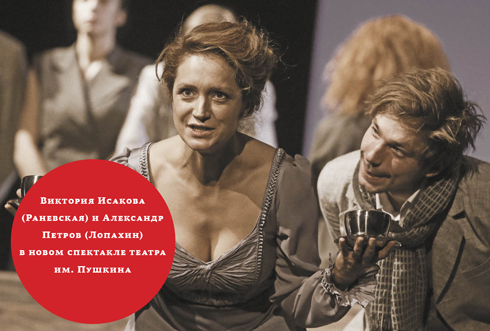
The premiere at the Pushkin Theater was a gift for the author’s birthday: on January 29, Anton Pavlovich Chekhov celebrated the 155th anniversary. On this day, director Mirzoev published on his Facebook page poetic initiation to the “Cherry Garden”, which, upon closer examination, turned out to be a directorial explication of the performance.
The play "Cherry Orchard" is a breakdown,
Replicas out of place,
very compact blood pressure;
If its territory
Break into plots,
There will be a trick effect:
It seems to be all voluminous and living,
On the left, the cloud is lace,
The petals are pouring on the face,
Anna is passionate about a scoundrel
Petya strangles her in his arms,
Unbuttering a blue dress.
The other shores Mirzoev composed his performance as fun as these verses: if it is a comedy, then it is absolutely black. More precisely - brown. Stylized for the old tear-off cinema using the effect of Sepia, which is used by photographers and operators to create retro-style. Artists Alexander Lisyansky and Alla Kozhenkova managed to reproduce this effect of ancient photography on stage: gray-brown tones of decorations and costumes, muddy yellow light (lunar), rumbling on faces, shabby leather leatheries and suitcases ...
The rhythm of the play is uneven, intermittent, like the breath of a seriously ill. In the corner of the stage there are three musicians, lively sound, the hits of a fashionable cabaret in different languages-like tapers in the symptographer of the beginning of the last century, they accompany the action, forcing the actors to dance something Spanish, then wring their hands in a hard bend, then creep in a twine. It seems that the heroes do not disappear from the stage - they exist together all the time, then scattering like broken beads, then rolling again, clinging to each other. Their crowd is a polyphonic, galloping, bubbling; That miserable heap - frightened, quiet, dumb. One or the other is pushed out of this bustle of the same gray little men to say something important, inhale with full chest and dive back back into the thickness of gray bodies, as in a muddy river Styx.

Here flashed the fiery red mane of Charlotte (Vera Voronkova): clown make-up, piercing voice of the carpet, ridiculous Galifa, tie-deductions. Charlotte, like a ferryman, like a local haron, drags the souls of the heroes from the shore to the shore, catching them from the water, does not allow them to choke, leads to their senses of bloodless bodies. Ain-Tswei-Drie! - And droppers with blood fall from the sky. Ain-Tswei-Drie! - The needles gently enter the veins. The bodies seem to freeze in the air, slowly swaying in a somnambulic dream. They are revived? Are they killed? Azazello watered Margarita and master with fatal wine to bring them back to life. Charlotte pumps blood from the heroes to let him breathe. This unbearable feeling of painful suffocation is almost physically transmitted to the hall.
Here, all a little strangled, choking like a boy Grisha from a distant, bright, young past. Therefore, a blond boy in a sailor, as if a lost prince from the Mirzoevsky “Boris Godunov”, looks like a gloomy joke, not vulgarity. And the rope stretched to trembling on heavy giant swings-it seems that it is about to break. And the rope that dangles on the neck of Ranevskaya,-it seems that he is about to drag on, will not allow the classical monologue to finish. "Lane, overwhelmed ... his throat tightened with a loop."
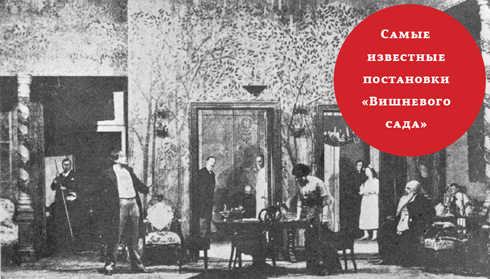
The premiere of the play took place on January 17, 1904 at the Moscow Art Theater: Ranevskaya was played by Knipper-Chekhova, Gaeva-Stanislavsky, Lopakhina-Leonidov 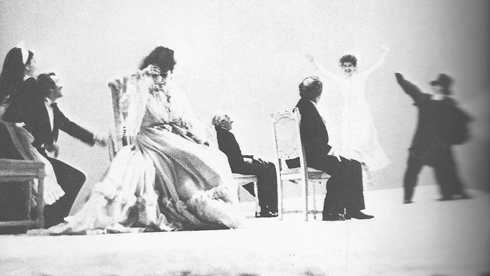
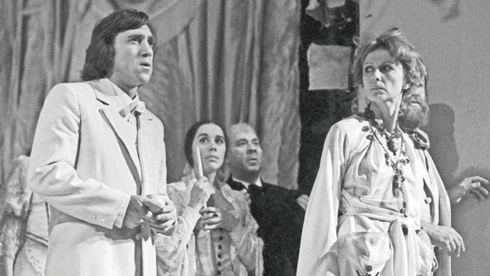
Then there will be a beach party. Flood striped suits, vodka in plastic cups, funny swims to the music, no solitude - all together, only together. And the grandiose defile to the Kasabian rings - it looks like a stubborn dance of the zombie, the corps de ballet of the dead Michael Jackson from the cemetery "thriller". “Firs has a devil for dinner, the light goes out,” - as it is said in the poetic directorial explication of Vladimir Mirzoev.
Ranevskaya - Victoria Isakova, a real theater star. Actors usually say goodbye to their played roles, taking them off like a bulbous husk. Isakova is different. She wraps her roles on a fist like guts, and drags along from drama to drama. Maybe that's why her heroines seemed to be sewn from different lives, from different eras, from different shreds and buttons - like a beloved bear from a nursery, with a shelter and different eyes. Her Ranevskaya is Tsvetaeva’s sister, just played by the actress in the film “Mirrors”. She is barefoot, in a shapeless dress, simple-haired, with a wandering smile-in the crowd of dancing somewhere on the side. And so he wants to get to the beat, and is always a little late. And there are no torn telegrams - because maybe there were no telegrams? And there was no menton? Maybe she just fell off the loop in some attic and now wanders along the shore and calls: “Grisha! My boy! " And it scratches the throat, and wheezes. And to Firce Socks, it seems that she is laughing. And he laughs out of place. Ranevskaya is the same red as Charlotte. And he also does not know, "who am I, where." When she looks at the surrounding people - they turn into buzzing spots, without faces, without appearance. The ghost sees ghosts.
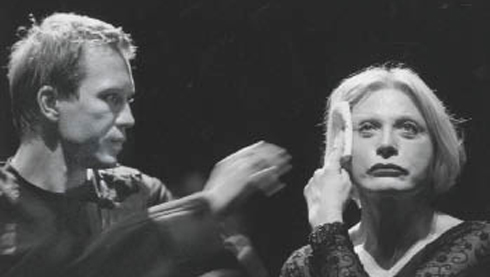
The performance of Emuntas Nyakroshus (2003) with Evgeny Mironov - Lopakhin and Lyudmila Maksakova - Ranevskaya walked about six hours 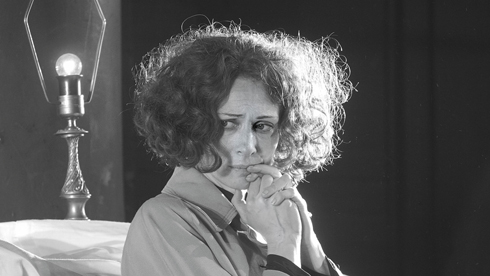
Of course, there will be no new life. And there will be neither the station nor Paris.
She wanders among the bulky suitcases, as among the stumps, and a fragment of the rope hangs on the neck. Musicians play.

This is the first Chekhov of Vladimir Mirzoev. Hard, mocking, irrational. Actors are difficult. It seems that they do not know the finals. And such surprise in the end - have we really been not? There is no sound of an ax, and nothing collapses, but even vice versa, stands without trembling, or a cross, or a bridge, grown into the floor, into the ground, like a tombstone.
This "cherry garden" is like Tsvetaevskaya "Poem of the End": "The last bridge. I won’t give my hands, do not take it! The last bridge. The last bridge. "
Photo: Vyacheslav Prokofiev/ITAR-TASS, Mikhail Strokov/ITAR-TASS, Start-std.ru, Wikipedia.org, Victor Bazhenov/Photoxpress, Vasiliev/Interpress/ITAR-TASS